
гуманоиды · робототехника · Шанхай · производство
MATRIX-3 vs Xingzhe-2: Two Different Answers to What a Humanoid Should Be
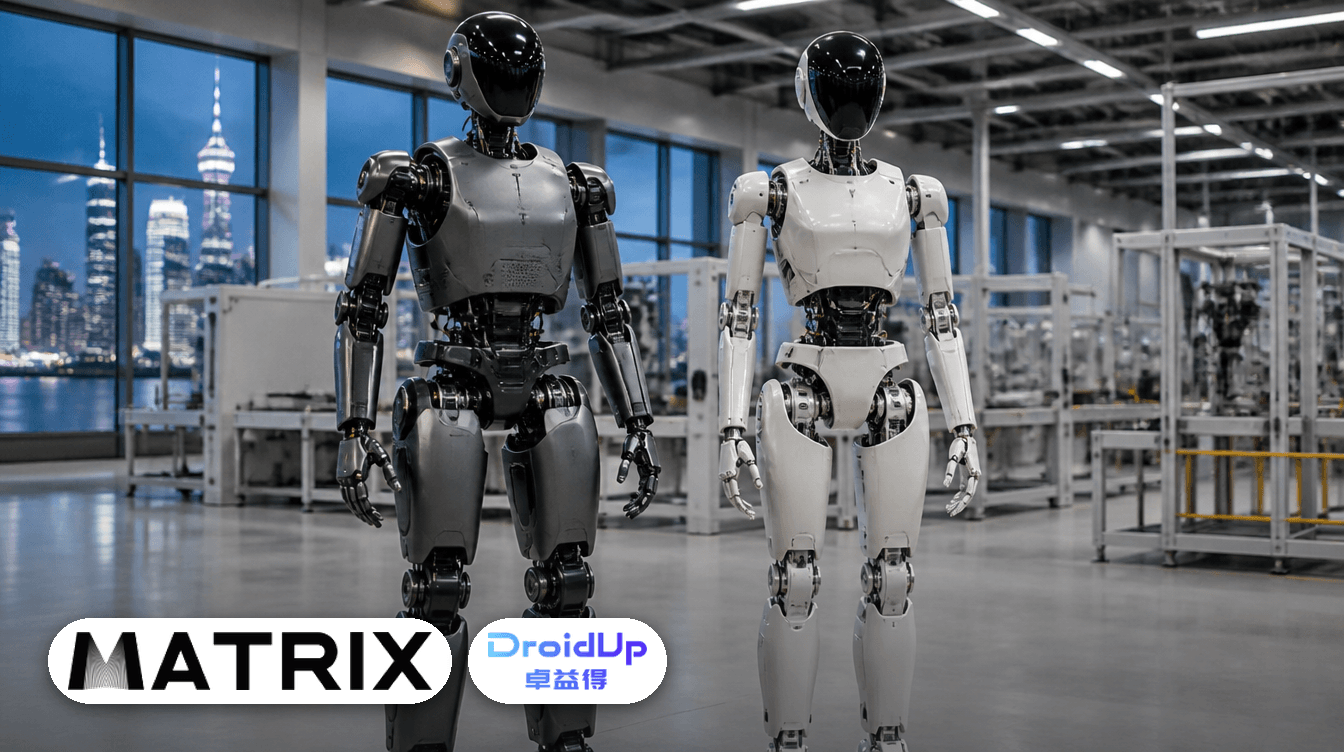
Humanoid robots are usually sold through the same set of numbers — height, degrees of freedom, top speed. Two factories from the Aura catalog, both based in Shanghai, approached this race from opposite directions, and comparing them shows that "humanoid" isn't one engineering problem — it's at least three.
A matrix built by Tesla China's former design lead
上海矩阵超智 / Matrix Robotics was founded in April 2024 by Zhang Haixing, the former head of Tesla's China design center who worked on the Optimus humanoid. Its flagship MATRIX-3 stands 170 cm tall, weighs 65 kg, and has five-fingered hands with 27 degrees of freedom on a cable drive, reaching a top speed of 3.9 km/h. The key detail is a 3D-woven biomimetic skin with built-in tactile sensors — the robot literally feels contact through its body surface, not only through sensors in the grippers.
MATRIX-3 runs on the company's own WAVE model with zero-shot generalization — meaning it theoretically doesn't need retraining for each new task on a production line, unlike robots that must be trained separately for every specific operation. The company's Shanghai plant is rated for 10,000 units a year — a serious figure for a company that, at the time of writing, isn't even two and a half years old.
DroidUp: a light body instead of a strong frame
上海卓益得机器人 / DroidUp took the opposite engineering path: instead of scaling up drive power, it scaled down body weight. The company builds fully biomimetic robots on a cable-tendon drive, and its flagship Xingzhe-2 weighs around 30 kg at full height — removing the classic humanoid constraint of battery energy density: the lighter the body, the less energy each step costs, and the longer the robot runs on the same battery.
The result of that approach isn't an abstract spec-sheet number but a real-world demonstration: in April 2025, Xingzhe-2 took third place at the world's first humanoid half-marathon, outlasting heavier, more power-hungry competitors on the course, not just on a stand. DroidUp's second line, Moya, pushes further toward "human" — silicone skin, a body temperature of 32-36°C and facial micro-expressions — meaning its job isn't industrial load-bearing but interacting with people in service scenarios.
Earlier generations are in the catalog too
Both Matrix Robotics and DroidUp show, through their earlier models, how quickly a single company's approach can shift. MATRIX-3's predecessor, MATRIX-1, was taller and heavier: 180 cm, 67 kg, up to 7.6 km/h and roughly 5 hours of runtime on a 2.28 kWh battery, with 22-DoF hands each lifting 10 kg. The move to MATRIX-3 is a clear decision to trade height and weight for maneuverability and tactile sensitivity, not just a "version 2.0" with bigger numbers.
DroidUp shows a similar pattern across the Xingzhe-1 → Xingzhe-2 pair and a separate branch, Xueba 01 — a body variant of Xingzhe-2 standing 1.75 m tall and weighing about 30 kg, with silicone skin and facial expressions. Xueba 01 became known as the first robot enrolled in a graduate program: in 2025 it was admitted to the Shanghai Theatre Academy — more a marketing stunt than an engineering milestone, but a good illustration of the market DroidUp is ultimately aiming its Moya and Xueba lines at: not a factory floor, but public interaction with people.
What this means in practice
If the task is heavy manipulation on a line where grip strength and tactile feedback matter, Matrix Robotics' logic fits better: the trainable WAVE model and tactile skin are built exactly for that. If the task is long autonomous operation or human interaction where weight and energy efficiency matter more than payload, DroidUp's architecture fits better: a lighter body stays on its feet longer on the same battery.
Both approaches can be seen at factories in the same city, Shanghai, in a single trip — the philosophical difference between Matrix Robotics and DroidUp is clearer from comparing two robots side by side than from a spec sheet PDF.
These factories are on the route of our Robotics Expedition — see them in person, not just on video.