
таиланд · byd · great wall · автопром · промышленные роботы
Thailand: localizing robotic assembly lines at BYD and Great Wall Motor plants
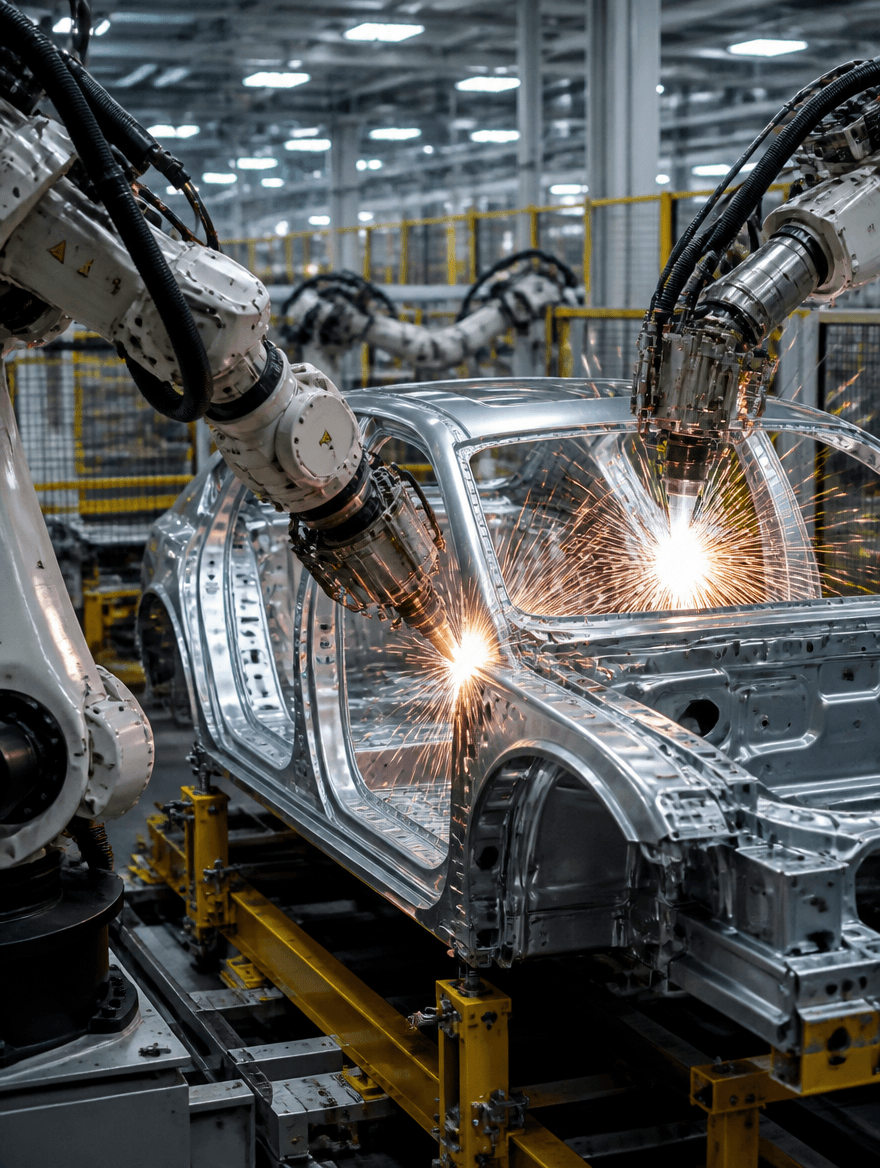
Thailand has been a regional assembly hub for Japanese automakers for decades — Toyota, Honda, and Isuzu long ago turned the country into what's called the "Detroit of Asia." But over the past three years Chinese EV makers have moved into that niche, and BYD became the first Chinese automaker to build a full-cycle plant in Thailand rather than just a screwdriver-assembly node. The plant in Rayong province, with roughly 150,000-vehicle annual capacity, opened in 2024 and was designed from the start for a highly automated body shop.
Why automation belongs here specifically
Body welding and paint work are the two most capital-intensive and, at the same time, most naturally automatable stages in car manufacturing: weld seam precision directly affects safety, and paint booths require tightly controlled environments where human presence is both unnecessary and hazardous. That's exactly why both BYD and Great Wall Motor — which opened its Rayong plant back in 2021 after acquiring a former General Motors site — built their Thai lines around robots for arc and spot welding, plus manipulators for sealant application and paint operations from day one.
For both companies, Thailand isn't a peripheral market but a launchpad for exports into the rest of Southeast Asia and Australia: local production unlocks incentives from Thailand's Board of Investment (BOI) and access to ASEAN free-trade zones that direct imports of finished cars from China don't get.
Who's putting the robots on the lines
The supplier structure is interesting: the Chinese automakers themselves rarely ship a full equipment set from China — lines are more often assembled from a mix of European and Japanese robotic arms (ABB, KUKA, Fanuc, and Yaskawa have long had assembly and service capacity in Thailand) combined with Chinese machine-vision systems and systems integration. The reasoning is pragmatic: Thai engineers and service centers have trained on Japanese and European platforms for decades, and a full swap of the maintenance ecosystem would raise the risk of line downtime early in production.
The local effect goes beyond the auto industry
The arrival of two large robotic body shops has a secondary effect on the whole Rayong province and neighboring Chonburi, home to Thailand's Eastern Economic Corridor (EEC) — an industrial zone specifically targeting EVs and high-tech manufacturing. Local integrators who'd serviced Japanese lines for decades are now retraining staff for new robotic cells, and Thai universities (King Mongkut's Institute of Technology among them) have expanded mechatronics programs to meet growing demand from the auto sector.
What it signals for the region
Thailand shows the model by which Chinese manufacturers are entering Southeast Asia: not through finished-product exports but through capital investment in production capacity designed from the outset for high automation. That's a departure from the decade-old playbook, when assembly lines in developing countries were deliberately kept less automated to exploit cheap labor — today, precision and consistency requirements in EV manufacturing are strict enough that skimping on automation no longer pays off even where labor is cheap.
The Thai government's role
Thailand's Board of Investment deliberately built an incentive package around EVs and related automation as far back as the late 2010s, well before Chinese brands entered the country at scale. The incentives include corporate income tax exemptions of up to eight years for projects meeting Eastern Economic Corridor criteria, plus simplified visa procedures for foreign engineers servicing new equipment — the latter proved critical during the early ramp-up of BYD's and Great Wall Motor's robotic lines, when much of the commissioning work fell to engineers flown in from China and Japan on short assignments.
There's a flip side too: competition for qualified robotic-line technicians has intensified to the point where Thai engineering schools started getting direct requests from automakers to train students on specific manipulator models — a practice previously more typical of Germany or Japan than Southeast Asia.
Anyone curious which specific robotic arm manufacturers work on lines like these across Asia can browse our catalog of industrial robotics companies.