
гуманоидные роботы · MatrixRobotics · RobotEra · DroidUp · UBTech · DeepRobotics
Humanoid robots in 2026: comparing the models you can actually order
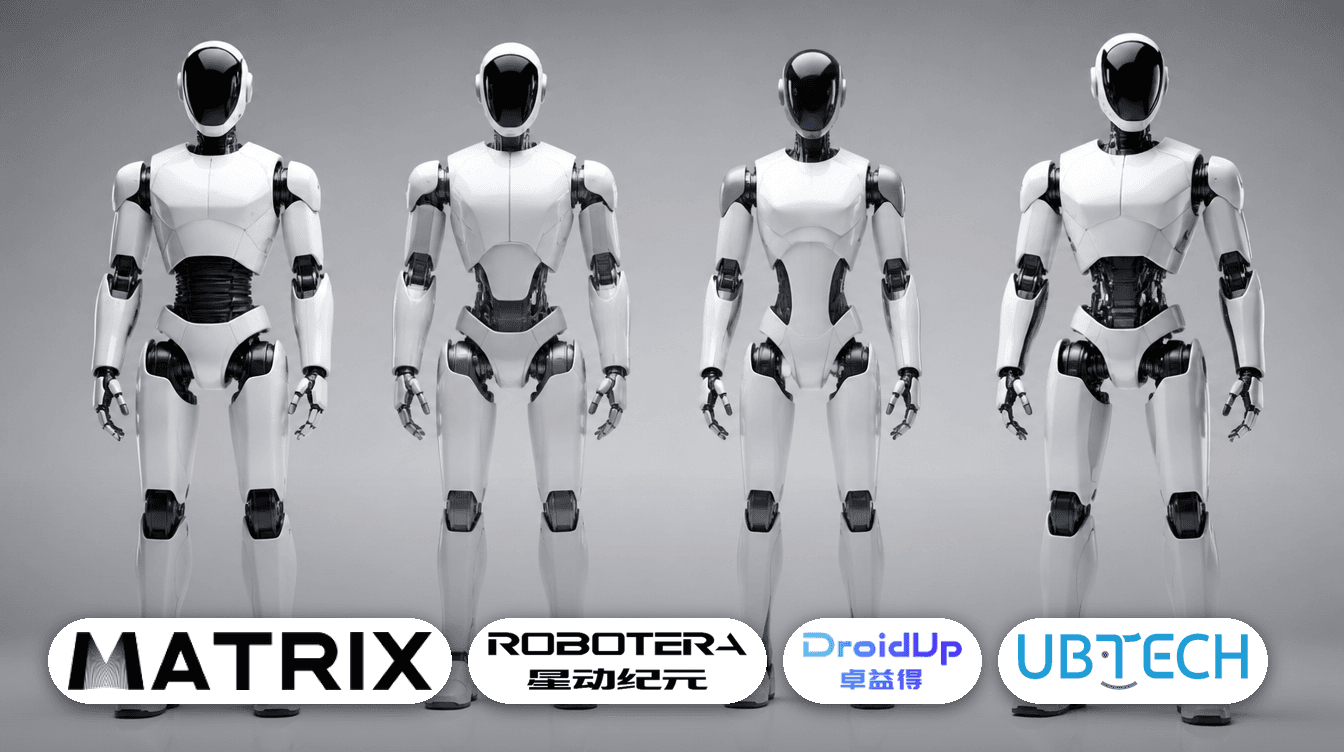
A couple of years ago, "humanoid robot from China" meant a flashy video and zero delivery specifics. Today our catalog lists five manufacturers with real serial models: MatrixRobotics and DroidUp from Shanghai, RobotEra from Beijing, UBTech from Shenzhen, and DeepRobotics from Hangzhou. Here's how they actually differ, numbers first, no marketing.
MatrixRobotics: speed or dexterity
MATRIX-1, the first-generation flagship: 180 cm, 67 kg, tops out at 7.6 km/h with about 5 hours of runtime per charge. Hands with 22 degrees of freedom lift 10 kg each — a rare case where a humanoid actually carries something instead of just posing.
MATRIX-3 is smaller and slower (170 cm, up to 3.9 km/h), but its woven biomimetic skin has tactile sensors built right into the surface. 27 degrees of freedom in a cable-driven hand — that's about fine finger work, not hauling loads. It runs on the WAVE model, which generalizes new tasks without retraining: no need to re-train the robot for every small variation.
Need raw speed and strength? MATRIX-1. Need fine motor control and tactile feedback? MATRIX-3.
RobotEra: three models, three jobs
L7 — 171 cm, top speed 4 m/s, which is genuinely fast for a bipedal humanoid. Hands hold up to 20 kg. The ERA-42 model handles vision, body position, and plain language at once — you can tell the robot a new task instead of only programming it.
STAR1 is the off-road version: joint torque up to 400 N·m, top speed on uneven ground up to 12.8 km/h. This isn't a shop floor job — it's a site with rough terrain or inspection territory.
M7 is L7 without the legs. Cheaper, simpler to maintain, and plenty for stationary work: conveyor assembly, sorting.
DroidUp: from a half-marathon to grad school
Xingzhe-2 weighs about 30 kg and runs on a cable-tendon drive. In April 2025 it took third place at the world's first humanoid half-marathon — a live endurance test, not a demo booth.
Moya is the same platform with silicone skin, a body temperature of 32-36°C, and facial expressions. Built for reception desks or trade-show booths, where eye contact matters more than payload.
Xueba 01 went further and became the first robot admitted to a graduate program (Shanghai Theatre Academy, 2025) — a great case for PR and education projects.
UBTech Walker S: built for the real shop floor
36 servo actuators, hand-eye coordination, U-SLAM navigation. UBTech's real edge over many competitors is an actual track record supplying industrial customers, including automakers. Walker S more often ends up in a real production pilot than a demo.
DeepRobotics: inspection quadrupeds
Not humanoids technically, but they come up in the same conversation. X20 is the workhorse: IP66-rated, runs from -20°C to +55°C, climbs ledges from 20 cm and slopes up to 45°. X30 is the senior, tougher model: IP67, 2.5-4 hours of runtime, more sensors. Lite3 is the compact entry point: 12-13.5 kg, 1.5-2 hours of runtime, cheaper than the rest.
How to choose
Fine manipulation — MATRIX-3, or RobotEra's XHAND1 hand on its own. Speed and body payload — MATRIX-1 or L7. Human contact — Moya. Site inspection — DeepRobotics' quadrupeds, and the choice between X20 and X30 comes down to budget and required autonomy.
We take clients to the MatrixRobotics, RobotEra, DroidUp, and DeepRobotics factories as part of the Aura Robotics Tour — you can see the models working and ask engineers questions before signing anything.
These factories are on the route of our Robotics Expedition — see them in person, not just on video.