
гуманоиды · промышленная робототехника · каталог · AgiBot · UBTech
Humanoids in the Aura Catalog: Who's Actually Working the Factory Floor, and Who's Still in Demo Mode
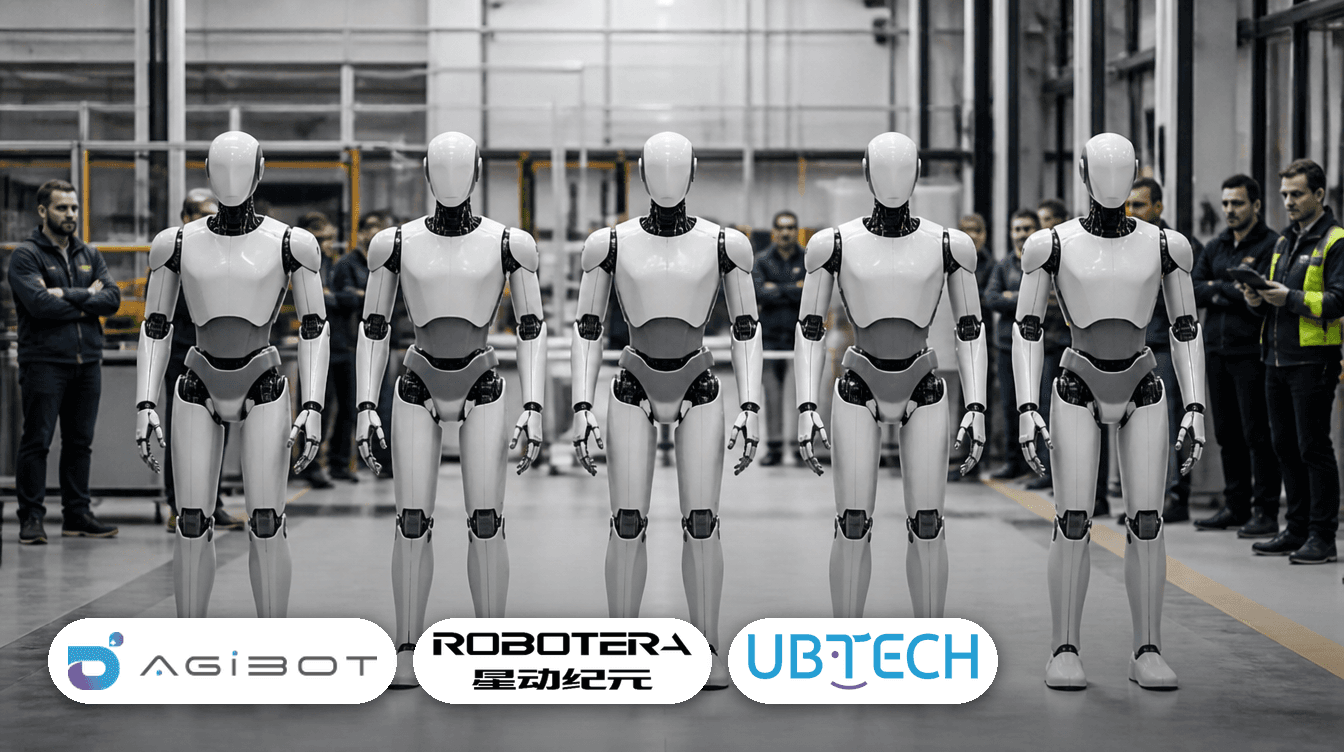
China's humanoid market is overheated with promo videos: a robot dances, a robot pours coffee, a robot runs a marathon. A more useful question for a buyer is how many units of a specific model are actually running production lines right now, not in lab conditions. Across five models from the Aura catalog, the answer varies a lot.
AgiBot Yuanzheng A2 — no longer a pilot, already a fleet
智元机器人 / AgiBot holds arguably the most convincing number on the market: over 960 Yuanzheng A2 units already deployed on factory floors. Standing 1.69 m tall, the robot has up to 49 degrees of freedom, moves at up to 7 km/h and carries up to 80 kg — enough for assembly tasks and moving components between line stations. For a buyer, that means one thing: this model has moved past the "promises" stage into serial operation, so there's already failure and maintenance data behind it, not just marketing numbers. See the factory's full catalog page.
Robotera L7 — the fastest hand in this lineup
星动纪元 / Robotera, spun out of Tsinghua University, is betting on speed and hand precision. At 171 cm, the L7 moves up to 4 m/s — faster than most humanoids in this segment — and its hands, with 12 degrees of freedom, hold up to 20 kg. All of it runs on the company's own ERA-42 model, combining vision, proprioception and language in one loop. In practice, that's a model for tasks where reaction speed and grip precision matter more than raw strength — sorting, precise assembly of small parts. More on the Robotera factory page.
UBTech Walker S — a conveyor for quality control
优必选 / UBTech is one of the market's oldest public players, and Walker S is already used on auto plant floors specifically for quality control and sorting, not demos. The model has 36 servo joints, bipedal walking, hand-eye coordination and U-SLAM navigation — meaning the robot orients itself in a shop floor independently, without pre-mapped routes for a specific task. Catalog on the UBTech factory page.
Matrix-3 — sensing skin instead of bare metal
上海矩阵超智 / Matrix Robotics is the youngest company in this lineup (founded in April 2024), but its team carries Tesla Optimus experience. The flagship Matrix-3, at 170 cm and 65 kg, features 3D-woven biomimetic skin with built-in tactile sensors and five-fingered hands with 27 degrees of freedom on a cable drive. Its top speed is modest next to competitors — 3.9 km/h — but the tactile feedback through the skin makes this model interesting wherever careful contact with fragile objects matters more than movement speed. Factory page: Matrix Robotics.
DroidUp Xingzhe-2 — the lightest body in the lineup
上海卓益得机器人 / DroidUp went the minimal-mass route: the full-size Xingzhe-2, on a cable-tendon drive, weighs about 30 kg — noticeably lighter than competitors of similar height. In April 2025 the model took third place at the world's first humanoid half-marathon, which demonstrates drive endurance more than direct industrial applicability — but a lighter body means less load on supporting structures and potentially more flexible integration wherever robot weight is a constraint. Catalog: DroidUp factory page.
What this means for picking a model
If the task is conveyor-line assembly or moving loads right now, AgiBot and UBTech already have a proven operating track record. If grip precision is the priority, Robotera is worth a closer look. Matrix-3's tactile skin and DroidUp's lightweight build are more niche-specific solutions than universal picks. Matching a model to your task and delivery logistics is a separate conversation, best had with specifics on the table.
These factories are on the route of our Robotics Expedition — see them in person, not just on video.