
гуманоидные роботы · Zerith · гостиничная робототехника · клининг
Zerith: the humanoid cleaning hotel rooms on a production line
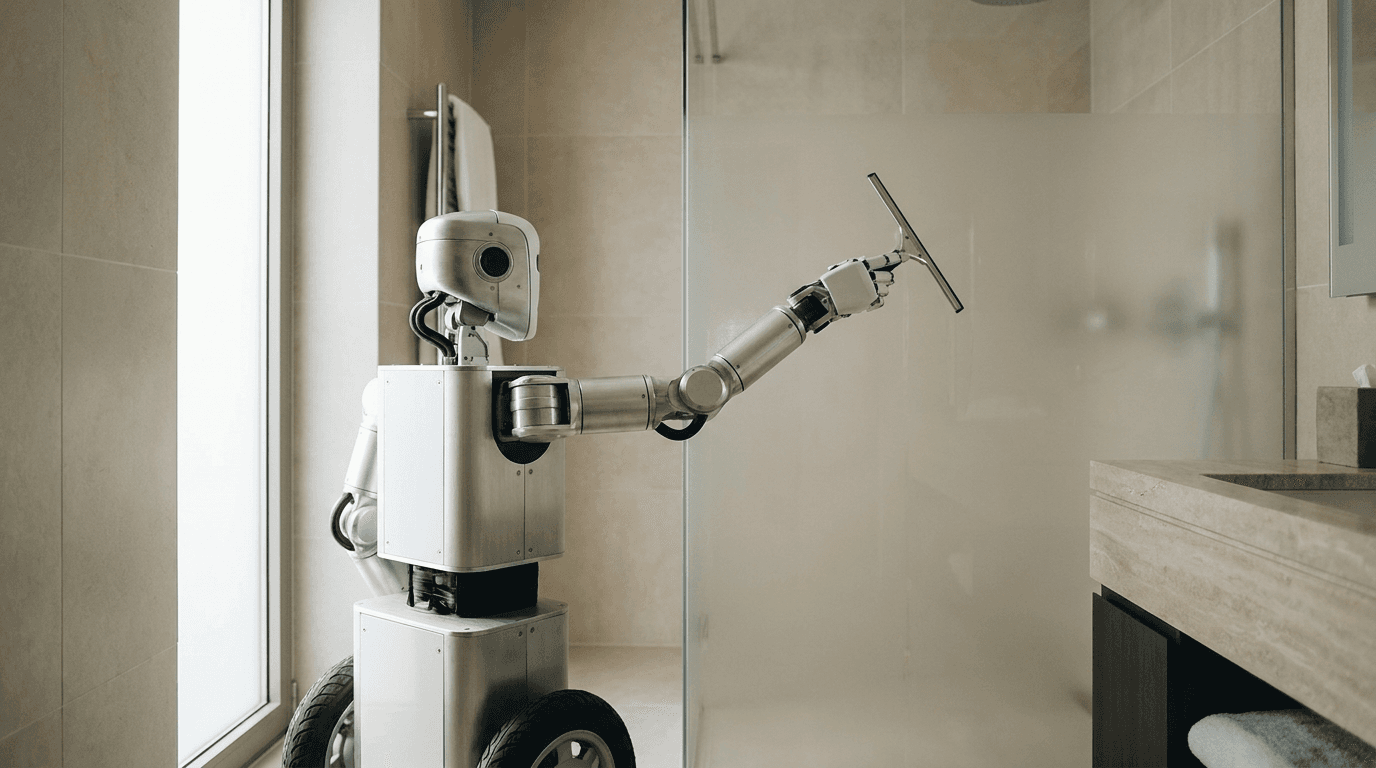
Most humanoid makers field one flagship and a lot of promises about future use cases. Zerith / 零次方机器人 took a different approach: it chose two fundamentally different mechanical layouts for two different jobs, and pushed one of them all the way to series production at hundreds of units a month — a rare sign of maturity in this industry.
Mass application as a priority from day one
Zerith positions itself from the start as a humanoid developer aimed at mass application rather than trade-show demos. That shows in the product structure: instead of one universal "do-everything" platform, the company split its lineup into full-size bipedal platforms in the Z series and wheeled robots with manipulators in the H series, which are easier and faster to deploy in real scenarios.
The Z series: complex mechanics for complex tasks
The Z1 model is a bipedal humanoid with 27 degrees of freedom and peak joint torque of 150 N·m. Worth noting is its proprietary EtherCAT-based electronics — an industrial communication standard between controller and actuators with minimal signal latency, used wherever real-time movement synchronization matters. That protocol underpins Z1's stability on uneven surfaces: the system reacts to a loss of balance faster than it could over slower communication protocols.
The H series: a wheeled base solves the practical job faster
A completely different logic drives the H1 model. Here the bet isn't on bipedal walking — the hardest and most expensive part of robotics — but on a wheeled platform with a manipulator. For hospitality cleaning — bathroom cleaning, vacuuming, mopping, restocking room supplies — bipedal walking simply isn't needed: it adds cost and failure points without a payoff where the robot is already working on a flat corridor and room floor. The result of that pragmatic choice is series production of over 100 H1 units a month — a proven production line, not one-off prototype assembly.
Why this matters for a buyer
It's tempting to assume a "real" humanoid has to walk on two legs — that looks more dramatic and closer to the sci-fi image of a robot. But from a deployment-economics standpoint, what matters more than form is reliability and cost of ownership. Both Zerith lines — Z and H — are listed in the factory's catalog card, and comparing them directly shows: wherever the task doesn't require climbing stairs or crossing rough terrain, the H1's wheeled base saves money and maintenance time alike.
Where to look first
For hospitality and commercial cleaning, where the environment is predictable, H1 is a practical choice with already-proven series production. For tasks with more complex spatial geometry — production floors with thresholds and uneven flooring, research projects — it makes sense to look at Z1 and its stability figures on uneven surfaces. There's a third factor often overlooked when comparing bipedal and wheeled solutions: staff training. The wheeled H1 platform behaves predictably and doesn't require the operating team to understand complex balance dynamics — if something along the route goes wrong, the robot simply stops rather than loses balance. For a hotel operator whose technical staff is already stretched across other duties, that lowers the adoption barrier not just in equipment cost but in the time needed to train employees on the new hardware. The bipedal Z1, in turn, earns its keep where the ability to cross uneven ground and obstacles is what makes automating the route possible in the first place — for instance, sites with mixed flooring, thresholds between rooms, or temporary obstacles typical of an active construction site or a production floor with frequently rearranged equipment. Finally, it's worth asking the supplier for concrete mean-time-between-failure data on the serial H1 model — at over 100 units a month in production, the manufacturer already has real-world operating statistics, not just lab testing, and those numbers give a far more honest picture of reliability than a standalone prototype's spec sheet.