
центральные кухни · YANC · пищевое оборудование · авиационный кейтеринг
YANC: central-kitchen equipment from a factory with roots going back to 1983
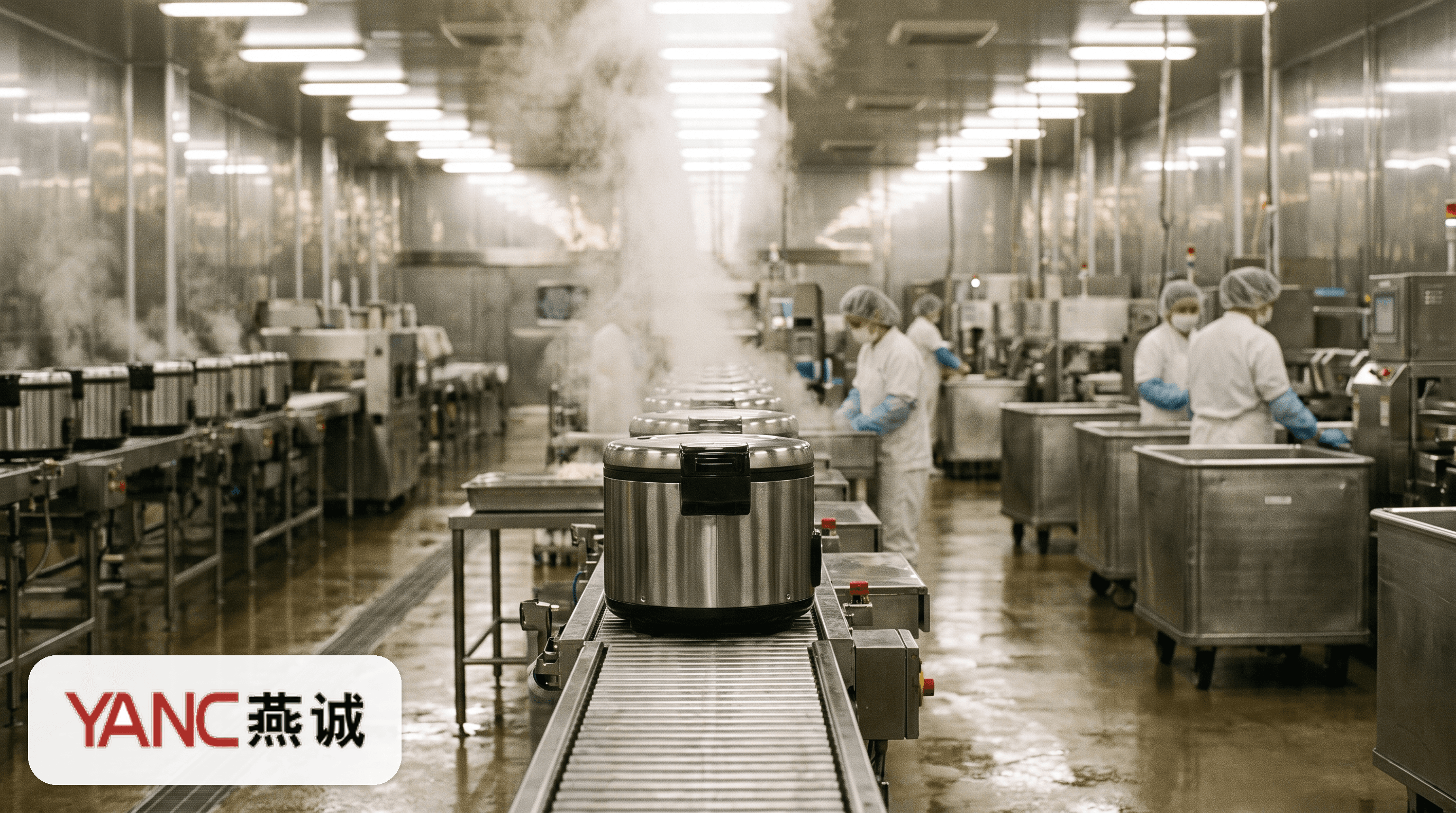
Talk of robotization usually conjures a factory full of manipulators and conveyor belts. But the central-kitchen niche — preparing hundreds or thousands of portions a day for airlines, cafeteria chains, and government institutions — has its own automation logic, and YANC illustrates it better than most.
Half a century of experience, counting from the roots
The company's history traces to the Beijing Vegetable Food Machinery Plant, founded in 1983 as a state-owned enterprise. That's rare in the food-equipment market, where most manufacturers date to the 2000s or even the 2010s. Over that span the company has delivered over 2,000 central-kitchen projects and developed more than 200 equipment types — accumulating experience not in a single narrow operation, but across nearly the entire industrial food-preparation cycle.
The full manufacturing cycle stays in-house
An important detail for a buyer: the full equipment-manufacturing cycle happens in-house, not through subcontractors. In practice that means single accountability for quality at every stage — from casting the kettle to assembling the finished line — rather than fragmented responsibility across several subcontractors for different parts of one system.
From rice to dishware: the breadth of the line
YANC's line covers nearly the entire central-kitchen cycle: rice-cooking and portioning lines (the YC-XR340-Z and YC-ZC9000 models), cooking and portioning equipment (YC-ZB40, TW-RD400, TW-500D, the compact TW-260), industrial deep fryers, cooking kettles for soups and side dishes, and finally industrial dishwashers — meaning the equipment covers not only preparation but the final stage of the cycle, one that often stays manual even in otherwise automated kitchens.
Over 60 patents and a research base
The company has over 30 years of development behind it and more than 60 patents and industry standards to its name — meaning some of the solutions that are now industry norms for central kitchens in China were developed here, not borrowed from adjacent industries.
A project tested every day, mid-flight
One of the company's flagship references is in-flight catering for China Southern Airlines. Airline catering is one of the most demanding scenarios for food equipment: strict sanitary standards, tight time windows between preparation and takeoff, and a volume that has to scale to thousands of portions in sync, with no room for delaying boarding. YANC's rice, thermal and washing equipment line is featured in the factory's catalog card.
Who this fits
If the task is equipping a central kitchen for a cafeteria chain, a food-production combine, or a logistics catering center, YANC brings ready references specifically at that project scale, not just one-off equipment deliveries — worth weighing when choosing a supplier for a project this size, where the equipment matters less on its own than the track record of launching a turnkey line. Another reason why half a century of experience carries real practical weight today is the accumulated library of solutions for non-standard volume patterns. A central kitchen rarely runs the same load profile every day: airline catering has peak hours before departures, a cafeteria chain has a lunch rush, government institutions see seasonal swings in the number of people served. A manufacturer with a track record of hundreds of completed projects has already run into most of these scenarios and can match a line configuration — from the compact TW-260 to higher-throughput models — to a customer's actual load schedule, rather than offering one universal setup that then needs reworking to fit the kitchen's real operating rhythm after installation. One last thing worth weighing: for a project of this scale, what matters isn't just whether the needed equipment model exists in the lineup, but whether the supplier has a proven track record of launching several units in sync as one production cycle — it's precisely at the stage of integrating multiple equipment types into a shared flow that delays most often appear, delays that are avoidable when a supplier already has a proven methodology for a project at this scale.