
инвестиции · гуманоиды · автопром · Китай
XPeng IRON: from a record $900 million round to mass production
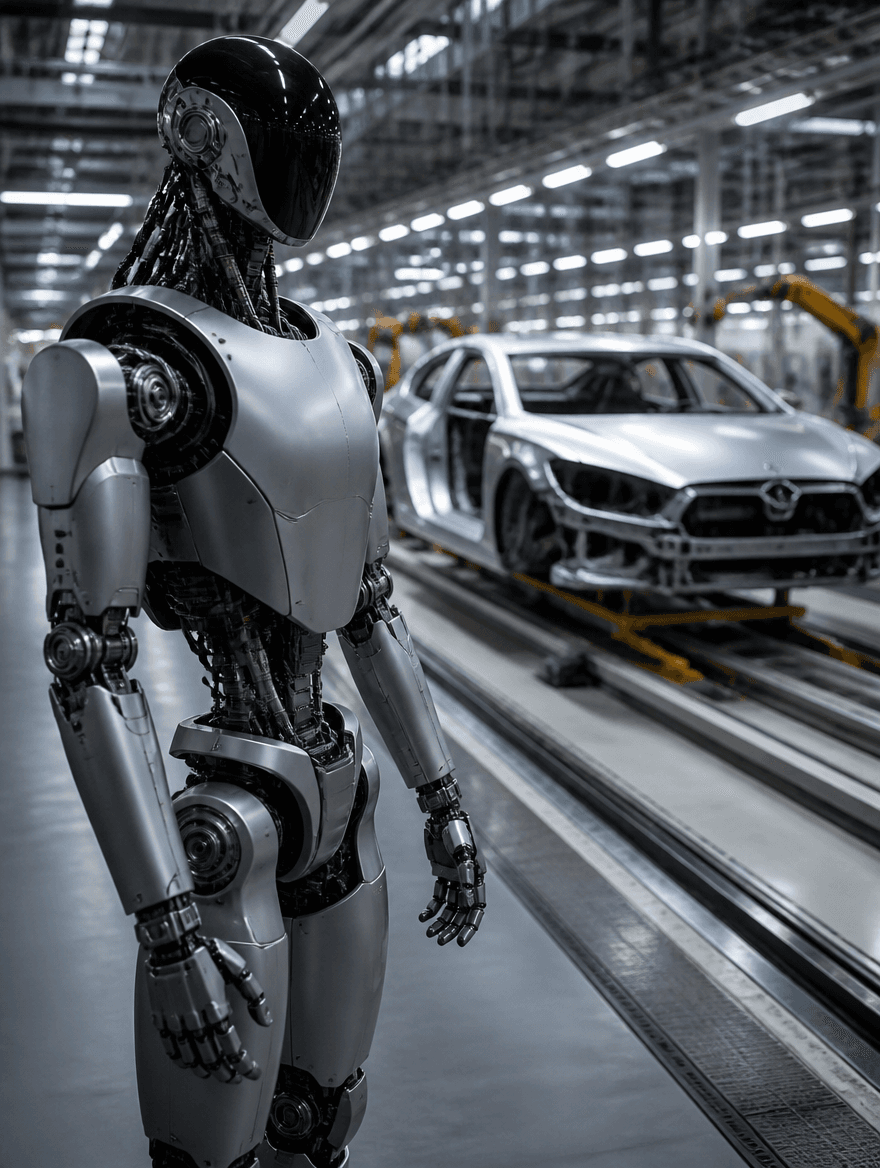
On August 24, 2026, the robotics division of XPeng closed a funding round exceeding $900 million at a post-money valuation above $6.3 billion — the largest private round in the history of China's embodied-AI industry. The figure alone signals how seriously capital now treats humanoids as an actual business rather than a flashy auto-show demo.
Who put in the money, and why
The round was led by IDG Capital, one of China's most experienced venture funds known for backing long-horizon tech stories. But the strategic investor lineup is even more telling: Tencent and Alibaba, two internet giants, joined in — and for them, an investment in XPeng's humanoid isn't just a financial bet, it's a way to stake a claim in the embodied-AI ecosystem years before the market consolidates around two or three leaders.
The logic mirrors what drove internet giants into previous tech waves — cloud platforms, semiconductors, electric vehicles. Getting in early on a potential category leader buys access to data, partnerships, and influence over platform architecture, not just an equity stake.
From cars to robots — a logical move
For XPeng itself, an electric-vehicle maker, betting on the IRON humanoid looks less exotic than it might seem from the outside. The company already holds engineering competencies critical to robotics: battery systems, electric motors, computer-vision-based autonomous driving, and a manufacturing culture built around mass-assembling complex mechanical products. An automaker is essentially converting accumulated expertise into an adjacent industry — exactly what market analysts have been saying for a while: the leading humanoid manufacturers a few years from now may well be automakers rather than robotics startups.
A concrete timeline and its first stress test
XPeng's goal is stated with unusual precision: the IRON humanoid is meant to reach mass production by the end of 2026, with first customer deliveries starting in 2027. That's an aggressive timeline by industry standards, where most competitors still describe "mass production" in far vaguer terms.
But the ambitious schedule has already run into harsh engineering reality. Related to the state of solid-state battery technology, CATL chairman Robin Zeng publicly assessed solid-state batteries' maturity back in June 2026 at level 4 out of 9 on the readiness scale, stating mass adoption was unlikely before 2030. That assessment is exactly what forced XPeng to abandon its original plan to fit IRON with fully solid-state batteries and switch to hybrid cells — simply to keep the announced mass-production timeline intact.
What this episode says about the industry at large
The battery story is telling on its own: even a company with resources at XPeng's scale, backed by Tencent and Alibaba, cannot bypass the physical limits of technology that isn't mature yet. It's a useful counterweight to the general information climate around humanoids, where press releases routinely run a couple of years ahead of real engineering readiness.
At the same time, the fact that the round closed on these exact terms — the largest private round in the industry's history, with two internet giants at the table — signals that capital markets are betting not on a single impressive demo, but on a company with a manufacturing base capable of actually getting the product onto the assembly line. For the rest of China's humanoid industry, that's a signal: investors are getting pickier, and demos alone no longer cut it.
Automakers versus pure robotics startups
XPeng's round invites a different look at how power is distributed across the industry. While pure robotics startups — dozens of Chinese companies competing for investor attention — have to build manufacturing lines and supply chains from scratch, automakers already have working factories, proven quality-control processes, and years of experience dealing with safety regulators. That structural advantage could prove decisive precisely at the stage of moving from prototype to mass production — the exact stage where startups without an industrial background most often stumble.
If the hypothesis that automakers will dominate humanoid manufacturing holds up over the coming years, XPeng, with its $900 million round and an aggressive production timeline for IRON, will be one of the earliest concrete examples of what that transformation actually looks like — rather than just a theoretical framework from an analyst report.
A catalog of robotics manufacturers and related component suppliers is available on the Aura Robotics catalog page, where you can trace how supply chains form around projects like this one.