
центральные кухни · Xiangying · робот-повар · пищевое оборудование
Xiangying: a chef robot inside a line of 2,000 equipment sizes
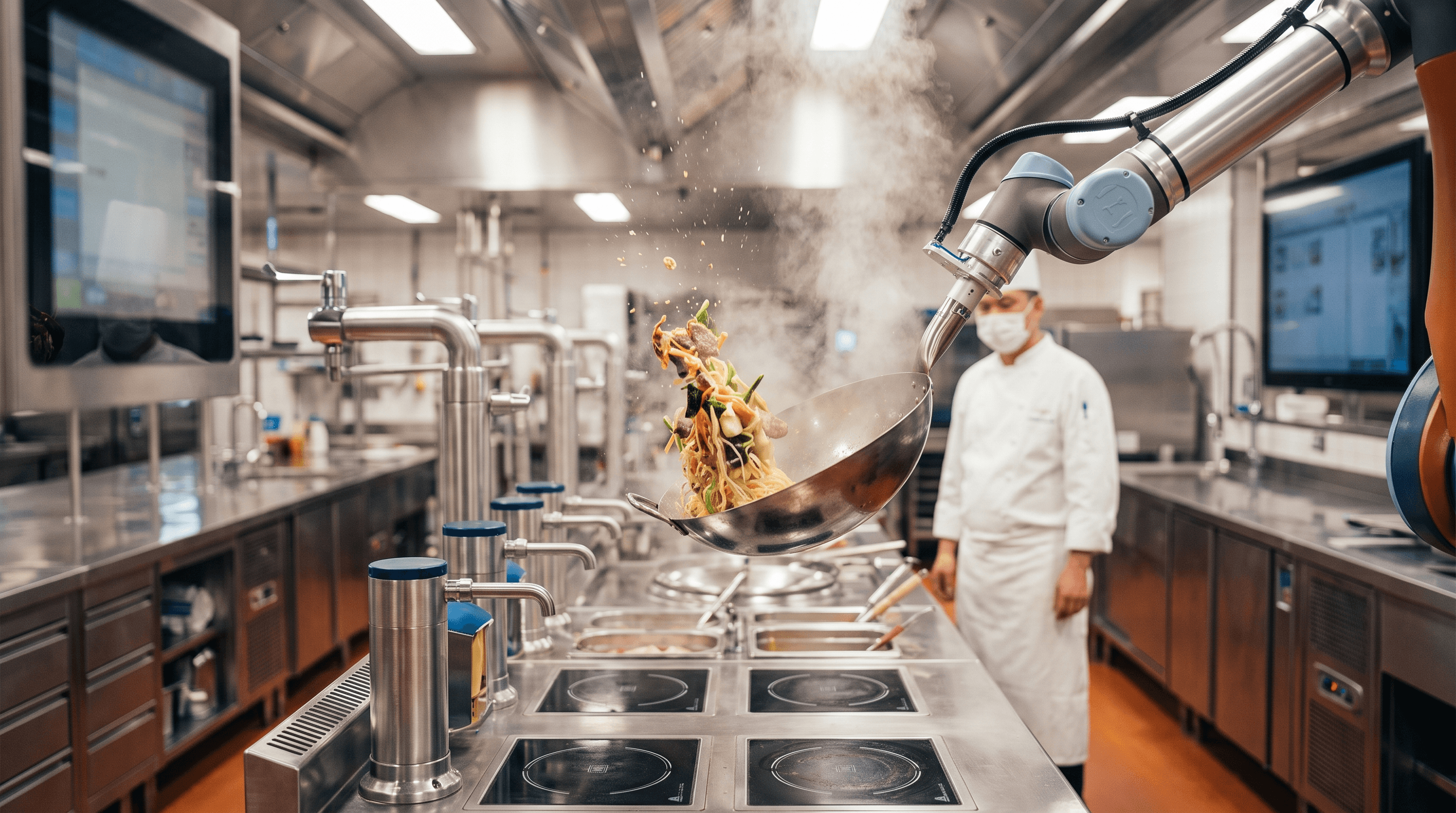
Borrowing a technology doesn't mean copying it wholesale. Xiangying, a central-kitchen equipment manufacturer with 31 years of history, built its line on technologies borrowed from the Japanese and European food-machinery schools but adapted for Chinese cuisine — different cooking ratios, different temperature regimes, a different set of standard dishes.
The scale of the line: 15 series, 2,000 sizes
The company's line comprises fifteen product series and around 2,000 size variants — meaning almost any kitchen configuration, from a compact fast-food point to an industrial production combine, has a ready-made model rather than requiring a from-scratch custom build. That breadth is rarely achieved without decades of accumulated experience specifically in adapting equipment to different production volumes.
Turnkey delivery: from design to commissioning
The company works turnkey — design, line fabrication, installation and commissioning happen in one cycle within one company. For the customer, that means a single point of accountability for the whole project instead of independently coordinating several contractors across different stages — a typical headache when launching a production line.
Chef robot R3: a manipulator instead of a cook at the stove
A particular standout in the line is the R3 chef robot — a manipulator for automated cooking to a fixed recipe. Unlike the line's classic equipment (kettles, wok stations, fryers), which automates one stage of the process, R3 reproduces the cook's entire sequence of actions: ingredient dosing, mixing, timing and temperature control — covering not a single operation, but effectively the whole recipe.
The rest of the line: from rice to noodles
Beyond R3, the line includes rice-cooking and packing lines, automated wok stations for cooking in set batch sizes, tilting cooking kettles for fast discharge, steam-cooking chambers for gentle heat treatment, industrial deep fryers, noodle-cooking lines, dishwashing complexes and vegetable washers — the full cycle from raw ingredient to clean dishware after serving.
Clients that test the equipment against daily volume
The company's customers include the fast-food chains Zhen Kungfu and Xibei, as well as Alibaba, Sanquan and Synear, plus Zhejiang, Tongji and Huazhong universities. Xiangying's full line — from rice lines to the R3 chef robot — is featured on the factory's catalog card. That client list means the equipment gets tested daily against real order flow across different formats — from a university cafeteria to a nationwide food-service chain.
Who this line fits
If the goal isn't a one-off equipment purchase but building a production line for a specific dish assortment — including automated cooking elements via R3 — the breadth of Xiangying's line and its project-delivery experience is a strong argument for choosing this single supplier over assembling a line from several different manufacturers. It's worth separately noting how the company balances the R3 chef robot against the rest of the line: R3 covers exactly the menu items where the recipe is stable and repeatable enough to be formalized into a manipulator program, while the classic equipment — wok stations, tilting kettles, steam chambers — stays responsible for operations that are simpler and cheaper to automate without full robotics. Splitting tasks by complexity like this, rather than trying to replace everything with a robot, is a practical approach: the customer gets robotics exactly where it delivers the most return per ruble invested, instead of overpaying for a manipulator where an ordinary automated kettle does just as well at a noticeably lower cost. One last practical point: when selecting a specific configuration from nearly two thousand available sizes, the choice should be based not on theoretical maximum throughput but on the actual projected order volume at a given location, including peak hours — an oversized line means paying for unused capacity, while an undersized one means queues and lost customers at rush hour, so sizing the line is best left to the supplier's engineers with experience at exactly this kind of scaling.