
科技游 · гуманоиды · X-Humanoid · Kepler · PNDbotics · тех-туризм
科技游: Three Humanoids in Aura's Catalog Worth Flying to China For
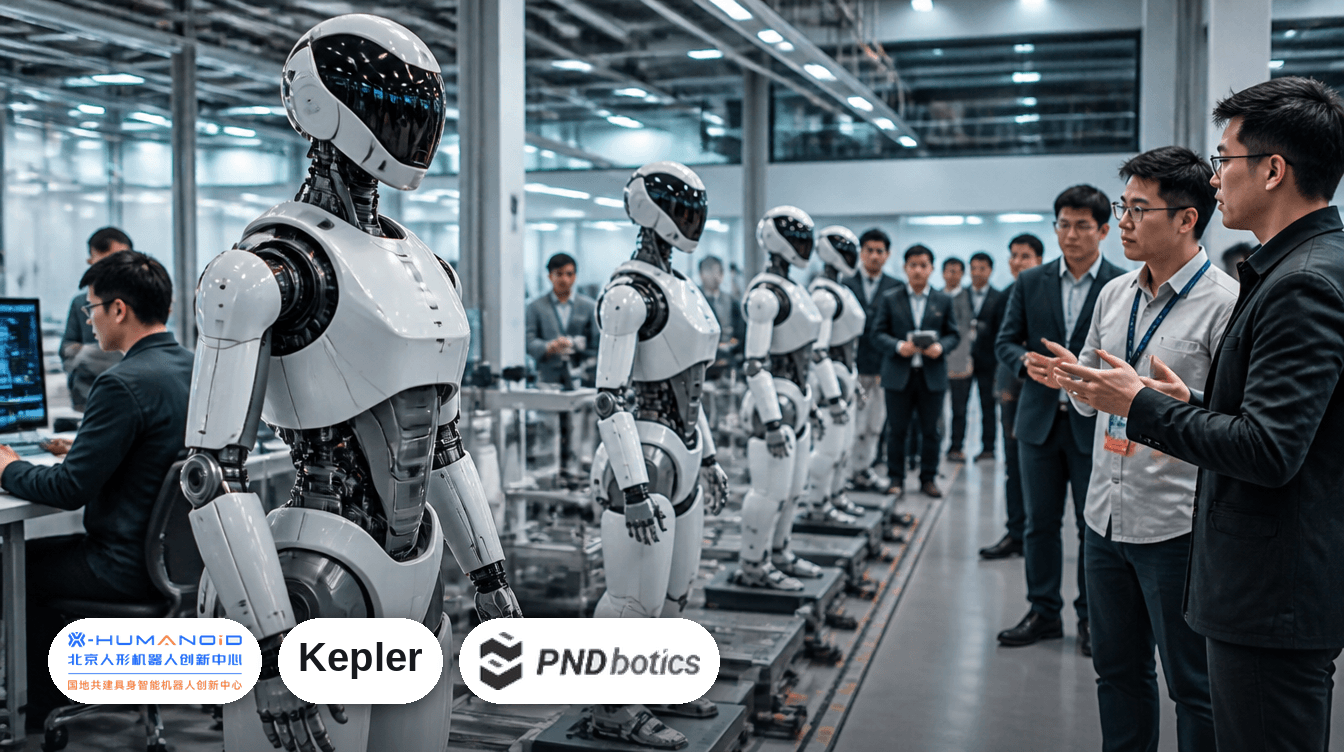
On August 10, 2026, Chinese business outlet Sina Finance named 科技游 — tech tourism, visits to factories and research centers — as one of the growing drivers of inbound travel to China. The term sounds abstract until you attach it to actual addresses. Aura's catalog has plenty of those — and three of them answer the same question in three different ways: how do you get a humanoid from lab to assembly line?
X-Humanoid: not a factory, a national lab
北京人形机器人创新中心 / X-Humanoid isn't a conventional manufacturer — it's a state-backed robotics innovation center working alongside universities and industrial partners. It develops the open Tiangong platform, and Tiangong holds two real records: version 3.0 (169 cm, 62 kg, 43 degrees of freedom, up to 12 km/h) became the first humanoid to climb 100+ stairs in a row, and the Tiangong Ultra variant won a humanoid half-marathon.
For a delegation, this is a rare chance to see not mass production, but the point where the industry hammers out shared standards — the software base, protocols, and testing methods that later spread across dozens of private companies.
Kepler: a humanoid that counts unit cost, not degrees of freedom
开普勒机器人 / Kepler is a Shanghai developer that deliberately put unit cost, not maximum specs, at the center of its strategy. Its flagship, K2 Forerunner, stands 178 cm and weighs 85 kg, with 52 degrees of freedom, cable-driven five-finger hands with 11 DoF lifting up to 15 kg and tactile sensors (96 points per fingertip), and a 2.33 kWh battery for 8 hours of operation. The company's bet is its own planetary actuators, which cut production cost without sacrificing payload or precision.
That's a direct illustration of a theme widely debated in international robotics press over the past few weeks: The Robot Report's analysts note that mass deployment of humanoids on factory floors is gated less by specs than by a price threshold. Kepler is one of the few manufacturers that built its entire engineering strategy around that threshold, rather than reaching it as a side effect of scaling.
PNDbotics: open architecture for people who need a platform, not a finished line
柏奥尼克机器人 / PNDbotics bets on accessibility and openness rather than maximum out-of-the-box autonomy. Its flagship, Adam, stands 167 cm and weighs 60-62 kg, with up to 41 degrees of freedom on quasi-direct-drive actuators, leg torque up to 340 N·m, and five-fingered hands.
The open architecture makes Adam a logical choice not for an assembly line, but for a university lab or R&D center that needs to modify the platform for its own tasks — mounting non-standard sensors, changing control algorithms, testing hypotheses a closed-architecture, finished-product manufacturer simply won't let you touch.
Three factories, three answers to "why go"
X-Humanoid shows where the industry hashes out standards. Kepler shows how unit cost gets engineered, not just capabilities. PNDbotics shows what a reconfigurable platform looks like, as opposed to one locked into a single fixed configuration. Three different but equally real reasons for the exact 科技游 Chinese business media are writing about: seeing with your own eyes what looks identical in an article or a video, but turns out very different in person.
Full spec sheets for the X-Humanoid factory, the Kepler factory and the PNDbotics factory are in Aura's catalog, with complete model lineups.
Why this isn't a passing fad, but a systemic shift
It matters that the note about 科技游 ran in a business outlet, not a travel one — that sets the trend apart from ordinary curiosity about a novelty. Companies buying equipment worth tens or hundreds of thousands of dollars treat an in-person factory visit not as entertainment but as part of due diligence: seeing quality control in action, watching the real pace of assembly, talking to engineers directly instead of trusting a spec sheet alone. That's exactly why the three factories in Aura's catalog — X-Humanoid, Kepler and PNDbotics — matter not on their own, but as three different examples of what's worth checking when choosing a supplier: openness of standards, cost engineering, and how reconfigurable a platform is for your own tasks.
Requires confirmation
Lead times and exact pricing for these platforms aren't given here — they get confirmed individually based on the task and order volume.
🔗 https://www.aura-robotics.ru/ — choose a robot for your task
These factories are on the route of our Robotics Expedition — see them in person, not just on video.