
Игры гуманоидов · соревнования роботов · WRC 2026
Long jump and table tennis: 2,056 robots from 16 countries competed at the Humanoid Robot Games
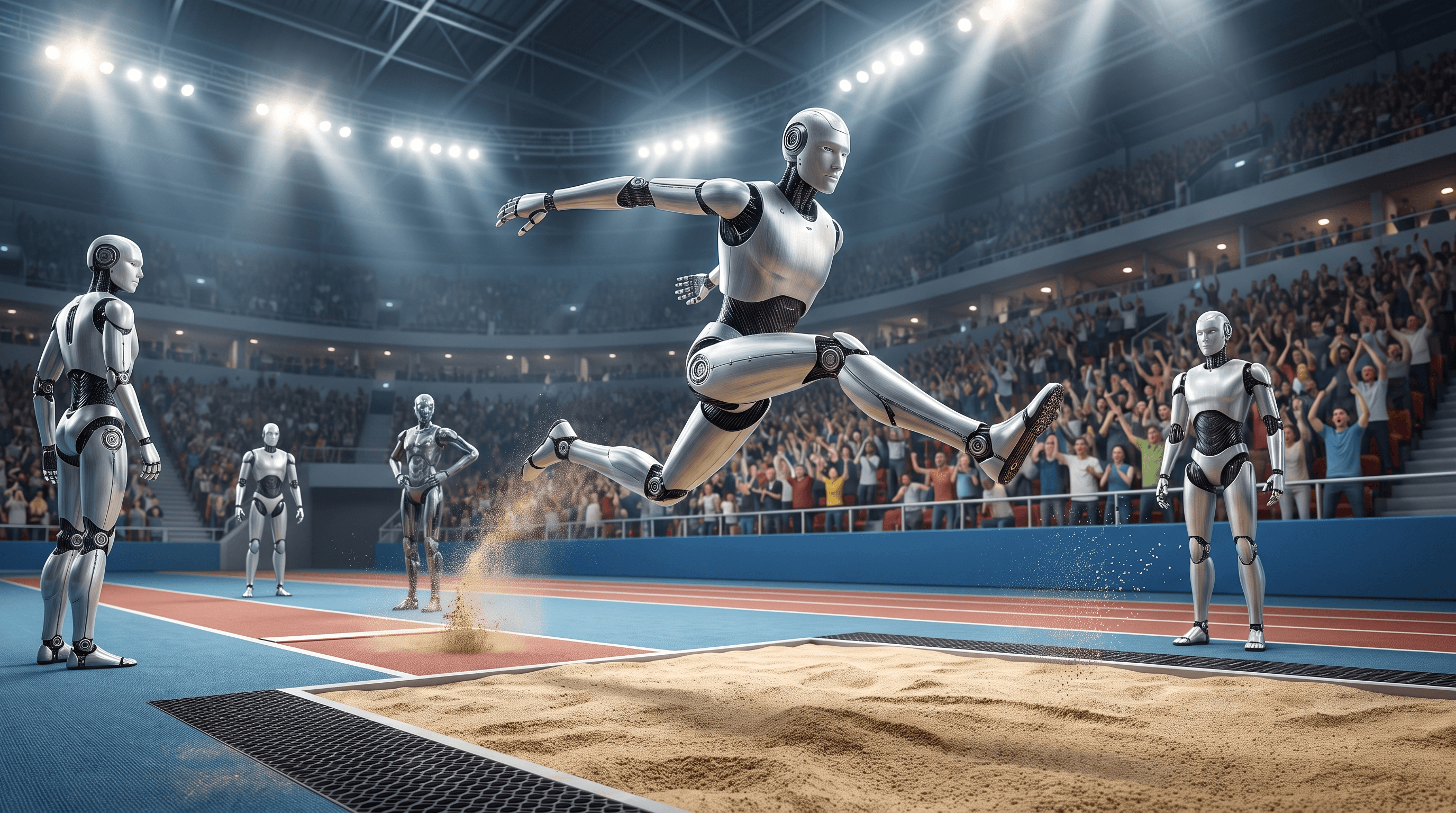
Running alongside the business program of the 2026 World Robot Conference (WRC) in Beijing was the second World Humanoid Robot Games — a competition bringing together 2,056 machines from 16 countries, according to media covering the event. The format expanded compared to the first edition: alongside familiar running disciplines, organizers added long jump, weightlifting, and table tennis — sports requiring fundamentally different types of motor control.
Why this isn't just a show
Each new discipline tests a specific engineering skill critical for industrial application. Long jump tests landing stability and the ability to absorb impact load without losing balance — exactly what a robot needs when working on an uneven warehouse or construction site surface. Weightlifting tests center-of-gravity control while lifting a load, directly transferable to logistics and industrial assembly tasks. Table tennis tests reaction speed and hand-positioning precision when handling a fast-moving object — a key skill for manipulating small parts on a conveyor line.
The scale of international participation
The presence of machines from 16 countries shows the format has stopped being purely a Chinese showcase — teams from around the world are drawn to it as a way to test their platforms against the largest concentration of competitors in one place. For organizers, it's also an additional data-gathering channel on the state of the industry as a whole: comparing results across national teams gives a far more objective picture of progress than isolated company press releases.
From game to sales tool
The competitive format long ago stopped being pure sporting entertainment for Chinese robotics — it functions as a public proving ground where potential corporate buyers can observe reliability and precision characteristics under conditions closer to real-world use than a manufacturer's controlled demo environment. The participant count growing to 2,056 machines is itself an indirect indicator of how many companies can field a working humanoid platform at all — a number that would have looked fantastical just three years ago.
A catalog of Chinese humanoid robots with real specifications is available on the Aura Robotics site.