
вьетнам · германия · гуманоиды · партнёрства · vingroup
Vietnam: VinDynamics × Schaeffler — a local company as a full partner
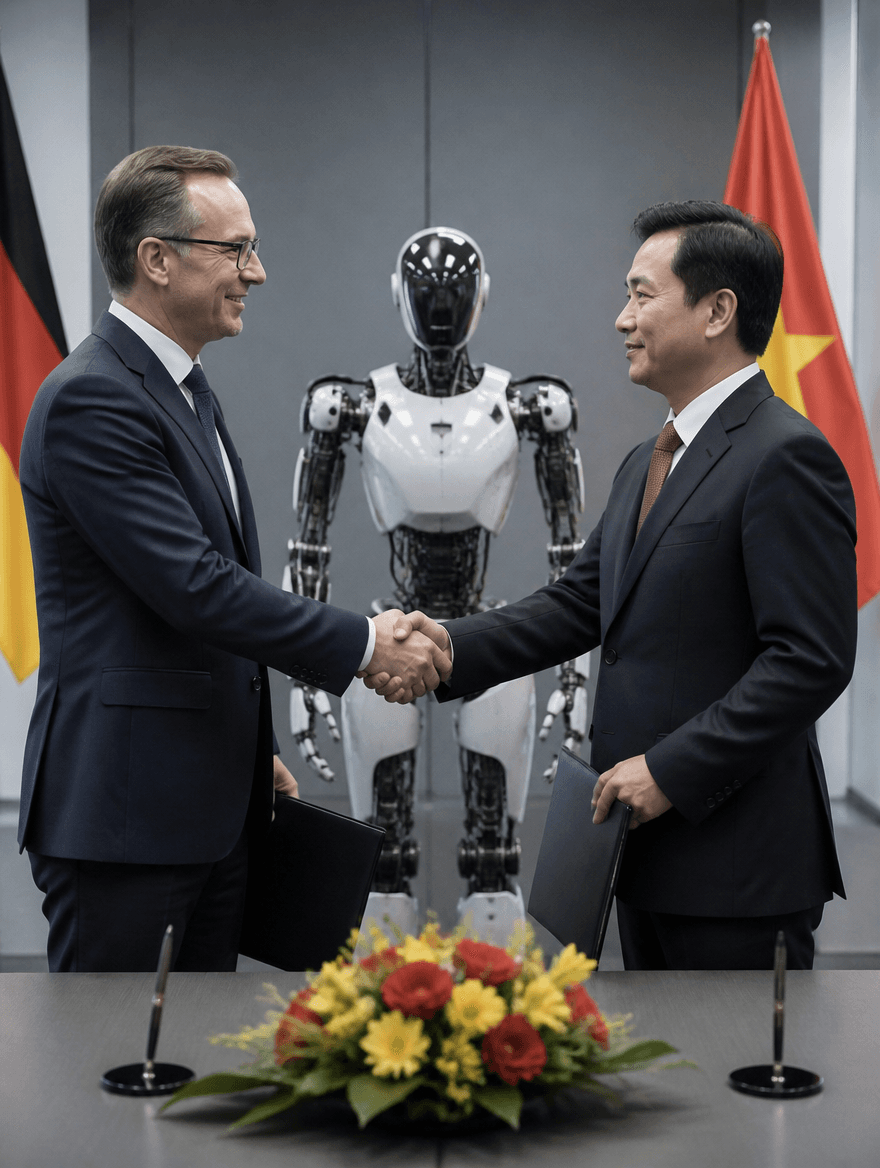
In discussions of Southeast Asian robotics, the region is usually cast as an assembly site — a place where foreign companies locate manufacturing to take advantage of cheap labor and tax incentives while keeping the actual technology development outside the country. The partnership between Germany's Schaeffler and Vietnam's VinDynamics breaks that pattern, which is exactly why it deserves attention.
Who the parties are
Schaeffler is one of the world's largest manufacturers of bearings, drive systems, and precision mechanical components — a supplier whose parts go into automotive, industrial, and increasingly robotics applications. For humanoid robotics, Schaeffler's expertise is especially valuable: bearings and drive components are critical parts of a robot's joints, determining both movement precision and machine longevity.
VinDynamics is a unit of Vietnamese conglomerate Vingroup — the same group behind VinFast electric vehicles and several other of the country's industrial ventures. Vingroup has long and consistently invested in diversifying beyond real estate, its historical origin, into EVs, electronics, and now robotics.
Why this isn't a routine deal
The key detail of the partnership isn't the collaboration itself, but its format. Usually, when a Western or East Asian company enters a Southeast Asian market, the local partner gets the role of assembly shop: production floor space, labor, local tax breaks — but not a seat at the table where product architecture decisions are made. Here, VinDynamics acts as a full development partner in humanoid robot creation, not a contractor assembling a finished German design.
That changes the picture for Vietnam's whole industry. A company participating in development rather than just manufacturing accumulates engineering competence that stays in the country after any specific project ends — unlike a pure-assembly model, where the know-how remains with the foreign rights holder.
Context: why now, why Vietnam
The partnership arrives amid a broader Vietnam-South Korea pivot toward technology cooperation. At a meeting in Hanoi in April 2026, the two sides agreed to jointly grow trade turnover to $150 billion by 2030 — and, more relevant here, the new emphasis signals that Vietnam expects partners to offer not just assembly orders, but a stake in developing next-generation technology. Korean firms Samsung, Hyundai, and LG already hold major manufacturing capacity in Vietnam, so the base for deeper technological integration already exists.
The partnership with Schaeffler — a German rather than Korean company — shows Vietnam isn't limiting itself to one geopolitical direction, but building parallel technology alliances across multiple regions at once.
Limits worth keeping in mind
It's important not to overstate the scale of the moment: Vietnam's industrial robotics market is still small — about $112 million in 2025, forecast to grow to $231.7 million by 2031. For context, that's an order of magnitude smaller than Singapore's or India's markets. The VinDynamics-Schaeffler partnership is a bet on the future, not a reflection of the current scale of Vietnamese industry.
At the same time, the country is forecast to need 1.2 million automation specialists by 2030 — and partnerships of this type, giving Vietnamese engineers real development experience rather than just assembly work, become part of the solution to that labor gap rather than just a nice press release.
A precedent for the rest of the industry
If the VinDynamics-Schaeffler partnership actually produces jointly developed components rather than remaining a statement of intent, it could set a precedent for other Vietnamese industrial groups. For now, most local Southeast Asian companies remain recipients of finished technology — license buyers, assemblers building to someone else's blueprints. A model where a local company participates on equal footing in defining product architecture requires not just capital but a willingness to share engineering risk with a foreign partner. Judging by its experience with VinFast, Vingroup appears ready for that role — the question is whether it will find followers at home.
If you're interested in manufacturing partnerships in Southeast Asia, Aura Robotics' catalog can help you navigate real manufacturers in the region.