
промышленные роботы · STEP · сервоприводы · сварочные роботы
STEP: industrial robots from an elevator-automation heritage
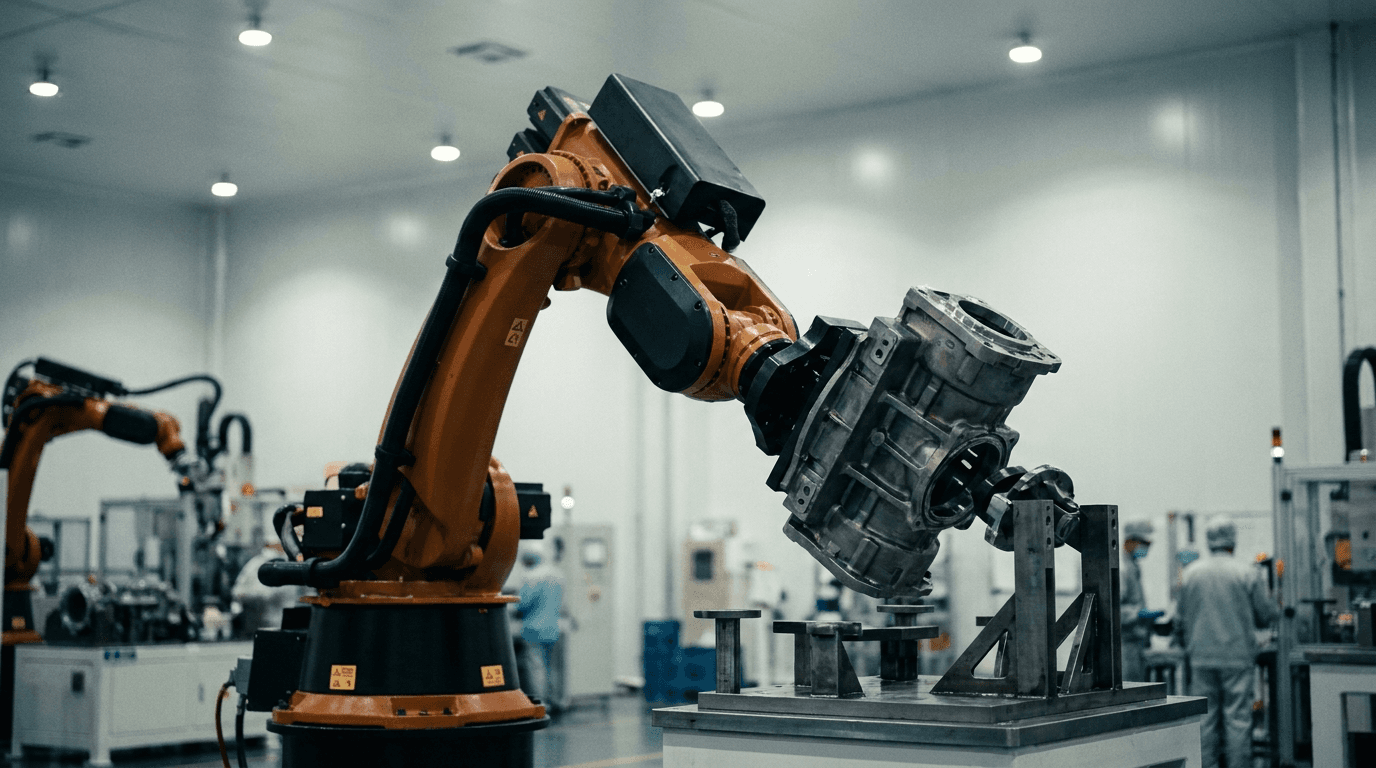
Not the most obvious background for an industrial-robot maker: elevator automation. Yet that's exactly where STEP / 新时达 grew from — the company has historical ties to elevator drive technology, and that heritage directly explains its current strength: proprietary controllers and servo systems.
Why it matters who builds the controller
Most industrial robots on the market are assembled from components sourced across suppliers: one plant builds the mechanics, another the reducer, a third the control system. STEP took a different path — the company builds its own controllers and servo systems, meaning it controls exactly the component that determines a robot's precision and response speed to a command. For a customer, that translates to more predictable compatibility across the whole system and, generally, faster technical support — there's no need to work out whose component failed.
The SR series: compact design with high-precision reducers
The line's flagship, the SR175/2700, carries up to 175 kg at a 2.7-meter reach. A 175 kg payload puts it in heavy-industrial-manipulator territory, capable of moving not just small parts but full workpieces or assembled subunits. Repeatability accuracy is ±0.06 mm: that means when it returns to the same point in a work cycle thousands of times in a row, the robot deviates from the target position by no more than 60 micrometers — comparable to the thickness of a human hair. For welding, machine tending or assembly, where cycle-to-cycle repeatability matters more than absolute positional accuracy across the whole workspace, that's the key figure.
The SD series: speed and precision for lighter tasks
Where SR is about payload, the SD series is about speed. The SD7/700 model is a compact, lightweight robot for sorting and assembly, combining high travel speed with positioning accuracy. Robots like this fit where a payload measured in dozens of kilograms isn't needed but the number of operations per minute is — for instance, on a small-parts assembly line in electronics.
Real-world shop-floor applications
STEP's robots are used for welding, machine tending, assembly and part handling — essentially the full basic operation set of a metalworking or assembly shop. Both the SR and SD series are listed on STEP's factory card in the catalog, with current lead times shown for each specific model.
What to weigh when choosing
For moving heavy workpieces, tending large machine tools, or welding steel structures, look at the SR series' payload and reach. If the priority is high cycle speed on an assembly or sorting line with moderate part weight, the compact SD series is the more logical fit. Either way, an in-house controller and servo-drive design is an argument for a more cohesive, natively compatible system rather than a set of components from different vendors under one shared housing. Another argument for in-house controller design is response speed when cycle conditions change. When every part of the system — from the wrist torque sensor to the trajectory-planning algorithm — is engineered by one team, a controller firmware update can be synchronized with servo-parameter changes without the version-incompatibility risk that regularly trips up systems assembled from different vendors' components. For a plant running a robot across three shifts with almost no downtime, even a small synchronization mismatch between controller and drive eventually shows up as accelerated gearbox wear and more frequent unplanned diagnostic stops. That's why plants running an intensive, continuous line more often choose manufacturers with a full in-house electronics-and-mechanics development cycle — reliability here isn't measured on a spec sheet but in accumulated hours of uninterrupted operation. Finally, when comparing proposals from different plants, it's worth requesting not just the spec-sheet repeatability figure but the conditions under which it was measured — shop-floor temperature, travel speed, wear at the time of measurement — because a stated ±0.06 mm under ideal lab conditions and the same figure on a real shop floor with temperature swings across a shift can diverge noticeably.