
сингапур · плотность роботов · полупроводники · автоматизация · порт
Singapore: 167 robots per 10,000 workers — how this density is calculated
"Robots per 10,000 workers" is a standard metric from the International Federation of Robotics (IFR) that allows comparing automation levels across countries regardless of economic size. By this measure, Singapore ranks sixth in the world and fourth in Asia, with a density of 167 industrial robots per 10,000 manufacturing employees. Let's unpack where that number comes from and what's behind it.
How density is calculated
The IFR methodology looks simple at first glance: take the total number of industrial robots installed in a country (based on shipment and commissioning data from previous years) and divide it by the number of people employed specifically in manufacturing, not by the country's whole population or entire workforce. It's precisely this denominator — manufacturing jobs only — that makes Singapore's number so high: a city-state of about 6 million people has relatively small classic-manufacturing employment compared to, say, China or India, which mathematically inflates per-worker density given a high absolute robot count.
That doesn't make the number "dishonest" — the methodology is applied uniformly across all countries in the IFR ranking, so the comparison remains valid. But it's important to understand: density reflects automation intensity within a country's manufacturing sector specifically, not the overall level of robotization across the entire economy.
What lies behind the high density
The foundation of Singapore's density is its semiconductor fabs. The country remains the world's fourth-largest chip exporter, and semiconductor manufacturing is one of the most robot-intensive industries by nature: the cleanrooms where chips are assembled and tested require robotic precision and sterility that manual labor at industrial scale simply cannot achieve.
Singapore's robotics market grew impressively — from 890 million Singapore dollars in 2021 to 136% growth over five years. That's not organic growth of existing production lines but the result of deliberate government policy: Singapore has long and systematically invested in positioning itself as a high-tech manufacturing hub for semiconductors, pharmaceuticals, and precision engineering, offsetting a shortage of land and cheap labor with capital-intensive automation.
The port as a showcase for automation
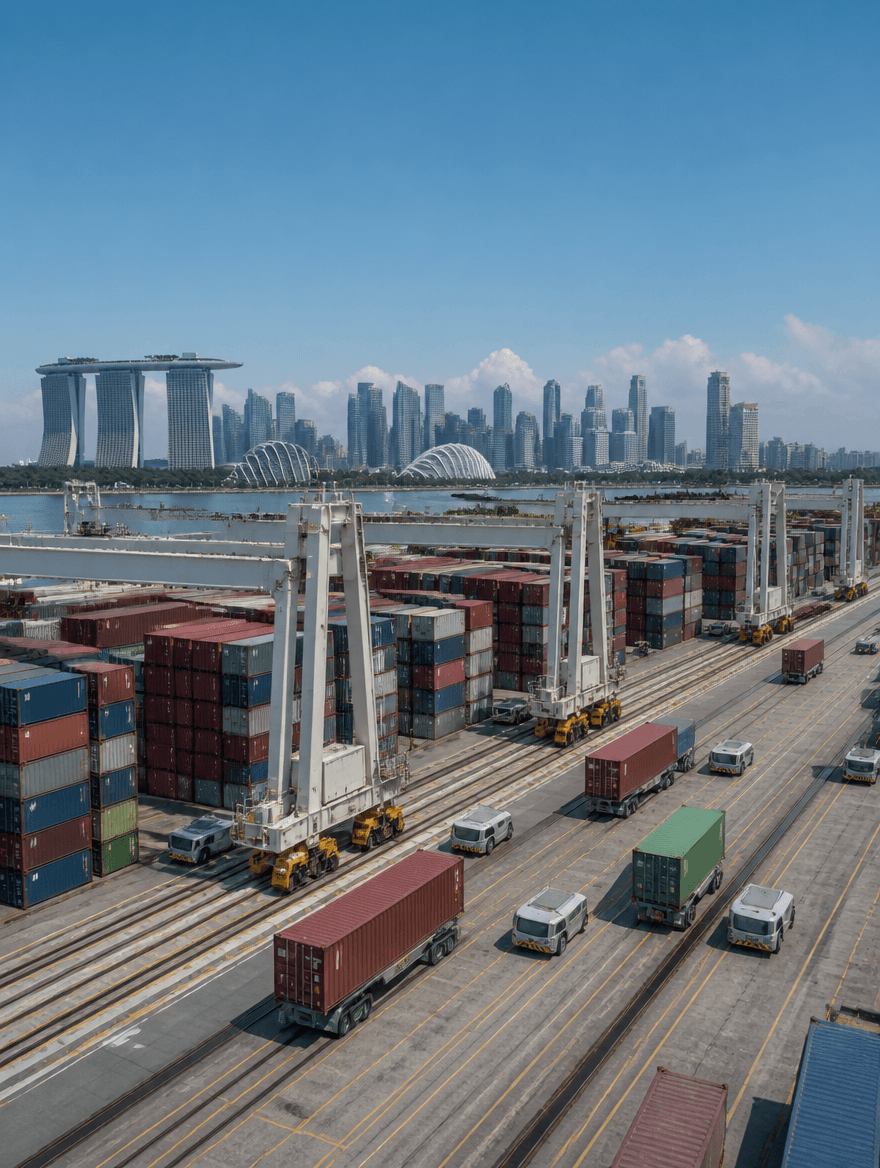
Beyond semiconductor fabs, another telling example of Singapore's automation is its port infrastructure. The Port of Singapore is one of the world's largest transport hubs, and its newer terminals are built for maximum automation: robotic cranes, autonomous vehicles for moving containers, minimal human involvement in routine cargo-handling operations. This isn't a story separate from industrial robotics — it's part of the same underlying logic: a small territory and labor shortage make capital-intensive automation economically more attractive than in countries with an abundance of cheap labor.
What other countries can learn
Singapore's model is a useful counterexample to the common myth that automation density directly correlates with the size of a country's economy or population. Neighboring countries in the region — Vietnam, Indonesia — lag by orders of magnitude in robot density precisely because their manufacturing sectors are built on a cheap-labor model, where the capital cost of robotization isn't yet economically justified for most operations.
Singapore, on the other hand, shows that high robot density is the result of a deliberate industrial choice (a bet on high-tech, capital-intensive sectors like semiconductors) combined with limited labor resources, which makes automation a necessity rather than an option. For countries planning their own automation strategy, Singapore's example is a good illustration that robot density grows fastest where the government deliberately builds industrial specialization around it, rather than simply waiting for organic technology adoption.
The metric's limits
A caveat about the metric's weaknesses is worth adding. High robot density per manufacturing worker says nothing about the quality of the jobs left to people, or how diversified a country's economy is beyond a narrow set of capital-intensive sectors. Singapore is strong precisely where it concentrated investment — semiconductors, port logistics, pharmaceuticals — but that's not a universal recipe: no other country in the region is likely to replicate Singapore's density without a comparable inflow of capital into specific high-tech niches.
If your company is considering manufacturing automation modeled on high-tech hubs like Singapore, Aura Robotics' catalog can help you find suitable equipment suppliers.