
складская робототехника · SENAD · машинное зрение · логистика
Senad: machine vision instead of retrofitting the warehouse
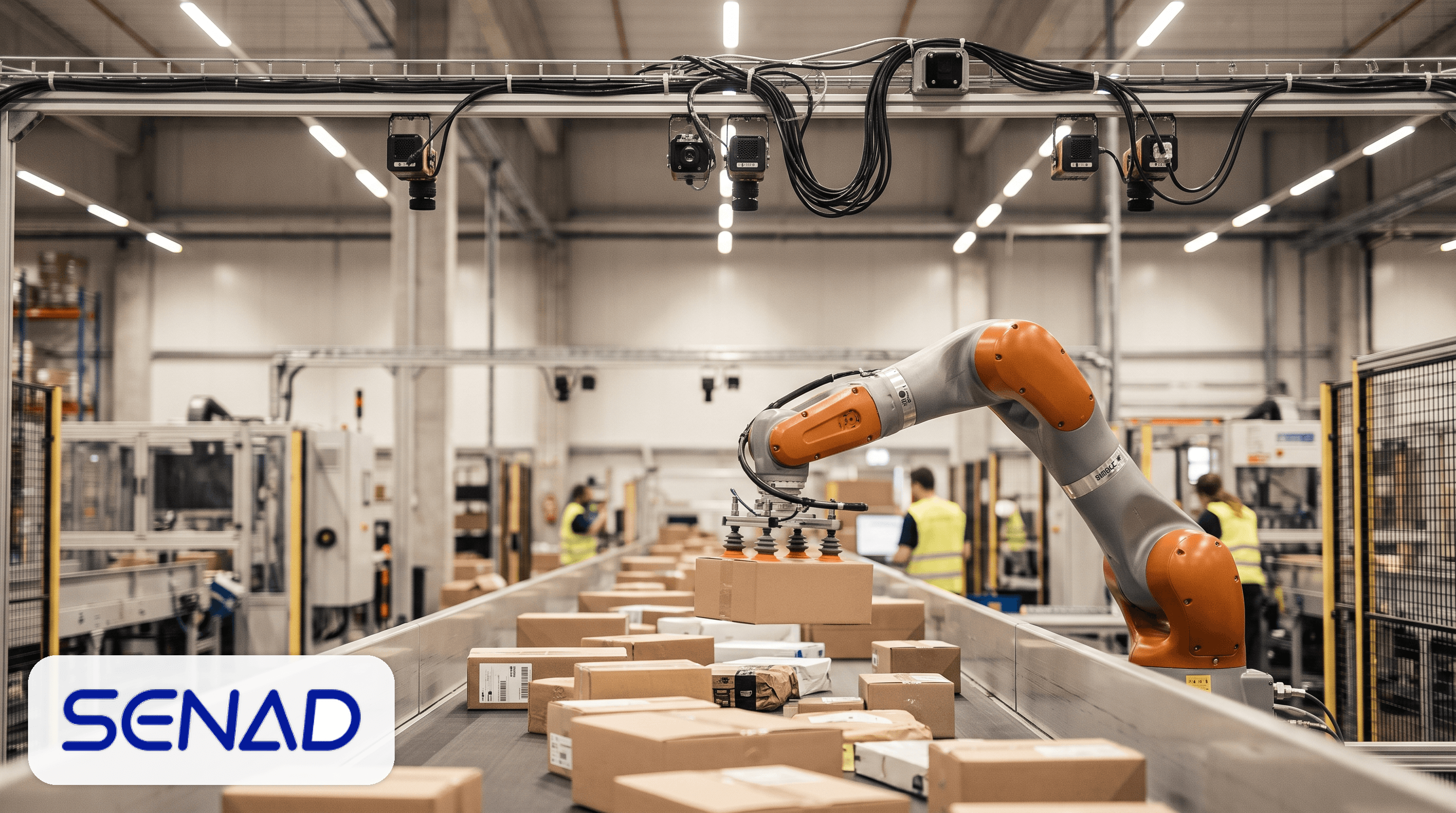
Every warehouse has a bottleneck rarely discussed in public: unsorted cargo. Uniform boxes stacked neatly on standard pallets are relatively easy to automate — the difficulty starts where a single pallet mixes boxes of different sizes, or bags that nobody pre-sorted. SENAD is a company whose core expertise is machine vision — deep learning, image processing and pattern recognition — applied to the messiest, least structured part of logistics.
A focus on intelligent logistics and warehousing
SENAD doesn't try to cover every robotics niche at once — the company's specialization is concentrated on intelligent logistics and warehouse operations. That narrow focus usually means solutions matured across many projects in exactly this niche, rather than a universal but shallower lineup.
Unloading robots: no site retrofit required
One of the core product lines is unloading robots, which work with containers, vans and carts, handling boxes and bags without any site retrofit. That's a significant point: many automated solutions require rebuilding the logistics node around a specific robotic system — new ramps, dedicated guide rails. SENAD's solution slots into existing warehouse infrastructure, cutting capital costs and reducing downtime during installation.
DWS and 3D cameras: measuring without stopping the flow
The DWS unit (dimensioning-weighing-scanning) alongside 3D volumetric cameras captures precise dimensions and weight for every parcel right on the conveyor, without stopping the flow. For a logistics operator, this directly feeds delivery-fee accuracy — pricing by volumetric weight requires exactly this kind of data, and manual measurement at a flow of thousands of parcels an hour simply isn't possible.
Depalletizers: sorting out what couldn't be standardized
A particular strength is depalletizers that handle mixed, unsorted pallets — pallets carrying goods of different sizes and shapes with no single stacking pattern. This is where machine vision does most of the work: the system has to recognize each individual box's boundaries in the pile on the fly, before the manipulator picks it up.
Clients and warehouse-system integration
The company's clients include DHL, EMS, Lazada and JD, and its solutions integrate with a customer's WMS (warehouse management system), BMS and OMS (order management system). SENAD's sorting, weighing and loading/unloading robot line is featured in the catalog.
Who this fits
If a warehouse or distribution center's bottleneck is precisely an unsorted, mixed cargo flow — marketplaces, parcel operators, retail with a wide range of packaging — SENAD's solutions deserve first consideration: they're built for exactly this automation-unfriendly case, not for perfectly standardized pallets. It's worth separately addressing the economics of deploying a solution like this: the bottleneck of unstructured cargo flow is usually solved either by hiring extra staff to manually break down complex pallets or by pre-sorting at the supplier's end — both options either grow the payroll or add logistics time to the supply chain. A vision-guided robotic depalletizer moves that operation directly onto the receiving warehouse floor and folds it into the general conveyor flow, rather than leaving it as a separate manual step that slows the whole batch-processing cycle. For a marketplace or parcel-service operator where order volume grows faster than the sorting headcount, this isn't just a matter of convenience — it's a direct way to avoid scaling staff in proportion to volume growth, and integration with the customer's WMS, BMS and OMS lets the automation's effect show up directly in warehouse productivity reporting, not just as a standalone robot metric. Finally, when choosing a supplier for a solution like this, it's worth requesting recognition-accuracy figures on the customer's own cargo samples rather than generic ones — the actual packaging mix at a specific warehouse (crumpled boxes, irregularly shaped plastic bags, pallets deformed in transit) often differs noticeably from the idealized samples on a supplier's demo stand, and those are exactly the samples worth testing the stated accuracy against before signing a contract.