
робототехника · AGV · компоненты · гуманоиды
Brains and Hands for Other People's Robots: Seer Robotics and LinkerBot
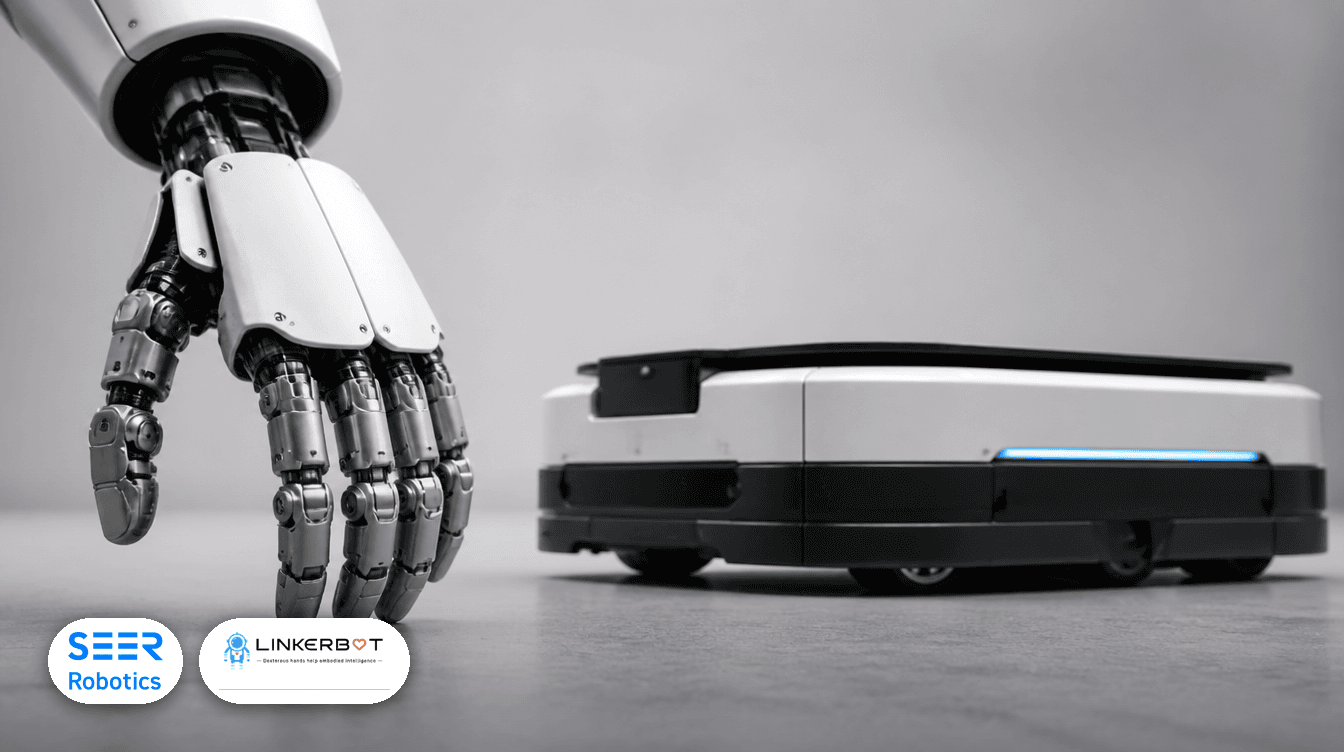
When people picture robots, they usually imagine a complete machine — a body, legs or wheels, a manipulator arm. But behind the scenes of the industry there are companies that sell not the machines themselves, but what other manufacturers build them out of: "brains" for navigation and "hands" for fine motor control. Two factories from the Aura catalog do exactly that.
Seer Robotics: selling the system that drives the cart, not the cart itself
上海仙工智能 / Seer Robotics, based in Shanghai, doesn't build the mobile robots and forklifts themselves — it builds the controllers and navigation software that other manufacturers use to build their own equipment. Its flagship SRC controller is a universal solution for mapping, localization and navigation of mobile platforms; the SRC-3000FS variant is certified to the PL d and SIL 2 functional-safety standards — not a marketing badge, but concrete confirmation that the system passed independent risk assessment for failure on a warehouse floor where people work alongside autonomous equipment.
Separately, the company supplies AMB undercarriage chassis platforms with load capacity from 400 kg — the actual "cart," for clients who need more than the electronics, a full mechanical base. And its RDS system solves a problem that in practice is often harder than any single robot's navigation: fleet dispatching, when dozens of mobile robots and forklifts from different procurement batches are working the same warehouse floor at once, and something has to decide which one goes first.
LinkerBot: hands for other people's humanoids
灵心巧手 / LinkerBot, based in Beijing, specializes in a different bottleneck of the industry — anthropomorphic hands with a high degree-of-freedom count and tactile sensors, supplied to other humanoid manufacturers and research centers as a component, not a finished product.
The lineup scales by task complexity. Linker Hand O is a five-fingered hand with 6-7 active degrees of freedom and a built-in tactile sensor array, up to 5 kg payload. Linker Hand L goes further: 21 degrees of freedom (17 active) on a tendon drive, ±0.20 mm positioning accuracy, finger speed up to 440°/s at a mass of just 1.4 kg — specs that matter most where a hand has to do more than squeeze an object, actually manipulating it (turning, re-gripping, metering force). Linker Hand T is a variant built for tactile research tasks, with a dense pressure-sensor array on the fingertips — no longer a working tool, but a measuring one.
Why this is its own category of business, not just "parts"
Dozens of companies in China make humanoids and mobile robots, but not every one of them can afford to build both a navigation stack and a many-degree-of-freedom anthropomorphic hand from scratch — those are separate, expensive engineering tracks. Seer and LinkerBot make their money precisely by solving that narrow problem better than the end manufacturer could on its own, and selling the solution as a component inside someone else's product.
What this means in practice
If the task is integrating autonomous mobility into an already-running warehouse with a mixed equipment fleet, Seer Robotics is worth a look — its RDS solves fleet dispatching, not just single-unit navigation. If the task is fitting a manipulator or humanoid platform with a hand capable of real fine motor control rather than a simple gripper claw, LinkerBot's logic fits better: degrees of freedom and tactile feedback where a plain gripper used to be enough.
These factories are on the route of our Robotics Expedition — see them in person, not just on video.