
робопсы · Корея · Китай · оборона
Robot dogs on duty: from river monitoring to South Korea's army
Municipal services in Tianjin use quadruped robots for daily water-quality monitoring on the Haihe River — and this isn't a token pilot project but routine operational work: the robot walks to the riverbank on its own, takes a sample, returns to base and transmits the data without a single person having to make that round on foot in the rain or heat. It looks far less dramatic than a humanoid sprinting a hundred meters, but these are exactly the boring, repetitive tasks where robot dogs are already replacing human labor today, not in some theoretical future.
From civilian monitoring to military deployment
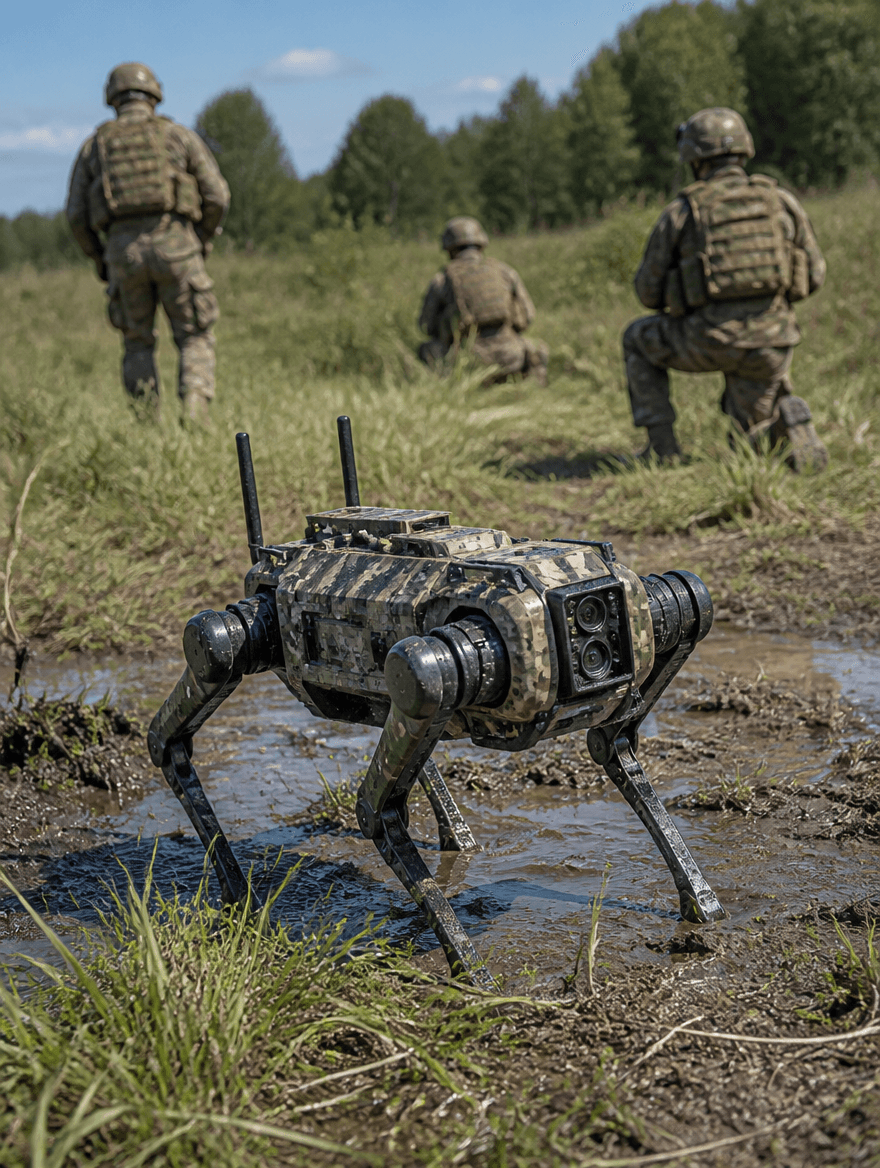
A completely different use case for the same basic platform type is unfolding in South Korea: the RB-01K, jointly developed by Rainbow Robotics and Hyundai Rotem, is set to enter service with the South Korean army before the end of 2026. Unlike civilian inspection robots, the military version is built for reconnaissance and patrol in conditions where the risk to a human operator is unacceptably high, rather than simply saving municipal staff time.
Same core mechanics, two very different payback economics
What's interesting is that the underlying engineering challenge for a civilian and a military robot dog is nearly identical — stable movement over uneven terrain, autonomous navigation, operation in adverse weather — but the economics of justification differ sharply. A city service only needs to weigh the cost of one inspection cycle against a human inspector's salary; a military buyer cares less about direct cost savings than about reducing risk to personnel, which makes it willing to pay a much higher premium for platform reliability and ruggedness.
Hyundai is building a supply chain for humanoids and robots at the same time
Tellingly, alongside the RB-01K military order, Hyundai Motor Group is mobilizing roughly 200 tier-one suppliers to build an internal component supply chain for humanoids in general — meaning the Korean conglomerate is building industrial capacity not for one specific model, but for an entire family of robotic platforms at once, from quadrupeds to bipeds. That approach reduces the risk of a single military contract remaining an isolated episode without a follow-on product line.
What this means for the service robotics market
The simultaneous civilian and military application of a single engineering platform is a sign of technological maturity: when a quadruped robot can operate in both a municipal and a defense context without a fundamental architecture redesign, it suggests the core problems of stability and autonomous navigation are largely solved, and competition is shifting toward specialized add-ons for specific use cases. An overview of currently available quadruped robot models is.
Where the market goes from here
The next logical step for the robot-dog market isn't more pilot projects but standardization: the emergence of reference deployment scenarios (infrastructure monitoring, perimeter patrol, inspection of hard-to-reach sites) for which a buyer can select an off-the-shelf platform instead of commissioning custom development from scratch. That's when quadruped robots stop being a bespoke solution for advanced city services or well-funded militaries and become as routine a procurement line item as industrial manipulators on an assembly line are today.
It's also worth noting the flip side: the same robotic platform being used for both military and civilian purposes at scale raises dual-use export-control questions that are currently handled deal by deal rather than under a single international standard, meaning manufacturers have to clear each shipment individually depending on the buyer country. in the Aura Robotics catalog.