
гуманоидные роботы · искусственный интеллект · Robbyant · Ant Group
Robbyant: the company selling not the robot, but its brain
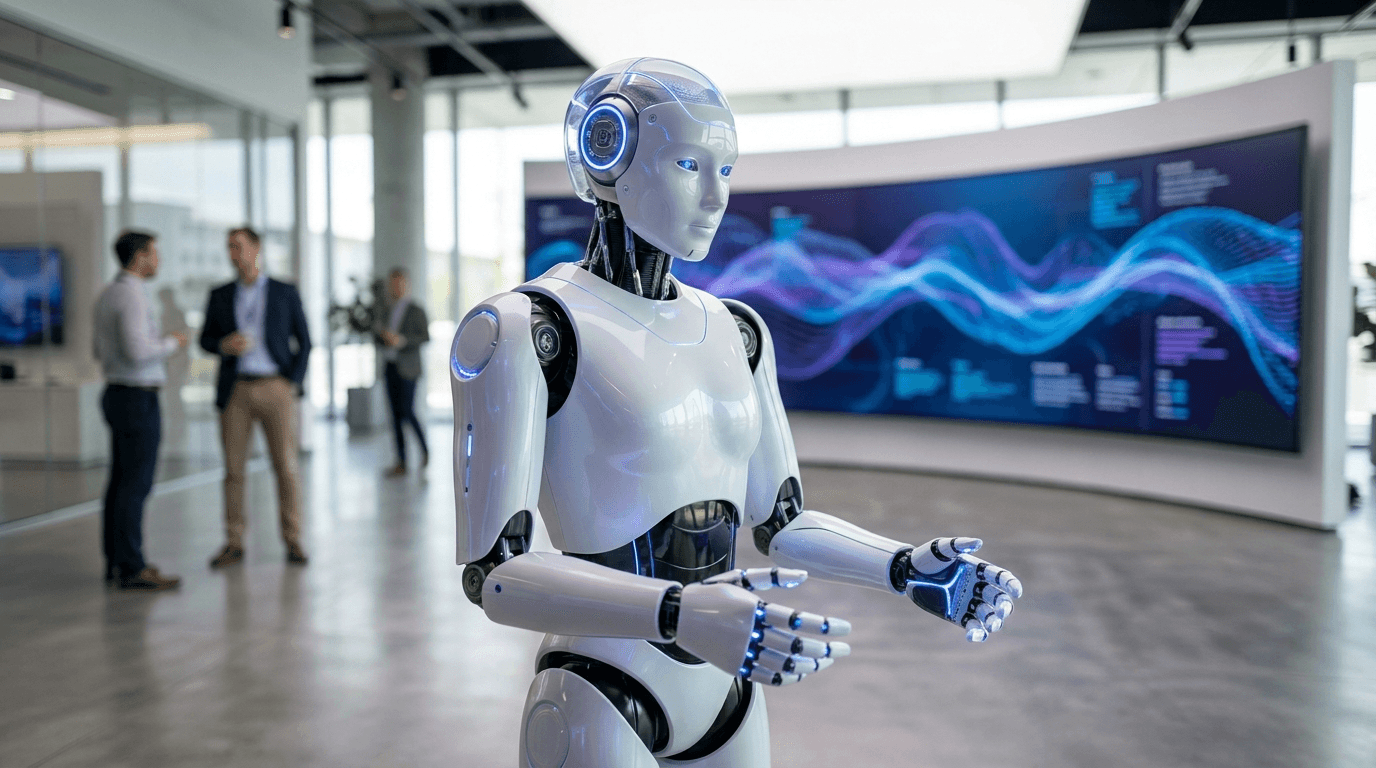
Ask about a humanoid robot and you'll usually get height, weight, and hand payload. But there's a less visible spec that rarely makes it into the datasheet: what the robot actually thinks with. Robbyant / 蚂蚁灵波科技, an embodied-intelligence unit of Ant Group — the company behind the Alipay payment service — has placed its bet on exactly that layer: not the body, but the model that turns a camera feed into a hand movement.
A full stack instead of one part
Most humanoid manufacturers compete on hardware — degrees of freedom, joint torque, battery runtime. Robbyant builds a different layer entirely: software, spanning spatial perception of the environment through to action models and feedback from the surroundings. In practice that means the company isn't developing one object-recognition algorithm — it's building the full "see it, understand it, grasp it" pipeline, one that can in principle be transplanted onto another manufacturer's chassis.
LingBot-VLA: trained on tens of thousands of hours
The flagship product is the LingBot software platform, and specifically the LingBot-VLA model (vision-language-action). It's trained on tens of thousands of hours of recorded real-world manipulation — not simulation, but actual hands-on interaction with objects. In practice, this means a robot running this model can generalize a task like "pick the item up off the table" to objects it has never encountered before, rather than simply replaying a memorized arm trajectory.
LingBot-Vision: perception as a standalone module
Separately, the company ships the LingBot-Depth perception module (listed in the catalog as the LingBot-Vision line) — an open 3D-vision component that can be bolted onto another maker's robot so it starts perceiving scene depth instead of a flat image. For an integrator who has already picked a chassis from one manufacturer but isn't happy with its object-recognition quality, this is a ready-made block rather than a from-scratch project.
Why license to competitors
What sets Robbyant apart from most players in the market is its revenue model. The company doesn't just showcase its own R2 humanoid platform, built to develop a universal robot-control model — it simultaneously licenses industry-specific commercial versions of that model to third-party robotics manufacturers. Revenue, in other words, doesn't come only from selling hardware but also from selling software that runs on someone else's hardware — a model long established in the auto industry (autonomous-driving suppliers sell their stack to any automaker), but still rare in robotics.
What this means for a buyer
If you're evaluating a humanoid for a pilot deployment — in logistics, at a service point, on a production cell — the key question isn't only "what does this robot do out of the box," but also "what model is it running, and how does it get updated." Development at Robbyant's scale, trained on tens of thousands of hours of real manipulation, improves the odds that a robot adapts to a new task without months of manual fine-tuning on-site. For a business owner without a deep technical background, the practical takeaway is simple: the smarter the perception and motion-planning layer, the fewer engineers you'll need on the floor to configure the robot for your specific warehouse or shop. The parent company's context is telling too: Ant Group is one of China's largest fintech players, and its move into robotics through Robbyant signals that interest in embodied intelligence today comes not only from traditional engineering firms but from tech giants experienced in processing huge volumes of user-behavior data — and modeling a robot's behavior in the physical world requires exactly the same kind of statistical learning at scale, just trained on hand movements and objects on a table instead of clicks and transactions. For an integrator comparing several humanoid platforms side by side, it's worth asking each supplier directly which control model runs inside — an in-house closed development or a licensed solution like LingBot-VLA — because that choice directly determines how fast behavior can be adapted to a non-standard warehouse or shop-floor operation after installation. A practical tip for anyone choosing a robot like this for the first time: ask the supplier to show not just a demo video but a live scenario with an unfamiliar object — that's exactly where the difference between a genuinely trained, generalizing model and a scripted trick becomes obvious immediately, without a long technical explanation.
These factories are on the route of our Robotics Expedition — see them in person, not just on video.