
гуманоидные роботы · QIO Robotics · автономная розница · вендинг
QIO Robotics O1: the humanoid that runs its own storefront
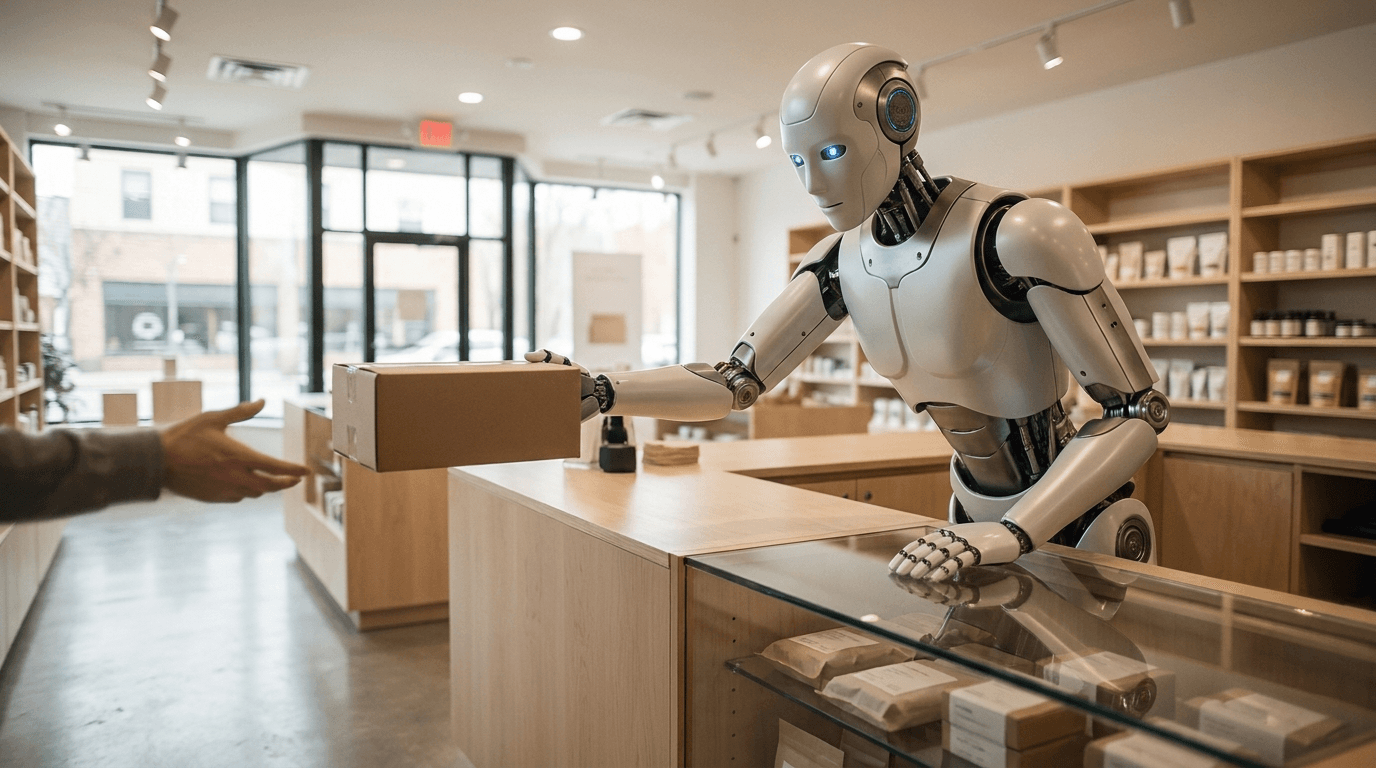
Most humanoids shown to the public either walk a stage or unload boxes in a warehouse. QIO Robotics / 启物科技 picked a third scenario: a robot that runs an entire retail transaction on its own — finding the item, picking it up, and handing it to the customer with no cashier and no operator standing by.
Who's behind the company
QIO Robotics was founded in 2024 in Beijing — young even by an industry where many players still count their history in single decades. But the team is unusual: graduates of Tsinghua and Peking University, specialists from the Chinese Academy of Sciences, plus engineers with backgrounds at Huawei, Microsoft and Baidu. For a non-technical reader, the reason this matters is simple: the company's focus isn't the body mechanics, which plenty of manufacturers already handle — it's the "brain": a proprietary inference framework and an energy-efficient on-device inference system that doesn't need a constant cloud connection.
O1: the numbers and what they mean in practice
The flagship O1 (internal name Qinglong) is a full-size humanoid, 185 cm tall and weighing 80 kg. It has 43 active degrees of freedom — 43 independently controlled joints and axes, which together produce motion close to human smoothness rather than the jerky, mechanical look of earlier robots. Peak actuator torque reaches 400 N·m: that's the unit measuring rotational force at a joint, and the higher it is, the more confidently the robot can hold and carry a heavy load without buckling at the knee or spine.
O1 walks at up to 1 m/s — a walking pace, not a sprint — while still able to carry up to 40 kg. For scale, that's roughly a full week's grocery bag for a family of four. For environmental awareness, O1 carries a 3D lidar and depth cameras that together give it a real-time volumetric map of the room rather than a flat image, so it correctly judges the distance to a shelf, a customer, or an obstacle in its path.
An autonomous storefront, not just a demo
O1 has already been demonstrated running an autonomous retail point: the robot independently carries out a commercial transaction, from offering a product to handing it over. That's fundamentally different from the usual service robot that walks you to a shelf or shows ads on a screen — this is a full service cycle with no human on-site at all. The QIO humanoid line in the catalog deserves to be evaluated from exactly this angle — not "how the robot looks," but "what operation it can carry out unattended."
Who this actually makes sense for today
Use cases here run toward next-generation vending, showroom consulting, and pickup points in awkward layouts where a standard locker-wall vending machine doesn't fit or doesn't suit the product size. A business owner evaluating store-point automation should compare not just "what one robot costs," but what it costs to staff an equivalent point across shifts — that comparison is what actually determines the economics of pilots like this one. Worth separately noting is the energy-efficient inference — running the neural network directly on the robot itself, without constant round-trip data transfer to the cloud. For a retail point, that matters: a delay of even a fraction of a second between a customer's request and the robot's response reads to people as "laggy" technology and directly undermines trust in the format. On-device inference also removes dependence on internet quality at a given location — and for retail spots inside malls or transit hubs, unstable connectivity is usually the weak point of any cloud-based automation. Combined with 3D environmental awareness from the lidar and depth cameras, this lets the robot behave predictably even in a crowded, noisy space, where sensors have to tell a genuine customer apart from a random passerby in frame. One more practical tip for a pilot project: before purchasing, it's worth running a peak-load scenario — the busiest hour of foot traffic in a mall or transit hub — because that's exactly when the load on recognition and route-planning is highest, and that's where you see whether the platform actually holds its stated numbers under real conditions rather than a controlled demo.