
переработка птицы · роботизированная обвалка · весовая сортировка · пищевое оборудование
From slaughter to sorting: what a fully equipped Chinese poultry line looks like
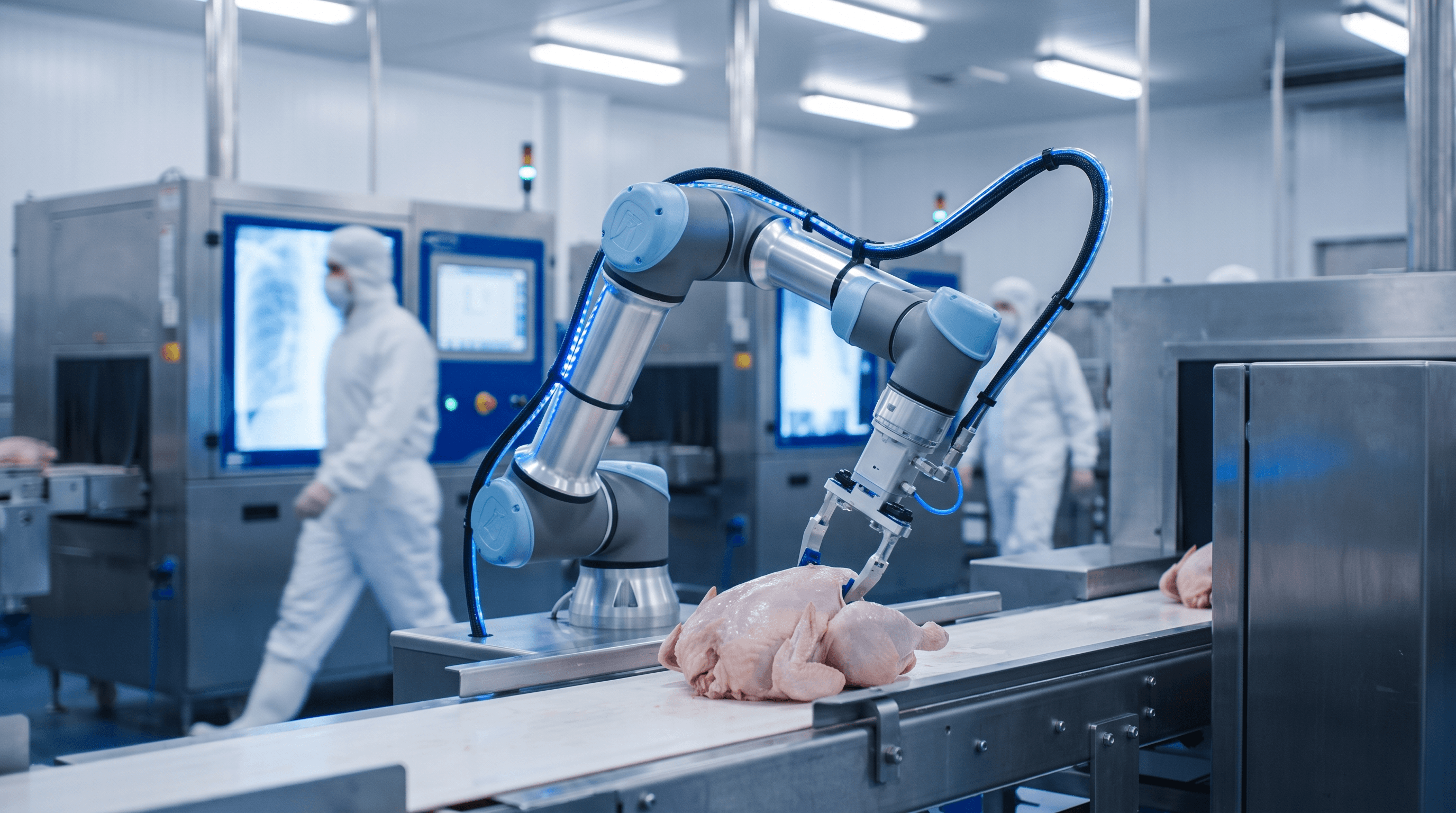
A poultry-processing line rarely runs on one type of equipment — it's usually a chain of several specialized stations, each with its own job and its own supplier. The line between "automated" and "robotic" here matters a great deal: the former runs a fixed conveyor program, the latter recognizes an object and adapts its motion to that object's specific shape. Let's walk the line in order — from slaughter to packaging.
The start of the line: slaughter without a manipulator
Qingdao Raniche Machinery Technology is a fully Chinese manufacturer of poultry slaughter lines with 30 years of experience, a 40,000 m² plant, and shipments to more than 60 countries. The line works as a turnkey solution — stunning, scalding, plucking, evisceration — with a capacity range from 300 to 15,000 birds an hour, a spread that determines whether the line fits a small shop or a large combine. An important distinction: Raniche's equipment is automated (conveyors run on a set program) but not robotic — there's no manipulator that recognizes and adapts to an individual carcass.
The middle of the line: where robotics starts
This is where the approach diverges. Mayekawa China, the Chinese unit of Japanese manufacturer Mayekawa, produces the DAS line of robots for fully robotic poultry deboning: manipulators with video analysis and X-ray measurement remove meat from the bone with no operator involved. Notably, it offers a specialization in turkey thigh (the TAKIDAS model) — a rare niche on the Chinese market — while the TORIDAS II, YIELDAS 3000-E1 and WINGDAS models handle chicken thigh, breast and wing deboning respectively.
Foodmate is another global leader in robotic turkey and chicken deboning, operating in China through its H-Plus Machinery China structure. The core technology is X-ray measurement of carcass geometry before the cut: the system "sees" through to the skeleton and feeds coordinates to a servo-controlled knife that cuts with a precision unattainable by manual deboning at conveyor speed. The flagship product is the ULTiMATE Whole Leg Deboner for whole-leg deboning.
Why X-ray and video analysis matter so much in practice: poultry carcasses aren't identical in size or bone shape, and a knife running a single fixed trajectory without measurement either leaves meat on the bone (lost product yield) or cuts into the bone (defects and a risk of bone fragments in the product). Measuring before the cut solves both problems at once.
The end of the line: weight control without a manipulator
The final station is weight sorting and quality control, and robotics isn't needed here either — the job is handled by conveyor scales and sensors. Nanjing Eruis Equipment, operating since 1980, specializes in automatic conveyor weight sorting of poultry with ML-based weighing accuracy monitoring. Guangdong Easyweigh Equipment supplies weight graders and quality-control systems (metal detectors, X-ray inspection) for chicken, wings, meat and seafood. Dongguan Coso Electronic Tech, founded in 2005, produces checkweighers and X-ray inspection at a 4,000 m² plant. Shigan Industrial covers the compact end — weight sorters in the 5–1,500 g range for small and mid-size lines.
Assembling a line from multiple suppliers
Equipment for slaughter lines, robotic deboning and weight sorting is grouped under the corresponding catalog sections — end to end across the processing cycle. The general selection principle: slaughter and weight sorting are conveyor automation with a straightforward "birds or kg per hour" capacity metric, while deboning is genuinely robotic, per-unit work, where cutting precision on non-identical carcasses matters more than raw belt speed.
What to weigh before purchasing
When planning a line for a specific plant, split the budget into three categories from the start: conveyor-based slaughter automation (Raniche), robotic deboning (Mayekawa China, Foodmate), and weight control (Eruis, Easyweigh, Coso, Shigan) — three different equipment classes with different degrees of robotization, and accordingly different payback logic for each stage of the line. When planning a purchase, it's also worth accounting for the fact that these three equipment classes need different levels of on-site service support: the conveyor mechanics of a slaughter line and weight sorters follow a standard preventive-maintenance schedule familiar to most food-plant technical teams, while robotic deboning lines with X-ray measurement and servo drives require more specialized staff skills — sensor calibration, updates to the carcass-geometry recognition software. That's why, when choosing a robotic deboning supplier, it makes sense to clarify technical support and operator training terms upfront, rather than treating that question as secondary to the equipment purchase itself.