
гуманоидные роботы · Noetix Robotics · образовательная робототехника · доступные роботы
Noetix Robotics: a humanoid starting at 9,998 yuan, and a marathon runner on the same platform
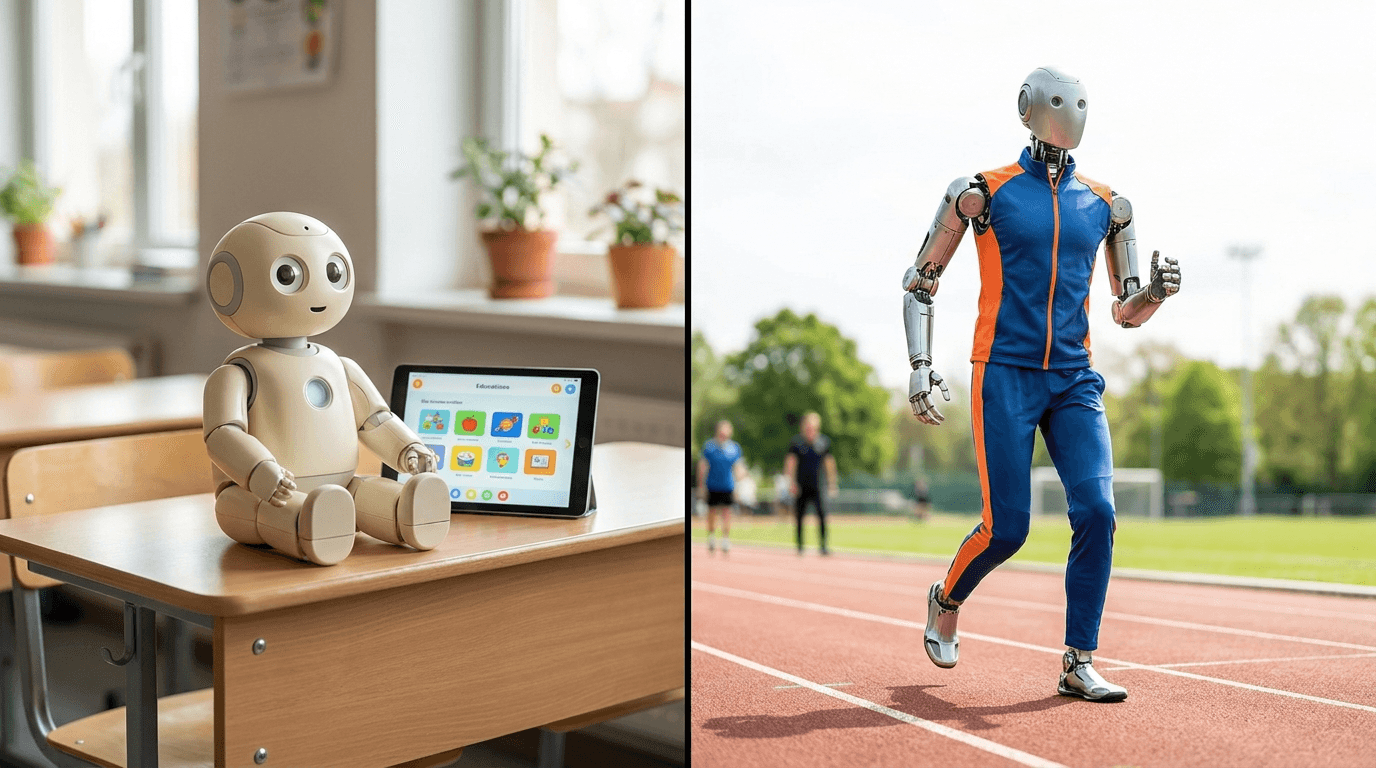
Conversations about humanoid robots usually run into the price question fast, and the answer is usually disheartening: flagship models cost as much as a luxury car. Noetix Robotics / 松延动力 shows the market isn't that uniform anymore — the company fields both an industrial flagship that runs a marathon and a model priced closer to a good laptop.
A young company with a fast start
Noetix Robotics was founded in September 2023 in Beijing — entering the humanoid market later than many competitors, yet it has already built a notable order book. "Over 2,500 orders" for the N2 model is a rare figure for the industry: most humanoid makers are still talking about one-off pilot shipments, not orders counted in the thousands.
N2: tested on a route, not just in a lab
The N2 flagship took part in the world's first humanoid half-marathon — an event where, unlike demo videos shot under controlled studio conditions, the robot doesn't get to pause: it has to hold balance, thermal management and battery charge over hours of running a real course, with uneven surfaces and unpredictable lighting. Finishing a distance like that is a far harsher stress test of gait stability and actuator thermal behavior than a standard trade-show demonstration.
Bumi: an affordable humanoid without a feature compromise
The line's second model, Bumi, is a fundamentally different product. At 94 cm tall and 12 kg, Bumi is nearly half the size and weight of an adult human, making it safe to operate in a classroom or a home around children. The manufacturer's stated starting price — 9,998 yuan (needs confirming for ruble equivalent and full turnkey delivery cost) — is an order of magnitude below most full-size humanoids on the market. Yet Bumi still ships with voice recognition and drag-and-drop visual programming: a child or student can build a sequence of robot actions by dragging command blocks, no coding required.
Why field two such different robots under one brand
The split isn't accidental — it's a deliberate strategy to cover two different budgets and use cases at once. N2 demonstrates the company's technological maturity and is a candidate for industrial and research pilots where platform endurance matters. Bumi is the entry point for the education and entertainment segment, where price and simplicity decide the outcome, not arm payload. Both humanoids are listed in the Noetix Robotics catalog card.
What this means for a buyer
If the goal is equipping a robotics club, a children's tech center or a demo zone, an affordable model like Bumi removes the main barrier to entering the humanoid category — price. If the goal is a pilot in a real working environment where stability and endurance matter, look at N2 and its proven record of long, continuous distance running rather than spec-sheet numbers alone. One more detail that often gets lost in the price discussion: Bumi fits not just entertainment but educational formats too — drag-and-drop command-block programming removes the entry barrier for children who haven't yet studied text-based code, while voice recognition lets teachers build dialogue scenarios with the robot as part of a language or public-speaking class, not just a narrowly defined robotics course. For a school or STEM center that already owns one or two flagship humanoids for demonstrations but lacks the budget to put that kind of hardware in every classroom, an affordable model like Bumi solves exactly this scaling problem: several Bumi units spread across different rooms cost noticeably less than a single full-size humanoid, while still delivering a comparable curriculum experience around robot interfaces and programming logic. It's also worth checking exactly what's included in the base configuration versus purchased separately — a charging dock, extra sensor modules, teacher-facing curriculum materials — since the total cost of equipping a classroom or lab can differ noticeably from the robot's stated starting price alone.