
IPO · машинное зрение · Гонконг · Китай
Mech-Mind: machine vision as humanoid infrastructure after its Hong Kong IPO
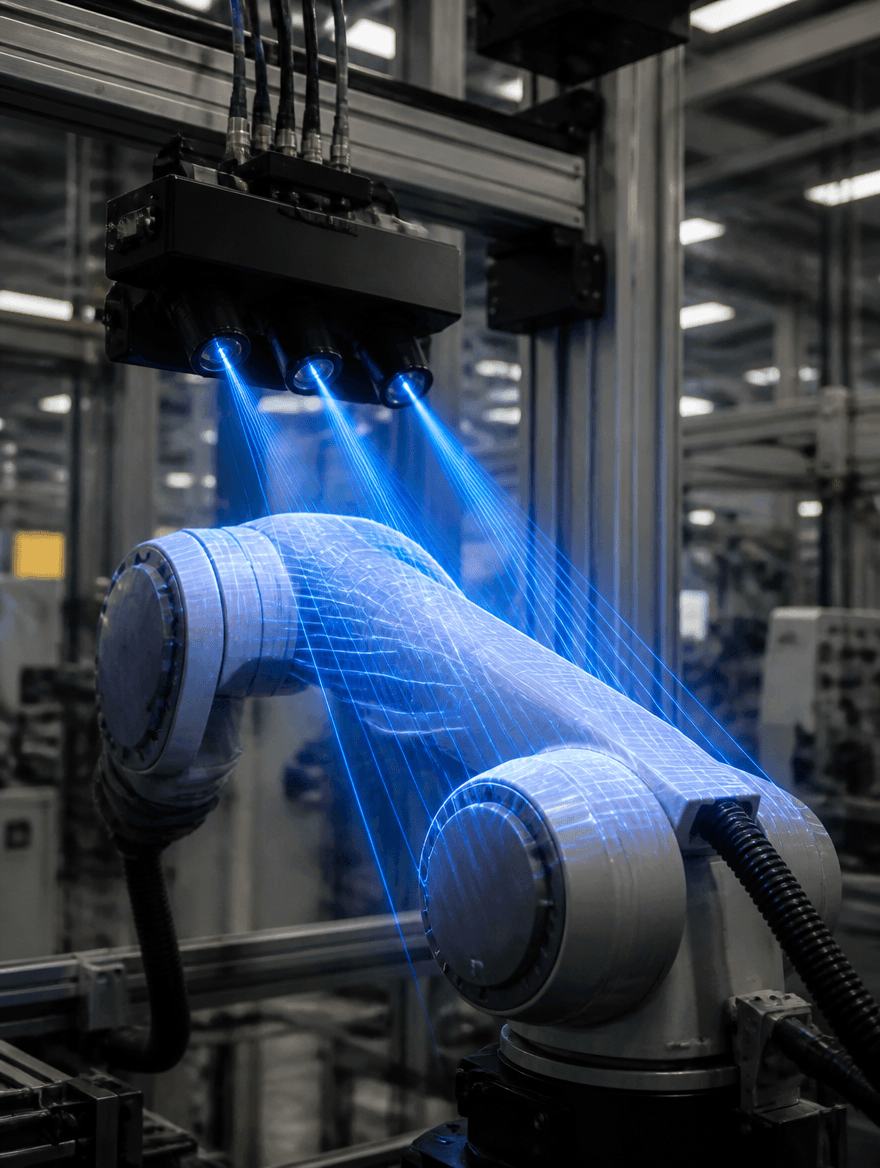
On September 1, 2026, a listing took place on the Hong Kong Stock Exchange worth remembering as a milestone: Mech-Mind Robotics became the first publicly traded embodied-intelligence company on that exchange. The company priced at the top of its range — HK$101.7 per share — for a final market capitalization of HK$12.7 billion.
Oversubscription that speaks for itself
The real indicator of market appetite wasn't the pricing itself but the demand for it. Retail investor applications came in at 3,835 times the number of shares on offer — a level of oversubscription rarely seen even at the hottest tech IPOs. That signals retail investor interest in embodied intelligence in China has moved from curiosity to a mass speculative and simultaneously long-term fascination.
A company that doesn't build whole robots
Here's a fact worth pausing on: Mech-Mind doesn't manufacture complete robots. The company supplies what could be called an "eye-brain-hand" bundle — 3D-scanning-based machine-vision components and control algorithms that plug into other companies' manipulators and production lines. This positioning echoes D-Robotics and its Sunrise chips: competition in embodied AI is increasingly shifting from "who builds the flashier chassis" to "who has the most precise sensing and compute system inside."
Why vision is critical infrastructure
Machine vision isn't an optional add-on to an industrial robot — it's literally its ability to navigate the real world, where parts don't sit perfectly aligned, lighting shifts, and assembly-line tolerances don't always match the theoretical drawings. A system that can identify an object's position in three-dimensional space in real time and hand precise coordinates to a manipulator determines whether a robot can perform complex tasks at all, beyond rigidly programmed repetitive operations.
That's why a mature machine-vision system, validated across tens of thousands of cycles, becomes a kind of infrastructure layer — as foundational to humanoids and industrial manipulators as the operating system once was to personal computers.
An IPO that opens a season
Mech-Mind's listing is also notable because it appears to open an entire wave of public listings from China's embodied-intelligence sector. AgiBot and X Square Robot are already preparing their own IPOs, taking Mech-Mind's precedent as a reference point. That's a logical development: after several years of private venture rounds, the industry has reached a stage of maturity where companies with clear revenue and a manufacturing base start seeking public capital markets, and investors look for a way into the sector without waiting for the next closed round reserved for select funds.
What this means for the rest of the industry
A successful IPO with a HK$12.7 billion valuation and enormous oversubscription sets a benchmark for valuing the whole niche of embodied-AI component suppliers — makers of compute platforms, sensors, actuators, and vision systems. For investors, it signals that betting on the industry's infrastructure layer, not just on finished humanoid makers, can be just as lucrative. For the industry itself, it confirms that specializing in one narrow but critical component of the technology stack can get a company to public markets no worse — and sometimes faster — than trying to build a whole robot from scratch.
Retail investors as the industry's new engine
The 3,835-times oversubscription level deserves its own analysis, because behind that number lies more than just hype around one company — it points to a much broader shift in how mass retail investors in China and Hong Kong behave. Retail investors are increasingly treating embodied intelligence not as a narrow technical niche reserved for professional venture funds, but as a full-fledged investment trend on par with electric vehicles or semiconductors a few years ago. That creates a kind of feedback loop: the more retail capital flows into listings like this, the more incentive the next companies in the sector have to accelerate their own IPO plans while the window of market enthusiasm stays open.
For the industry as a whole, that means public capital markets are likely to become just as significant a funding source for mature embodied-AI companies over the next year or two as traditional venture rounds — provided the company, like Mech-Mind, has clear revenue and a manufacturing base rather than just a polished pitch deck.
Profiles of companies supplying machine-vision systems and other key components for industrial and humanoid robotics can be found in the manufacturer catalog on the Aura Robotics website.