
малайзия · полупроводники · сертификация · клинрум · промышленные роботы
Malaysia: certifying robots for semiconductor packaging
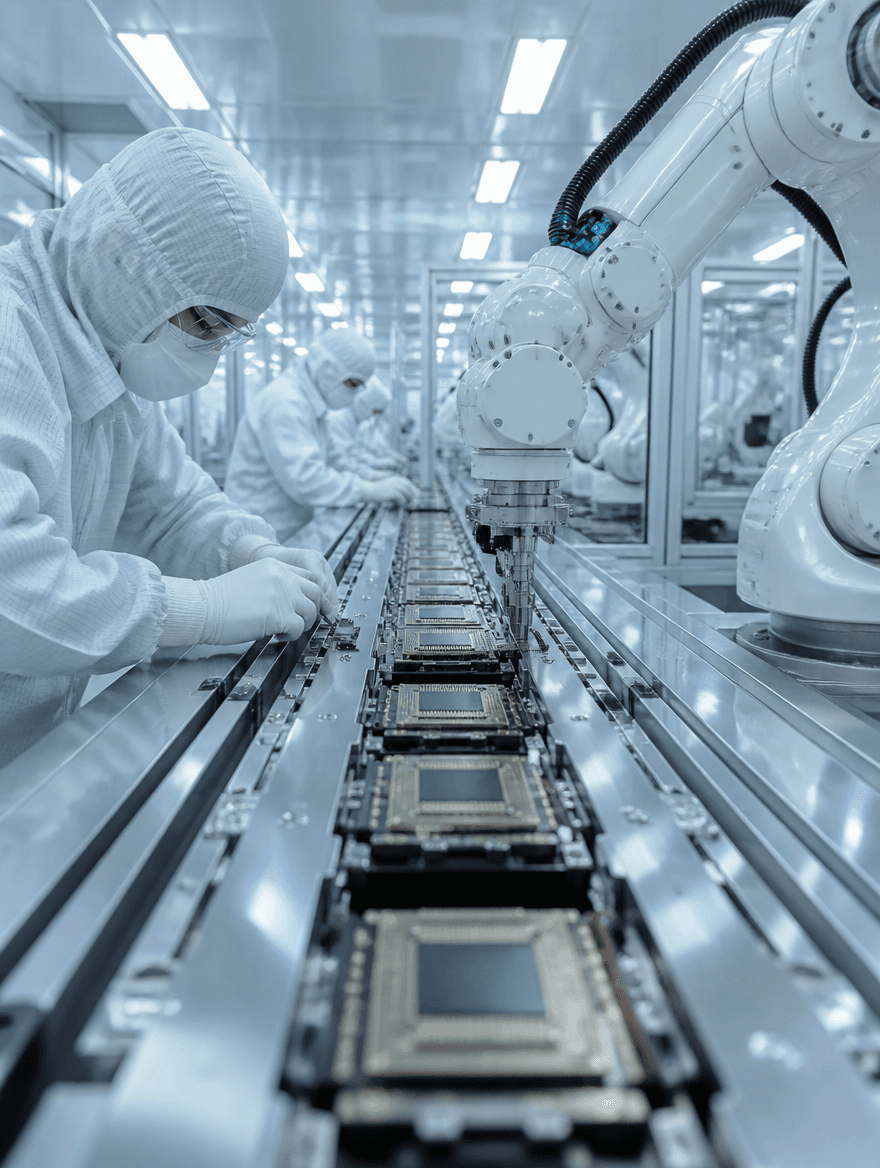
Malaysia holds roughly 13% of the global semiconductor outsourced assembly and test (OSAT) market, home to Intel, Infineon, Texas Instruments plants and dozens of contract manufacturers around Penang and Kuala Lumpur. This isn't wafer fabrication — that part of the chain belongs to Taiwan, South Korea, and the US — but the final, extremely cleanliness- and precision-sensitive stage: dicing wafers into individual dies, packaging them, and electrical testing.
Why certification here is especially hard
Working in an ISO Class 5–7 cleanroom imposes requirements that don't exist in ordinary industrial manufacturing: robots must minimize particle shedding (outgassing), withstand multi-hour cycles without overheating drive components, and operate with positioning tolerances measured in single-digit microns when handling dies thinner than a human hair. Any manipulator entering such a line must clear not just standard industrial safety certification (ISO 10218 for robots, ISO/TS 15066 for collaborative applications) but also SEMI industry cleanroom standards, which carry more weight in the semiconductor world than generic ISO norms.
The trouble is there are several such certifications at once, issued by different bodies (SEMI International, Malaysia's Department of Occupational Safety and Health, and the internal audits of the customers themselves, such as Intel or Infineon), and a robot manufacturer must clear them in parallel rather than in sequence — Intel's acceptance test protocols for new line equipment, for instance, are often stricter than baseline SEMI standards.
Who benefits from this complexity
The high certification bar favors a narrow circle of established suppliers — Japanese (Yamaha Robotics, Denso, Fanuc) and Swiss (ABB) makers of precision manipulators who have worked with the electronics industry for decades and already passed audits with the largest customers. Chinese robot manufacturers, aggressively advancing in general industrial automation, are noticeably weaker in semiconductor packaging precisely because of the long qualification cycle: getting cleared for an Intel line in Penang is a matter of years, not months, and requires reference installations that younger Chinese brands still lack.
The government's role
Malaysia's government treats the semiconductor sector as strategic and, in 2023–2024, launched a National Semiconductor Strategy targeting tens of billions of dollars in investment through the end of the decade. Part of that strategy is building local expertise in certifying automation equipment, so the country isn't solely dependent on foreign auditors when qualifying new lines — though as of 2025–2026, Malaysia's certification system still largely leans on international SEMI standards rather than domestically developed norms.
What it means for the automation market
Malaysia's case is a good illustration of how high technical barriers to entry preserve market structure: even with booming demand for automation in semiconductor assembly, new players enter this market slowly, because certification itself becomes a competitive barrier no less significant than price or robot performance.
A practical example of the qualification cycle
To understand the real timelines, it's worth walking through a typical path for a new manipulator entering a chip-packaging line. First, the manufacturer clears baseline SEMI certification at the component level — usually several months of lab testing for particle emission and electromagnetic interference. The equipment then moves to a pilot installation at the end customer's site, where plant engineers track positioning stability and defect rates against previously used equipment over weeks or months. Only after successfully clearing that stage does the robot earn "qualified supplier" status for that specific line — and that status generally doesn't carry over automatically to other plants of the same conglomerate in other countries; each requires its own local review.
Malaysia's inspector-training specifics
Malaysia's Department of Occupational Safety and Health has been expanding its ranks of inspectors specializing specifically in automated electronics-manufacturing equipment in recent years, since generalist industrial safety inspectors aren't equipped to assess the particular risks of cleanroom robotics. That's a slow process — training a narrowly specialized inspector takes years — and it's this shortage of qualified local oversight personnel, rather than any lack of will to regulate the sector, that remains one of the bottlenecks in Malaysia's certification system.
More on suppliers of precision manipulators for the electronics industry can be found in our manufacturers catalog.