
китай · по для роботов · ros · технологический суверенитет · open source
M-Robots OS: China's own ROS as a technological sovereignty strategy
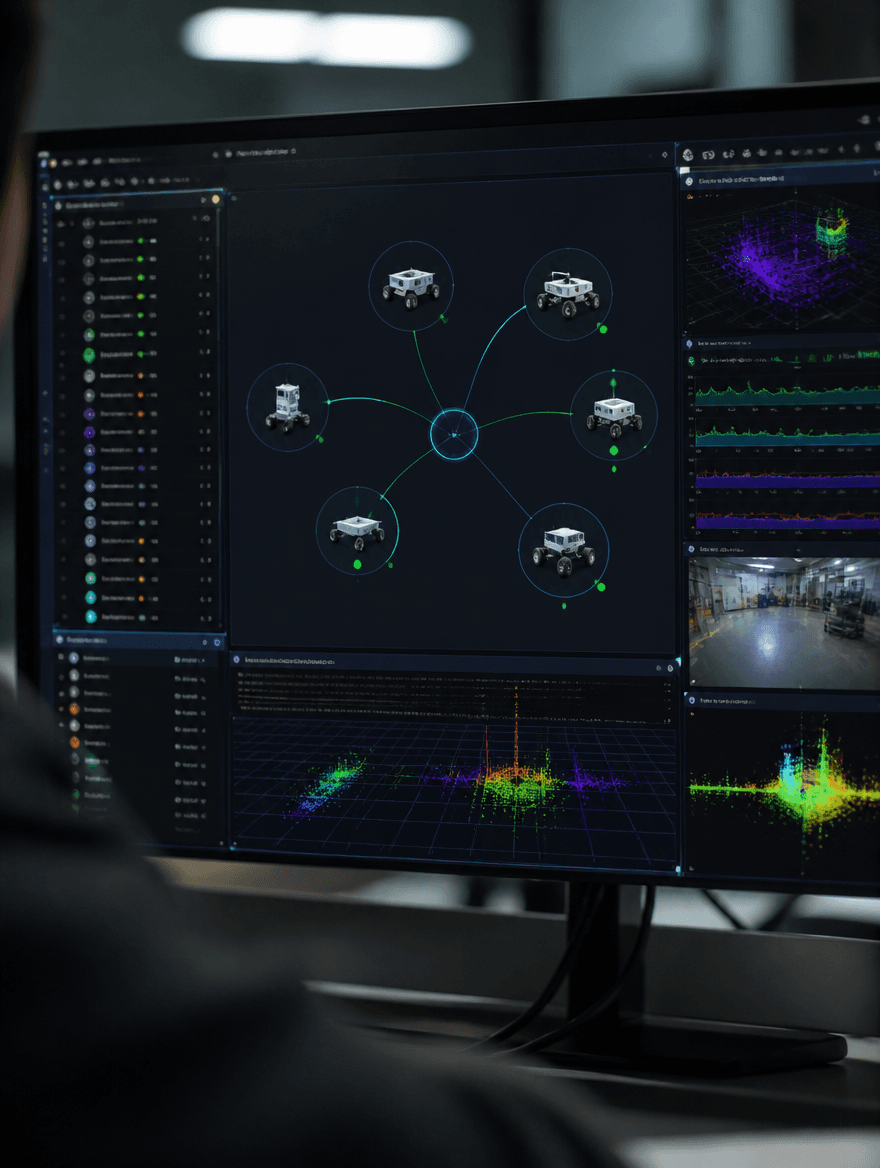
ROS (Robot Operating System) is the de facto global standard middleware for robotics, originally developed at Stanford and maintained by the American nonprofit Open Robotics. Nearly every university robotics course and the vast majority of commercial robots worldwide rely on ROS1 or its successor, ROS2, in some form. For China, which is building a technological sovereignty strategy around chips and EV batteries, having critical infrastructure for its growing humanoid industry depend on a software platform developed and maintained outside the country looks like a strategic vulnerability on the same order as reliance on foreign semiconductors.
What M-Robots OS actually is
The answer to that risk is the M-Robots OS platform, which became fully open source in July 2025. By the end of that same year, its developer handed control of the platform to the independent OpenAtom Foundation — a Chinese analogue of the open-source governance model where decisions are made by a distributed committee rather than a single company. Today, 16 specialized working groups develop the platform, signaling an attempt to build an institutional rather than corporate development model — closer in spirit to how, say, the Linux Foundation is run, rather than a model where a single vendor dictates the roadmap.
It's important to understand this isn't a "raw fork" of ROS renamed for a technological sovereignty checkbox. The key architectural detail is M-Robots OS's compatibility with ROS1, ROS2, and the relatively new Dora-rs ecosystem (a lightweight, real-time-oriented robotics framework gaining traction as an alternative to the heavier ROS2) all at once. This layered compatibility cuts migration costs by roughly 80% for companies that have already written code against existing standards — meaning a move to M-Robots OS doesn't require rewriting an entire codebase from scratch, but rather building an adaptation layer atop the body of engineering work a team has already accumulated over the years.
Why compatibility matters practically
Compatibility with existing ecosystems is a critical engineering decision, because a clean ROS replacement without backward compatibility simply wouldn't have been adopted by developers: the thousands of ready-made packages, drivers, and algorithms accumulated by the global ROS community over a decade and a half would become inaccessible with a full break from the ecosystem. M-Robots OS's developers clearly chose an "embrace and extend" strategy over "replace from scratch" — an approach that sharply lowers the barrier to entry for Chinese robot manufacturers who want to reduce dependence on foreign software but aren't willing to sacrifice access to the accumulated tooling ecosystem.
The state context
Embodied AI and robotics are explicitly named a national strategic priority in China, backed by preferential financing and dedicated industrial parks. Beijing places control over the entire supply chain of key components — including software infrastructure — in the same category as chips and EV batteries, industries where China has already achieved global dominance. M-Robots OS in this context isn't an isolated technical project but part of a broader program to eliminate dependence on foreign infrastructure at every layer of the robotics stack.
What it means for the global market
If M-Robots OS genuinely gains critical mass among developers outside China, the global robotics industry will get its first real alternative to ROS in a long time — rather than just a regional fork. It's premature to say so now, since the platform is still at an early stage of ecosystem development — but the architecture of the solution itself (openness, compatibility, institutional rather than corporate governance) looks more considered than many previous attempts to build national alternatives to Western technology standards.
More on the software platforms powering today's robots is available in our manufacturers catalog.