
гуманоиды · квадропеды · Китай · инжиниринг
LimX Dynamics: why the road to a bipedal humanoid starts on four legs
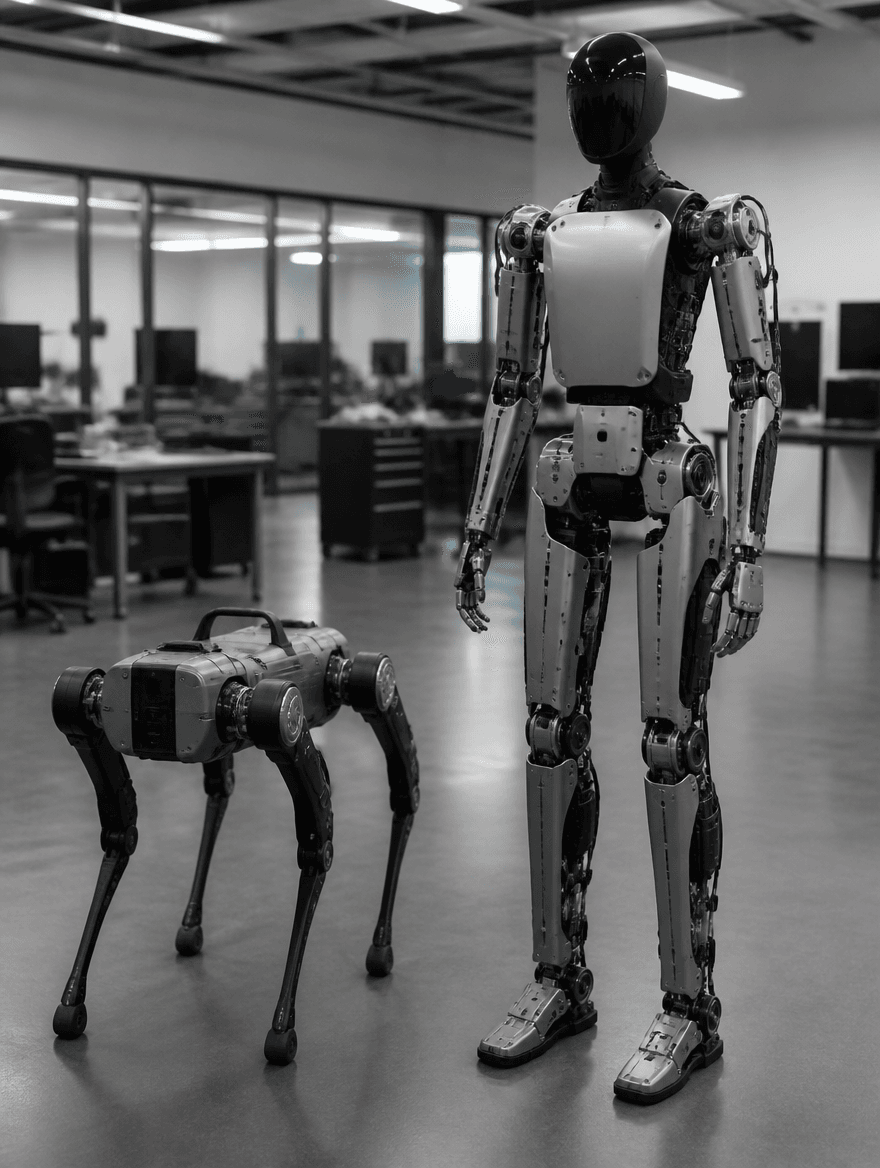
Balancing on two legs is engineeringly harder than on four — that's not a marketing line, just physics of weight distribution and support area. That's precisely why a large share of the teams now showing off confidently walking humanoids didn't start with a bipedal design at all — they started with a much simpler platform, a robot dog. LimX Dynamics is one of the clearest examples of that path.
Four legs as a training ground for algorithms
A quadruped isn't a side product to fund the team while engineers dream of a "real" humanoid. It's a deliberate methodology: on a platform with four points of contact, developers can safely work out balance algorithms, response to uneven terrain and external pushes, without the machine simply falling flat on its face at the slightest mistake. Four legs provide a margin of stability a bipedal design doesn't have — and that margin is what lets a team iterate faster and more safely.
LimX Dynamics followed exactly this route: first compact, lightweight quadruped platforms for research labs and industrial pilots, and only afterward, the transfer of accumulated balance algorithms onto a bipedal architecture. This isn't a one-off coincidence — Unitree, another prominent player in China's robot-dog market, took a similar route before moving into humanoids.
What actually carries over into a bipedal design
The key question is what exactly from four-legged development stays useful once the architecture switches to two legs. The answer lies less in mechanics and more in the software stack: model predictive control algorithms, real-time balance estimation, and response to unexpected disturbances — a push, uneven ground, a slippery patch of floor — transfer with far fewer modifications than one might expect.
The body itself, of course, has to be redesigned from scratch: different mass distribution, different joint kinematics, and a fundamentally different challenge of maintaining balance while resting on just two contact points instead of four. But the software foundation — how the robot fundamentally "thinks" about balance — turns out to be a shared layer that can be reused, speeding up entry into the humanoid market.
Coincidence or pattern
There's a notable correlation worth flagging: today, the most stable-walking humanoids on the market do indeed belong to companies with a history of working on four-legged platforms first. Formally that could be a coincidence, but the underlying engineering logic is convincing enough not to dismiss it as chance.
The industry loves to frame humanoids as the end goal and quadrupeds as a transitional stage. But the experience of LimX and its competitors suggests a more precise framing: a quadruped isn't a stop along the way to a humanoid — it's a proving ground where a critical competency gets built, one without which a bipedal robot simply won't stand steadily.
The commercial logic of a dual product line
There's also a very practical reason to keep both directions in the portfolio. Quadrupeds already generate revenue today — pipeline inspection, warehouse patrolling, construction sites where four legs handle uneven terrain better than wheels. Humanoids remain a far more capital-intensive, longer-horizon bet where the path to scale commercialization will take more time.
That portfolio structure lets a company like LimX fund the expensive development of a bipedal platform using cash flow from an already-working quadruped business, rather than depending entirely on the next venture round. It's a fairly rational strategy in an industry where development cycles run for years and investor patience often doesn't.
Investors are reading the same logic
Notably, venture capital has increasingly started asking startups exactly this question: what experience did the team have before taking on a humanoid. A company that can point to a track record of successful, already-commercialized quadruped platforms looks like a far less risky bet to an investor than a team starting straight off with an ambitious bipedal project and no intermediate step. This fits a broader trend across the industry: capital is getting pickier and paying closer attention not to how polished a presentation looks, but to the depth of the engineering foundation behind it.
For LimX Dynamics, that means the company's quadruped past isn't dead weight — it's part of the investment story worth telling potential partners and clients as proof of maturity, rather than a sign that the "real" humanoid is still somewhere down the road.
Anyone wanting to compare architectural choices across quadruped and bipedal manufacturers can check the robotics manufacturer catalog, covering companies at different stages of this journey.