
сенсоры · лидар · компьютерное зрение · робототехника · технологии
LiDAR versus cameras: how different architectures let a robot see the world
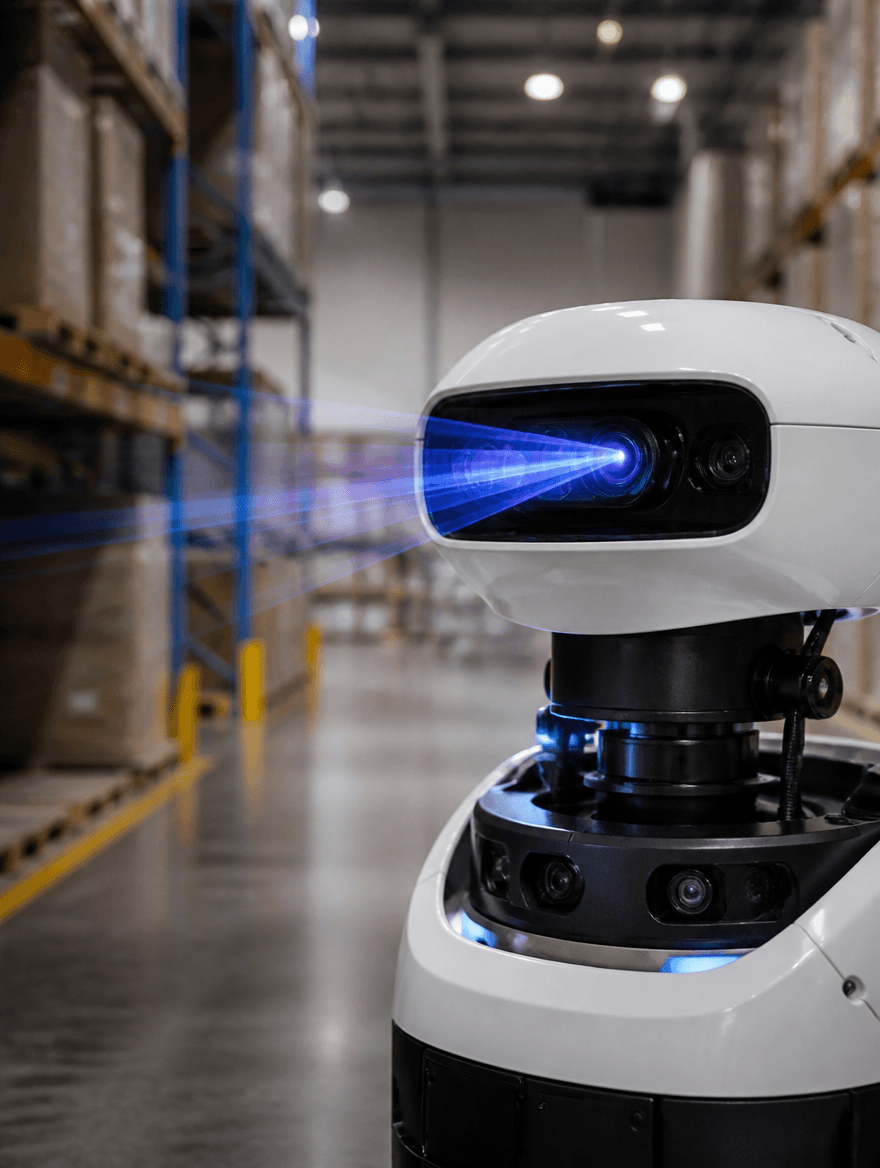
When it comes to how a robot "sees" the space around it, developers split into two camps: some bet on LiDAR (light detection and ranging), others follow Tesla's path and rely entirely on cameras plus neural-network image processing. The debate isn't abstract — it determines a robot's price, its reliability across different conditions, and even the developing company's engineering philosophy.
How it works physically
LiDAR emits laser pulses and measures their return time after reflecting off objects, building a precise 3D map of the space — a point cloud with a known distance to each point. This works regardless of lighting: LiDAR sees equally well in a pitch-dark warehouse and under bright midday sun outdoors, because it doesn't rely on ambient light — only on its own laser beam. The tradeoff is cost and mechanical complexity: spinning or solid-state LiDAR units remain noticeably pricier than camera modules and demand more careful mounting so vibration doesn't throw off calibration.
Cameras, by contrast, are an order of magnitude cheaper and mass-produced thanks to the smartphone industry, but they demand far more sophisticated image-processing algorithms: a neural network has to reconstruct the scene's 3D structure from a flat image (or a pair of images in a stereo setup), relying on textures, shadows, and parallax. In darkness or backlighting (sun shining directly into the lens), that reconstruction's quality drops sharply.
Why the environment dictates the choice, not ideology
In practice, the decision is most often driven by the specific operating environment. For an indoor warehouse with controlled, stable lighting, it's often cheaper to rely on cameras alone: light stays roughly constant, obstacles are static or predictable, and skipping LiDAR directly cuts per-unit cost when buying hundreds of robots for a distribution center. For streets and any uncontrolled environment — rain, fog, sudden lighting shifts exiting a tunnel — LiDAR is preferable, because the cost of a perception error is much higher there: an autonomous vehicle or a street delivery robot can't afford to "miss" an obstacle because of glare on wet asphalt.
The hybrid approach as compromise
Most serious humanoids and mobile platforms don't fully choose between LiDAR and cameras in practice — they combine both: LiDAR provides a coarse but reliable obstacle map for navigation and collision avoidance, while cameras handle object recognition, text reading, surface-material assessment, and other tasks where semantics matter more than geometry alone. Tesla is a notable exception, publicly dropping LiDAR in favor of a purely visual approach even for cars, but in warehouse and manufacturing robotics that kind of radical stance is rarer: the cost of a collision between an industrial robot and a person or expensive equipment usually outweighs the savings from cutting one sensor.
The practical takeaway for buyers
When choosing a robot for a specific task, it's more useful to ask not "which architecture is better" but "which architecture fits my operating environment." Stable indoor warehouse lighting is a signal favoring the cheaper camera-only solution; an open, changeable environment is an argument for LiDAR or a hybrid setup, even at a sensor premium.
Radar as a third, less visible player
Outside the "LiDAR versus cameras" debate, a third sensor type is often overlooked — radar, which uses radio waves instead of light. Radar is noticeably coarser in resolution than either LiDAR or cameras, but has a property neither competitor offers: it sees through rain, fog, and dust, which can substantially weaken both laser and optical signals. That's why some outdoor robotics platforms and automotive driver-assistance systems use radar as a supplementary rather than a primary sensor — a kind of insurance for extreme weather conditions where both LiDAR and cameras lose some accuracy.
Total cost of ownership, not just sensor price
Comparing LiDAR and cameras should account for more than a sensor's purchase price — total cost of ownership matters too. LiDAR requires periodic calibration and more careful handling during transport and maintenance — spinning units are particularly sensitive to shocks. Camera systems, conversely, are cheaper to replace when they fail, but image-processing algorithms demand more onboard compute, meaning a more powerful, more power-hungry onboard computer — an expense that partly offsets the savings on the sensor itself.
You can compare specific robot models by sensor type in our manufacturers catalog.