
центральные кухни · Leying · линии риса · пищевое оборудование
Leying: the manufacturer that helps write the industry standards for rice-cooking lines
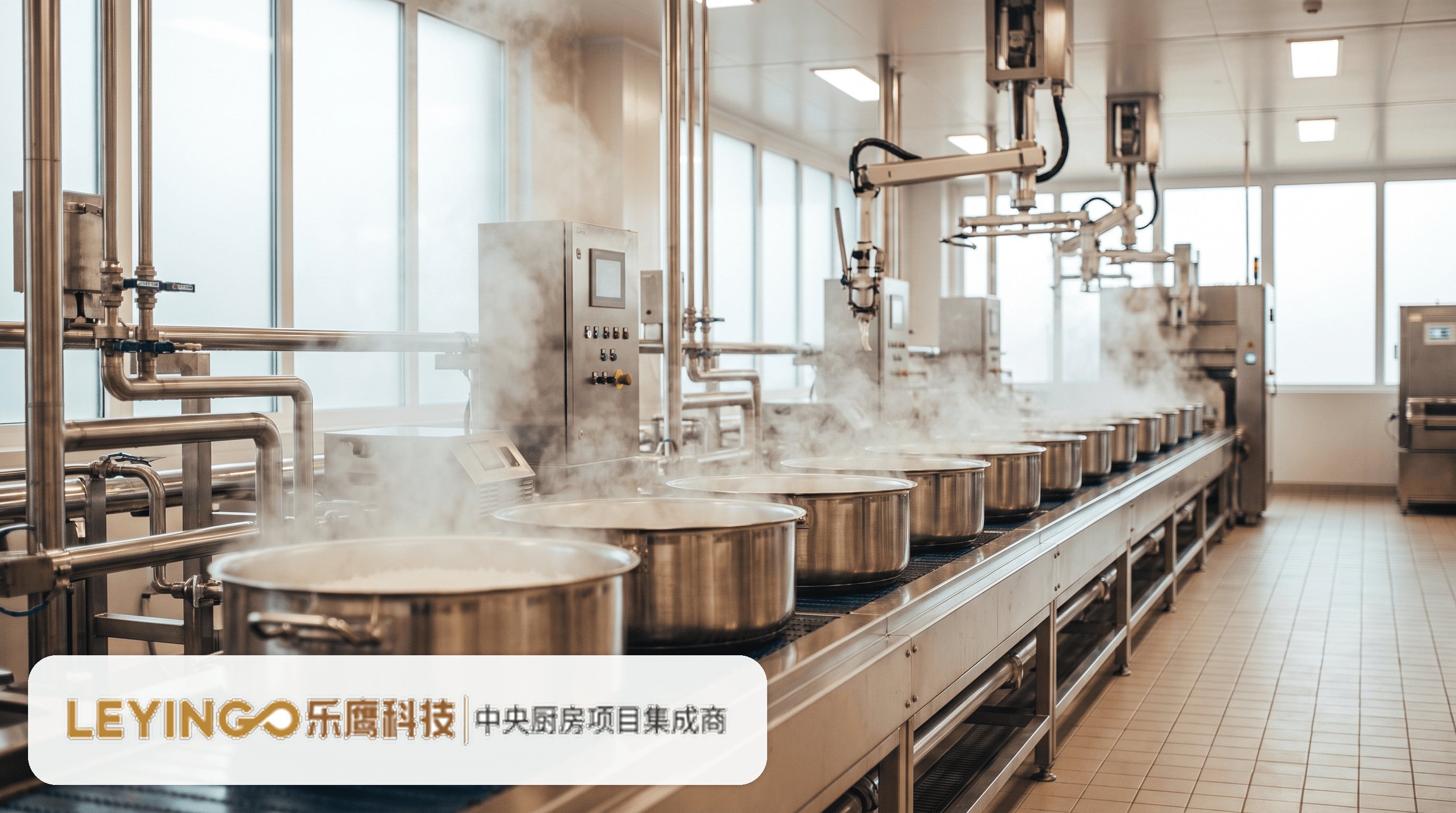
When an equipment manufacturer doesn't just meet industry standards but helps write them, that's a different category of trust. Leying, based in Nanjing and operating since 1991, is exactly that case: the company participates in developing national industry standards for rice-cooking lines and dishwashers, rather than simply manufacturing to already-established rules.
Above-average R&D investment for the industry
The company reinvests around 10% of revenue into R&D — a high figure for production equipment, usually meaning a meaningful share of sales goes back into the technology itself, not just sales expansion. Behind that sit over 100 patents and a national "high-tech enterprise" designation — an official category China grants to companies with a proven level of in-house development.
The flagship line: over 40% energy savings
One key product is the Unmanned Intelligent Rice Production Line (AI series, models AI-300/450/600, covering 300, 450 and 600 kg/h). The line runs fully unattended: filling, water dosing, lid covering, cooking, steaming, lid removal and pot washing all happen with no human involvement, under Siemens- and Mitsubishi-based control with servo drives. An energy-saving water system improves thermal efficiency by over 40% compared to the company's own earlier machines — a real improvement measured against the same manufacturer's product line, not a marketing comparison against someone else's outdated equipment. Water-dosing accuracy is ±1%, rice-dosing accuracy is within 0.5% — precision that directly determines batch-to-batch consistency of the finished product, which matters for chain food service, where a dish has to taste the same at every location.
A line for sushi and onigiri: rice for international chains
A separate line targets sushi and onigiri rice and ready meals, with a cooling conveyor after steaming and vinegar dosing during the steaming stage. Per the manufacturer's own catalog, this line's equipment is used by chilled-rice and ready-meal brands including 7-Eleven, LAWSON, FamilyMart, Ito-Yokado and Yihai Kerry — international chains with extremely strict product-consistency requirements across thousands of stores simultaneously. Line capacity is 150–600 kg/h on a raw-rice basis.
Compact solutions for smaller kitchens
For smaller volumes, the company offers the LYFZ cabinet-style rice cooker — a two-pot model (14 kg of rice per cycle) and a three-pot model (21 kg), with gas or electric heating and several layers of protection against overheating and cooking-time overruns.
An international client list and export markets
The company's customers include Foxconn, Cargill, Sinopec, Country Garden, and Nanjing, Tongji and Huazhong universities; equipment ships to the US, Japan, Taiwan, Hong Kong, Saudi Arabia, Singapore, Malaysia, Thailand and Iran. Leying's rice-cooking and thermal equipment line is featured on the factory's catalog card.
Who Leying fits
For chain food service or retail where consistent product quality across dozens or hundreds of locations matters, the AI line's dosing precision and energy efficiency are strong arguments. For a compact food point or a small canteen, the LYFZ cabinet cooker is the more sensible pick — it covers the same job without the excess capacity of an industrial line. It's also telling how the company transfers technology between segments: refinements proven on the industrial AI line for large chains later feed into simplified equipment for smaller volumes — meaning the dosing precision and energy efficiency originally developed to meet international retailers' requirements eventually become available to a compact point owner too, rather than staying an exclusive privilege of industrial scale. That sets a manufacturer with its own R&D center apart from a company that simply copies someone else's solution under its own brand: technological progress spreads down through the whole line rather than staying locked inside a single flagship model. One final consideration when choosing between lines: the scale of investment should be weighed not just against current production volume but against the business's growth horizon over the next 3-5 years — the AI series' modularity (300/450/600 kg/h models) lets you plan capacity headroom in advance, without overpaying for unused capacity today or hitting the line's ceiling within a year or two of active chain growth.