
гуманоидные роботы · Leju Robotics · образовательная робототехника · двуногая ходьба
Leju Robotics: the same humanoid heritage for a factory floor and a school robotics club
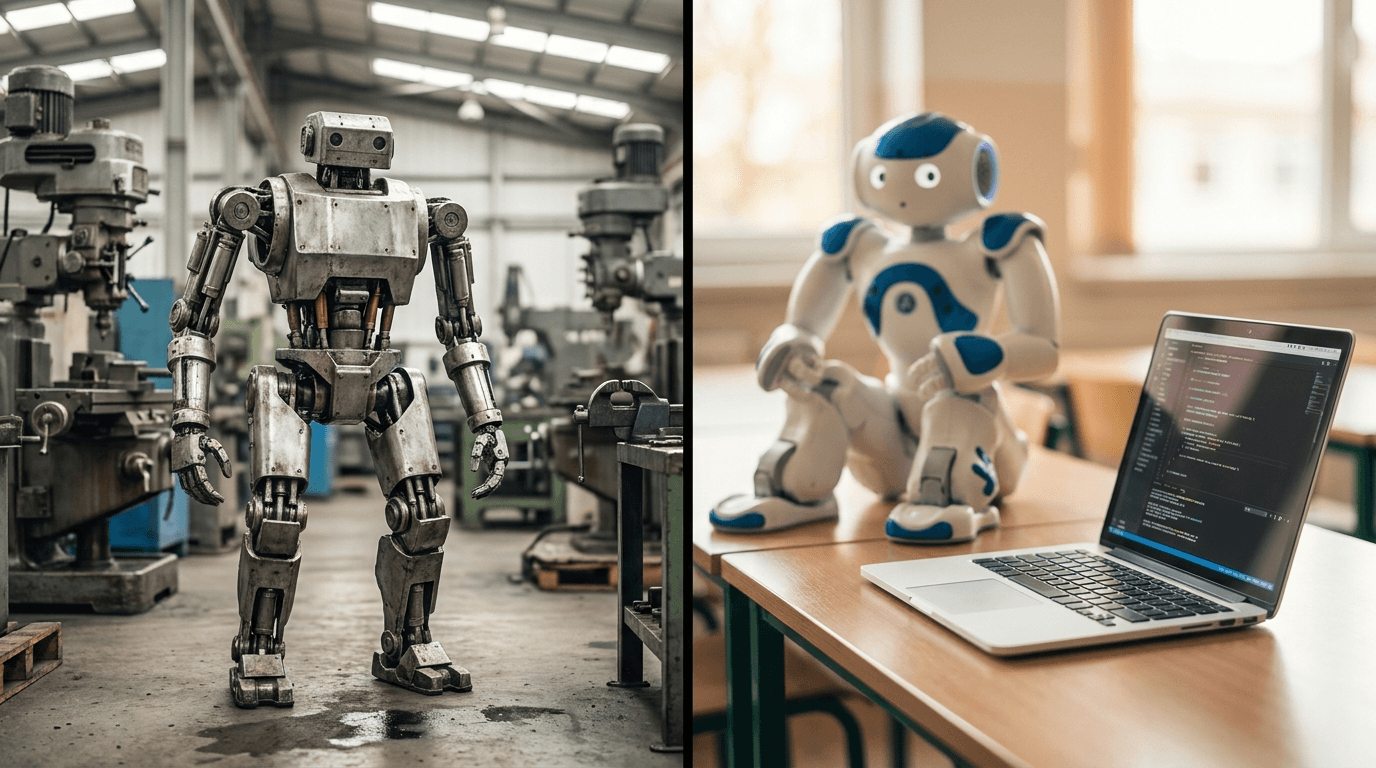
Humanoid robots for a factory and for a school classroom solve nearly opposite problems: one needs strength and payload, the other needs safety and simple programming. Leju Robotics / 乐聚机器人, one of the earliest Chinese bipedal-robot makers, operating since 2016, shows how a company can cover both segments while resting on the same engineering foundation.
A decade of work in a narrow, hard niche
Bipedal walking is one of robotics' hardest problems: unlike a quadruped or a wheeled base, a two-legged robot has to constantly balance, compensating for every shift in its center of gravity. Leju has worked on this since 2016 and over that time developed its own torque servo actuators and self-stabilizing gait algorithms — meaning it isn't buying off-the-shelf components from outside suppliers but controls the entire chain from actuator to control algorithm. That full-cycle development is usually what determines how steadily a robot holds up on an uneven shop floor or on a classroom carpet.
Kuavo: modularity for industrial and research work
The line's flagship, Kuavo, is a full-size modular platform. Joint torque reaches up to 360 N·m — this figure sets how hard the robot can push, lift and hold weight without losing stability. Omnidirectional walking — moving not just forward-back but sideways and diagonally without turning the torso — tops out at 4.6 km/h, comparable to an unhurried human walking pace. The key feature is interchangeable limbs and hands for different tasks: a customer can swap the end effector for a specific scenario instead of buying a separate robot for every operation.
Aelos and Roban: from robotics club to university lab
For education, the company offers two models. Aelos is a 19-degrees-of-freedom humanoid built for entry-level robotics programming and education. Roban is a more advanced model with 22 degrees of freedom, gait algorithms, Python programming (a language already nearly universal in school and university curricula) and Bluetooth connectivity for wireless control from a computer or tablet. The three-DoF gap between the two models is the difference between a basic set of movements and the finer motor control needed for advanced courses and robotics competitions.
Why it's one company, not two separate manufacturers
The fact that the industrial and educational lines come from the same hands isn't a marketing move — it's a consequence of a shared engineering base: stabilization algorithms proven on the heavy industrial Kuavo carry over, in simplified form, to the compact educational models, while field feedback from mass use of Aelos and Roban in schools gives the company real-world mechanical-reliability data outside the lab. Leju's full line — from Kuavo to Aelos and Roban — is featured in the factory's catalog card.
What to pick for your task
If the goal is a factory pilot or a research project where strength and modularity matter, Kuavo is the logical choice. If the goal is equipping a STEM center, a club or a university lab where safety, affordability and an approachable programming environment come first, choose Aelos for entry-level work and Roban for more advanced courses. One more practical point that often gets underweighted when choosing an educational humanoid is long-term parts availability and version compatibility. A company running both an industrial and an educational line on a shared engineering base tends to support that base longer and more reliably than a narrowly specialized maker of a single teaching model: demand for Kuavo components from industrial customers sustains manufacturing capacity that indirectly benefits Aelos and Roban owners too — replacing a damaged joint or servo is easier with a supplier running a diversified product portfolio than with a company producing one model in a small production run. For an institution planning to use its robots not for one semester but across several years, this long-term support factor deserves as much weight in the decision as the kit's upfront cost. Finally, it's worth asking the supplier for concrete examples of deployments in similar conditions: a production site differs from a classroom not only in housing durability requirements but in maintenance schedule too, and real-world, not lab, deployment track records are the best indicator of what to expect after installation on your own site.