
инспекционные роботы · промышленная робототехника · каталог · KunRobot · Deep Robotics
Inspection Robots: How KunRobot and Deep Robotics Keep People Out of Dangerous Zones
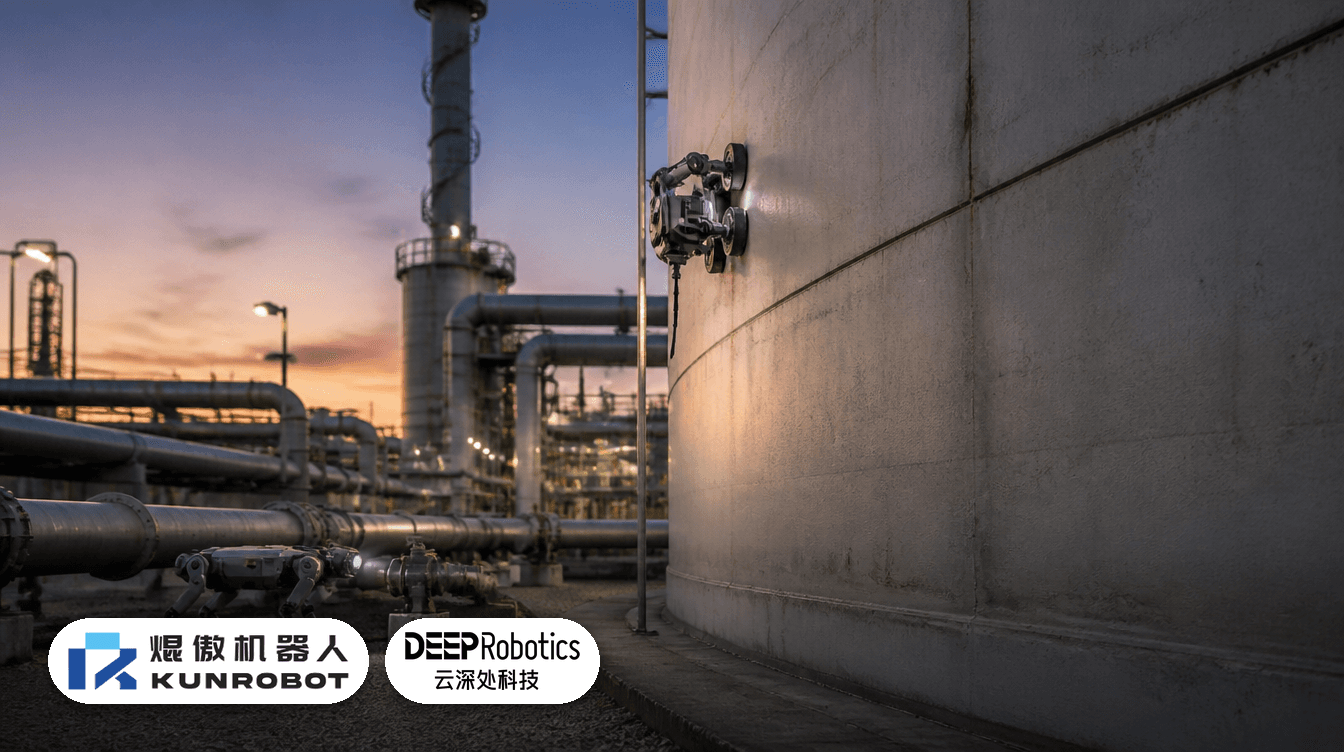
Not every useful robot looks like a humanoid or a warehouse stacker. There's a distinct class of tasks where a robot isn't there for speed or to cut labor costs, but because a location is physically awkward or outright dangerous for a person to reach: a ship's hull, a tank wall, a metro tunnel, a pipeline route. Two manufacturers in the Aura catalog solve this problem in fundamentally different ways.
KunRobot: a magnet instead of scaffolding and rope-access crews
昆傲机器人 / KunRobot, based in Chengdu, specializes in robots with magnetic adhesion — they literally stick to vertical metal surfaces and move along them while carrying inspection equipment. The application range covers tanks, ship hulls and steel structures — sites where human access normally requires scaffolding or a rope-access crew. Magnetic adhesion removes the need to build temporary access infrastructure altogether: the robot simply drives straight up the steel to wherever it needs to go. Catalog on the KunRobot factory page.
Deep Robotics: a robot instead of a human on a hazardous patrol route
云深处科技 / Deep Robotics, out of Hangzhou, took a different route — four-legged robots that walk the same ground a human patrol officer normally would: substation grounds, tunnels, pipeline corridors. The flagship X30 is built specifically for autonomous patrolling: IP67-rated housing, 2.5–4 hours of runtime per charge, and a higher density of perception sensors for navigating complex infrastructure. The smaller X20 is simpler but no less durable for everyday duty: IP66-rated, operating from -20 to +55 °C, clearing 20 cm+ steps and 45° slopes. The compact Lite3 weighs just 12.2–13.5 kg with a 2.5–4.5 kg payload — more of a lightweight research platform for simpler routes than a heavy-duty industrial tool. All three share the same underlying idea: thermal cameras and gas sensors in the payload replace a human exactly where a patrol means real risk — a smoke-filled tunnel, proximity to high-voltage equipment, a route with a possible gas leak. Catalog on the Deep Robotics factory page.
How to choose between the two approaches
If the inspection target is a vertical metal surface — a tank, a ship's hull, a steel structure — KunRobot's magnetic adhesion solves the access problem directly and removes the question entirely. If the target is an extended route across ground or floor — a substation site, a tunnel, a pipeline corridor — Deep Robotics' quadruped is closer to how a human patrol actually moves and integrates more easily into an existing inspection schedule. The economics work out the same way in both cases: not in how impressive the demo looks, but in reduced downtime and eliminating cases where a routine inspection would otherwise mean halting production or arranging work at height.
These factories are on the route of our Robotics Expedition — see them in person, not just on video.