
сервисные роботы · Китай · гостиничный бизнес · экспорт
Keenon Robotics: 100,000 service robots and a bet on the hotel franchise model
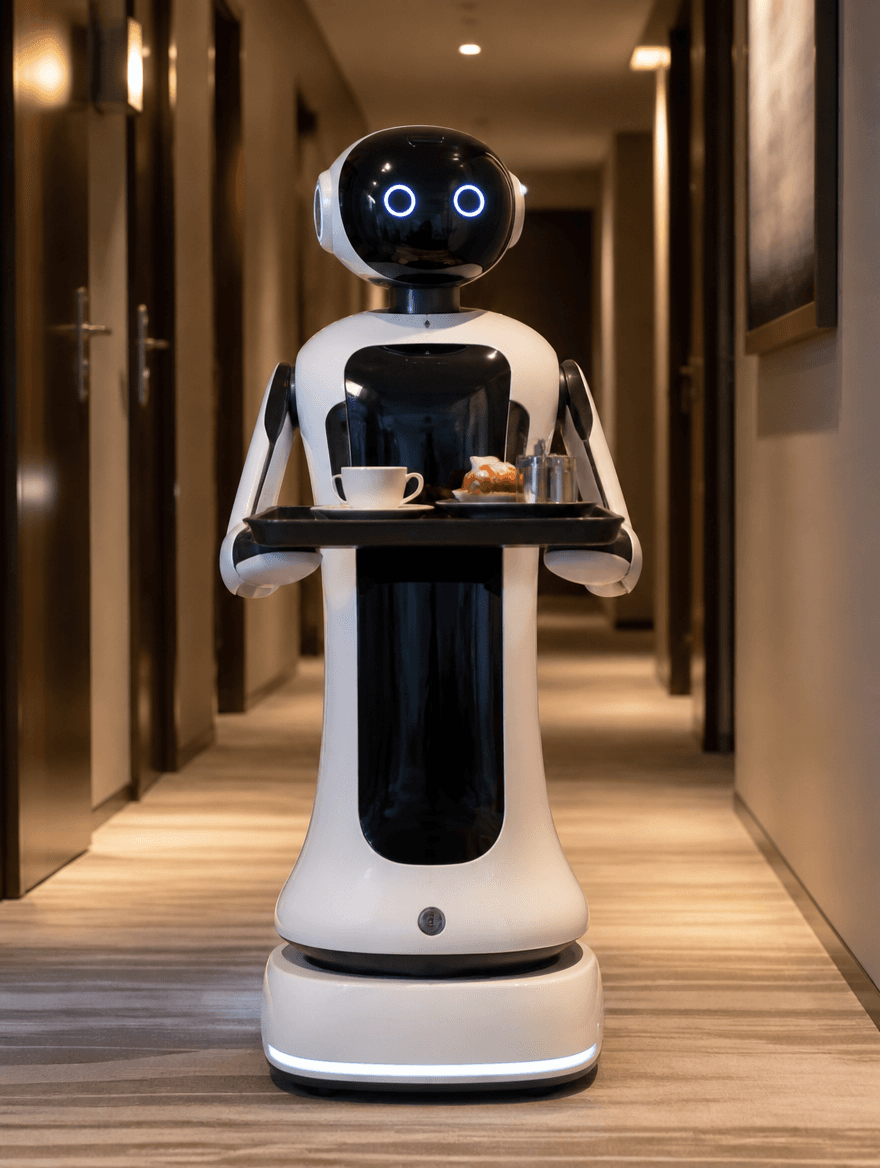
While the humanoid industry grabs headlines with flashy demos, the far less glamorous service-robotics segment is steadily racking up numbers that are hard to call niche anymore. Keenon Robotics has shipped more than 100,000 service robots to over 60 countries — a figure worth treating not as a nice statistic but as a real, established market with millions of operating cycles behind it.
A scale that stopped being an experiment
A hundred thousand units in actual operation is no longer a pilot project or a trade-show sample. It's a fleet that delivers orders down hotel corridors, carries dishes between restaurant tables, and moves between shopping-mall floors every single day without a hovering engineer. For scale, Keenon operates in the same weight class as another major Chinese service-robotics player, Pudu Robotics, which has shipped over 130,000 robots to 85-plus countries — between the two companies, roughly 230,000 units are already active worldwide.
Why hotels specifically
The hospitality segment is a convenient entry point for service robotics for several reasons at once. Tasks here are standardized and repeatable: delivering towels, water, and forgotten items to a room, moving luggage — operations that don't require creative improvisation but do require predictability and polite, unobtrusive behavior around guests. Hotel infrastructure is also better prepared for automation than most other environments: predictable floor layouts, electronically controlled elevators, stable Wi-Fi coverage.
From equipment sales to a franchise model
The key strategic question for Keenon is how to move from one-off robot sales or leasing to a model that generates recurring revenue and scales alongside growing hotel chains. A franchise logic looks like a natural next step here: instead of each hotel separately purchasing and configuring equipment, a chain operator receives a ready, standardized package — the robot, software, booking-system integration, and maintenance — as part of the overall franchise offer when opening a new property.
That model benefits both sides. The hotel chain gets a predictable cost line and a uniform service standard across all locations instead of scattered rollouts of varying quality. The robot maker, in turn, gets not a one-off deal but a long-term relationship with a growing chain — and the ability to forecast demand years ahead by syncing manufacturing capacity with new-hotel opening plans.
Competition for the hospitality segment is only starting
It's worth understanding that the hospitality segment of service robotics is far from a Keenon monopoly. Pudu Robotics has already deployed more than 1,000 FlashBot robots across the Atour hotel chain in China alone, and in Shenzhen, on an artificial island, the world's first fully robotic hotel is under construction, where check-in, luggage delivery, room cleaning, and restaurant service will be handled exclusively by robots running on a single AI platform. That means the battle for market share isn't so much over individual points of sale as over whose software ecosystem and franchise terms become the industry standard.
What this means for the market
The shift from one-off sales to a franchise model is a hallmark of a maturing service-robotics market. While competitors keep racing on units shipped, the companies that first build a durable recurring-revenue business model around hotel chains will end up with a far sturdier position than mere leadership in shipment statistics.
What a franchise model means for international expansion
There's a separate point of interest in how franchise logic could accelerate Keenon's international expansion. Instead of independently entering each new national market from scratch — registering a local legal entity, hiring a service team, building a sales channel — the company can lean on already-existing international hotel chains, which bring their own infrastructure of presence across dozens of countries. A franchise partner opening a hotel under a well-known brand in a new country simultaneously becomes an entry point for robotics, once it's already baked into the standard franchise package.
That's a fundamentally different, far less capital-intensive path to global expansion than the one taken by general-purpose humanoid makers, who have to build their own distribution and service network in each individual country almost from zero.
Hotel operators and other service businesses evaluating service-robotics deployment can review a wide range of manufacturers in the company catalog on the Aura Robotics website.