
япония · kawasaki · гуманоиды · промышленность · робототехника
Kawasaki Kaleido 9: a 180 cm humanoid with 41 degrees of freedom
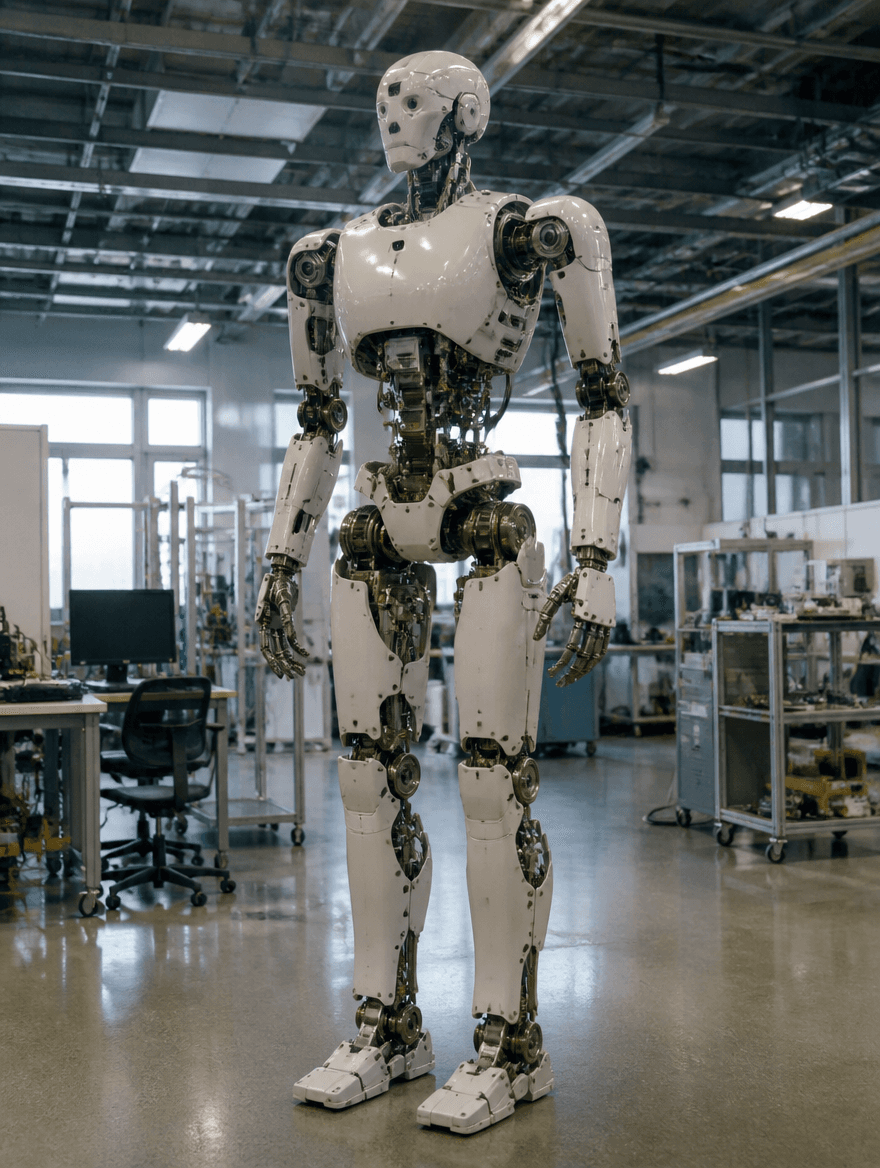
Industrial robotics is one of the few industries where Japan is still an undisputed heavyweight: FANUC, Yaskawa, Kawasaki, and Mitsubishi Electric all rank among the world's largest manufacturers of robotic arms. The open question of recent years is whether that competence converts into leadership on a new field — humanoid robots. Kawasaki Heavy Industries answers with a specific machine called Kaleido 9.
What Kaleido 9 actually is
The numbers speak for themselves: 180 centimeters tall, 86 kilograms, 41 degrees of freedom, and the ability to lift 25 kilograms with one arm. For context, 41 degrees of freedom is noticeably more than most mid-tier commercial humanoids, which typically run 20 to 30. Every additional degree of freedom means an extra joint or rotation axis — which means added control complexity, an additional component that can fail, and added cost. In other words, 41 degrees of freedom is a bid for maximally human-like kinematics, not a simplified version.
The 25 kg single-arm payload isn't arbitrary either — that's roughly the weight of a filled standard parts crate or a small industrial assembly. A robot engineered to lift that much with one arm is clearly aimed at real warehouse and assembly operations, not neatly handling small objects on a demo table.
A company with half a century in robotics
Kawasaki Heavy Industries is no newcomer: the company shipped its first industrial robot back in 1969 and has spent decades supplying manipulators to the automotive and electronics industries worldwide. That fundamentally distinguishes Kawasaki's approach from a typical Chinese or American humanoid startup: behind it lies half a century of experience in actuators, gearboxes, motion control systems, and — importantly — industrial reliability, meaning the ability to run for years in harsh shop-floor conditions rather than just perform impressively at a trade show.
That also explains why Kaleido reads more like an engineering machine than a consumer-facing product: Kawasaki has traditionally sold into the B2B segment to industrial customers interested in technical specs and reliability rather than robot aesthetics or charisma.
Mitsubishi Motors' parallel move
Tellingly, almost simultaneously with the Kaleido 9 unveiling, Japanese automaker Mitsubishi Motors signed a memorandum with Highlanders — a startup that grew out of the University of Tokyo — for joint development and series production of a humanoid. This is another example of a now-familiar Japanese pattern: rather than build humanoid robotics competence from scratch internally, a large industrial company partners either with a sister heavy-engineering firm (as Toyota does with Boston Dynamics) or with a university spin-off holding fresh algorithmic know-how.
The combination of heavy engineering from an industrial giant plus algorithms from a university startup can prove more effective than trying to do everything within one corporate structure — university teams tend to experiment faster with control and AI, while industrial giants provide the manufacturing base and capital to scale.
Japan's place in the global race
Meanwhile, Japan itself, according to industry analysts, is losing the crown in the humanoid race it effectively invented — the country was first to mass-produce industrial robots back in the 1970s, but now lags China specifically in humanoid development and deployment speed, where the number of startups runs into the dozens and development cycles are shorter.
Kaleido 9 is a good example of how Japan is trying to compensate for that gap not through startup volume but through engineering depth: fewer companies, but each drawing on decades of accumulated expertise in mechanics and actuators. Whether that strategy can outpace China's mass-production tempo is a question for the next two or three years.
What real-world operation will show
Spec sheets are only the first step. The real test for Kaleido 9 begins once the robot leaves Kawasaki's demonstration lab and meets the actual conditions of a warehouse or assembly floor: dust, vibration, temperature swings, and hours of continuous operation. Given Kawasaki's reputation for industrial reliability, the company has good reason to expect a successful transition from prototype to series deployment — but it's precisely that transition, not an impressive unveiling, that typically weeds out most humanoid platforms on the market.
If you're looking for industrial automation partners in Asia today, Aura Robotics' catalog collects vetted manufacturers rather than just prototype announcements.