
япония · аэропорт · unitree · гуманоиды · автоматизация
Japan Airlines × GMO: Unitree G1-based humanoids at Haneda Airport
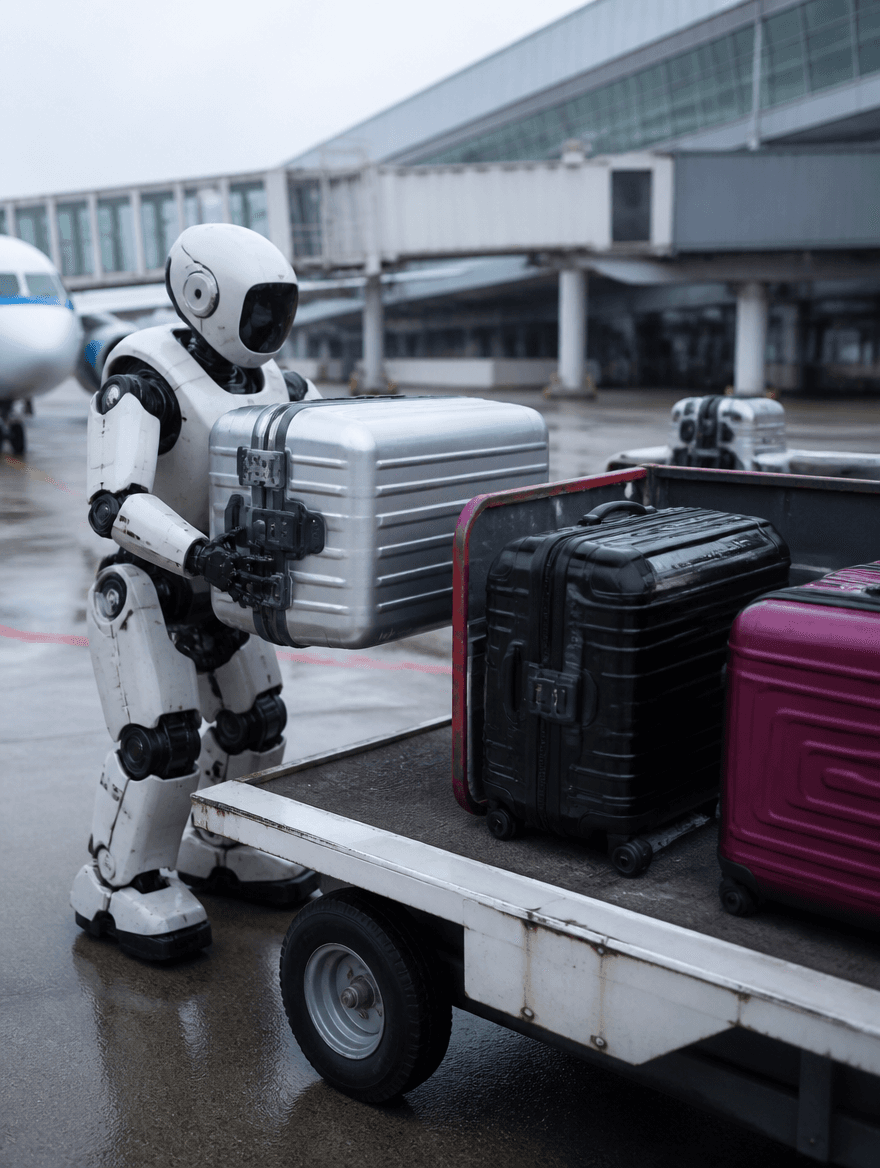
There is a certain irony in a Japanese airline, grappling with an aging workforce and a labor shortage, turning to a Chinese rather than a Japanese humanoid platform to solve the problem. That's exactly what Japan Airlines (JAL) did, choosing Unitree G1-based robots for a pilot project at Haneda Airport.
What exactly is being tested
Since May 2026, JAL, together with GMO AI & Robotics, has been trialing humanoids built on the platform of Chinese company Unitree at Haneda for two specific tasks: loading luggage and cleaning aircraft cabins. Neither task was chosen at random — both are among the most physically demanding and simultaneously most staff-short operations in ground handling.
The robots' technical specs are fairly modest: 132 cm tall, 35 kg, and just 2-3 hours of battery autonomy. This is clearly not a heavy industrial humanoid on the level of Boston Dynamics' Atlas — it's a compact, relatively affordable platform originally designed more as a research and service robot than a heavy-lifting machine.
Price as the deciding factor
The robot's base price is about 2.4 million yen, roughly $15,400. That figure is key to understanding JAL's logic: for that price, the company gets not an ideal, but a sufficient platform for a pilot — one that lets it quickly test the very concept of ground-operations automation without committing tens of millions of dollars to custom development up front.
By comparison, next-generation industrial humanoids from Western and Korean developers (such as Boston Dynamics' Atlas) cost orders of magnitude more and aren't yet available for commercial deployment at all — series production is only starting on a 2028 horizon. Whatever its modest specs, Unitree G1 has a decisive advantage: it exists, it's for sale, and it fits within a pilot project's budget right now.
The scale of the problem the pilot addresses
JAL employs roughly 4,000 ground-handling staff. A 2-3 hour battery life against a 4,000-person workforce makes clear that, at this stage, robots aren't replacing people — they're supplementing them for specific, physically demanding tasks during peak-load hours. Fully replacing a ground-handling shift with robots at this autonomy level is physically impossible; it would require either frequent battery swaps or a fleet rotating every few hours.
Still, even partial coverage of peak loads is a meaningful relief for an industry where physical baggage-handling labor is considered one of the toughest and least attractive jobs for younger workers — worsening the labor shortage against Japan's demographics.
What choosing a Chinese platform signals
The choice of Unitree over a Japanese or Korean alternative is telling in itself. Japanese heavyweights like Kawasaki and Mitsubishi are currently focused on more expensive, heavier industrial humanoids for automotive and manufacturing, not compact service robots for airports and hotels. In that lighter-weight category, Chinese manufacturers, and Unitree specifically, have achieved a clear price and speed advantage thanks to domestic market scale and a mature component supply chain.
For JAL, the pragmatic choice makes sense: rather than wait for an ideal Japanese alternative to emerge, take a ready, affordable solution and test the concept now. If the Haneda pilot shows measurable time savings and reduced staff burden, other Japanese ground-handling companies are likely to follow suit — regardless of the platform's country of origin.
Cautious optimism rather than a revolution
It's worth keeping expectations realistic: with 2-3 hours of autonomy and a weight of just 35 kg, talk of fully replacing human ground staff is premature. The Haneda pilot is, in essence, a controlled experiment with clear metrics: how much time the robot saves on a given task, how often operator intervention is needed, and how predictably the platform behaves in real airfield weather conditions rather than indoors. If those metrics prove convincing, expect the pilot to expand to other airports in the country and, likely, to other types of ground operations.
Companies considering similar pilot projects with ready, affordably priced humanoids should check out Aura Robotics' manufacturer catalog, which features vetted Asian platforms across different price segments.