
индонезия · бали · сервисные роботы · гостиничный бизнес · туризм
Indonesia: service robots for Bali's hospitality industry
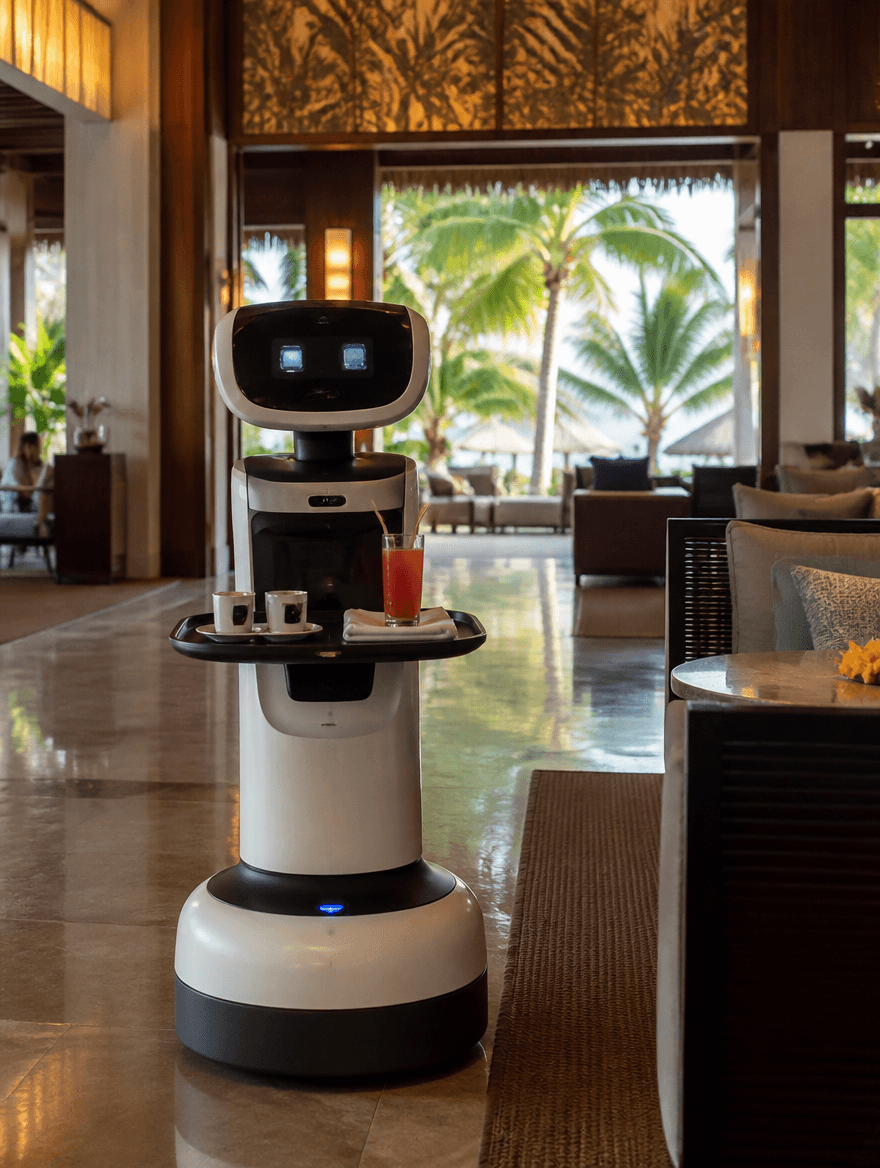
Indonesia's industrial automation market is valued at roughly $80.8 billion in 2025, with projected growth to $167 billion by 2032, and the overwhelming share of that story is about nickel smelters and heavy industry. But on Bali, which runs on a completely different economy, automation takes a much more tourist-friendly form: delivery robots and room-service bots wheeling trays, towels, and welcome drinks through resort lobbies in Canggu, Ubud, and Nusa Dua.
Why hospitality, specifically
Tourism forms a significant part of Bali's economy, and the island welcomes millions of foreign visitors annually — a flow that has steadily recovered in recent years after the pandemic collapse. At the same time, the island's hotel business chronically struggles with frontline staff turnover: waiting and courier work is physically demanding, and wages in Indonesia's hospitality industry remain among the lowest in Southeast Asia — which doesn't stop hotel managers from facing staffing shortages during peak tourist season.
Delivery robots — usually wheeled platforms with multiple shelves and a touchscreen, manufactured in China by companies like Pudu Robotics or Keenon Robotics — enter this segment as a solution to a narrow but persistent problem: overloaded frontline staff during breakfast rush or check-in peaks. The robot doesn't replace a waiter outright; it offloads repetitive trips between the kitchen and the tables.
The economics for a smaller hotel
For a chain five-star resort, buying a couple of robots is more of an image gesture and an Instagram moment for guests than a cost-optimization strategy. But for a mid-sized or small hotel with 40 to 80 rooms, leasing a single delivery robot can pay for itself by reducing pressure on two or three staff members during peak hours — though there's no precise, publicly available Indonesian data on payback periods specifically for Bali's hospitality segment as of late 2025, and any specific ROI figures found in distributor marketing should be verified case by case.
The market's import-dependent nature
Between 80 and 90 percent of industrial robots in Indonesia are imported, and the service segment is no exception: there's virtually no domestic manufacturing of waiter robots in the country — all hardware arrives through distributors based in China or Singapore, who also handle servicing. This creates a specific logistics wrinkle for Bali: the island is physically separated from mainland Java, and spare parts or a field service engineer take longer to arrive than they would in Jakarta, extending downtime whenever equipment breaks down.
How it fits the bigger picture
The story of Bali's hotel robots is notable not for its scale — it's a drop in the ocean next to Sulawesi's nickel smelting complexes — but for showing how, within the same country, service and industrial robotics develop on entirely separate tracks driven by different forces. Nickel automation is pushed by state policy banning raw ore exports; hospitality automation is pushed by ordinary competition for guest experience and a shortage of frontline staff. What unites both stories: almost all the hardware arrives from abroad, and Indonesia remains a market for consumption rather than production.
Cultural and service context
Bali hoteliers, whom our editors have spoken with through industry contacts, point to another non-obvious factor: guests from different countries react very differently to waiter robots. Tourists from East Asia generally take the technology in stride and even show interest, while a share of European and Australian guests — who make up a significant slice of Bali's tourist flow — sometimes complain that a robot "depersonalizes" the resort experience they expected from a tropical hotel. That pushes some management companies to deploy robots selectively — for example, only for late-evening room delivery, when frontline staff are genuinely stretched thin — rather than as a substitute for ordinary restaurant service.
Another practical wrinkle is humidity and sand. Bali's tropical climate and the proximity of many hotels to the beach put extra strain on the wheels and sensors of robots originally designed for dry, air-conditioned spaces in mainland China, raising the frequency of preventive maintenance compared with operation inside enclosed shopping malls.
If you're curious which service robot models are on the market for the hospitality sector, check out our manufacturers catalog.