
индия · рынок роботов · автоматизация · склад · инвестиции
India without a humanoid: the robot market grows 17% a year
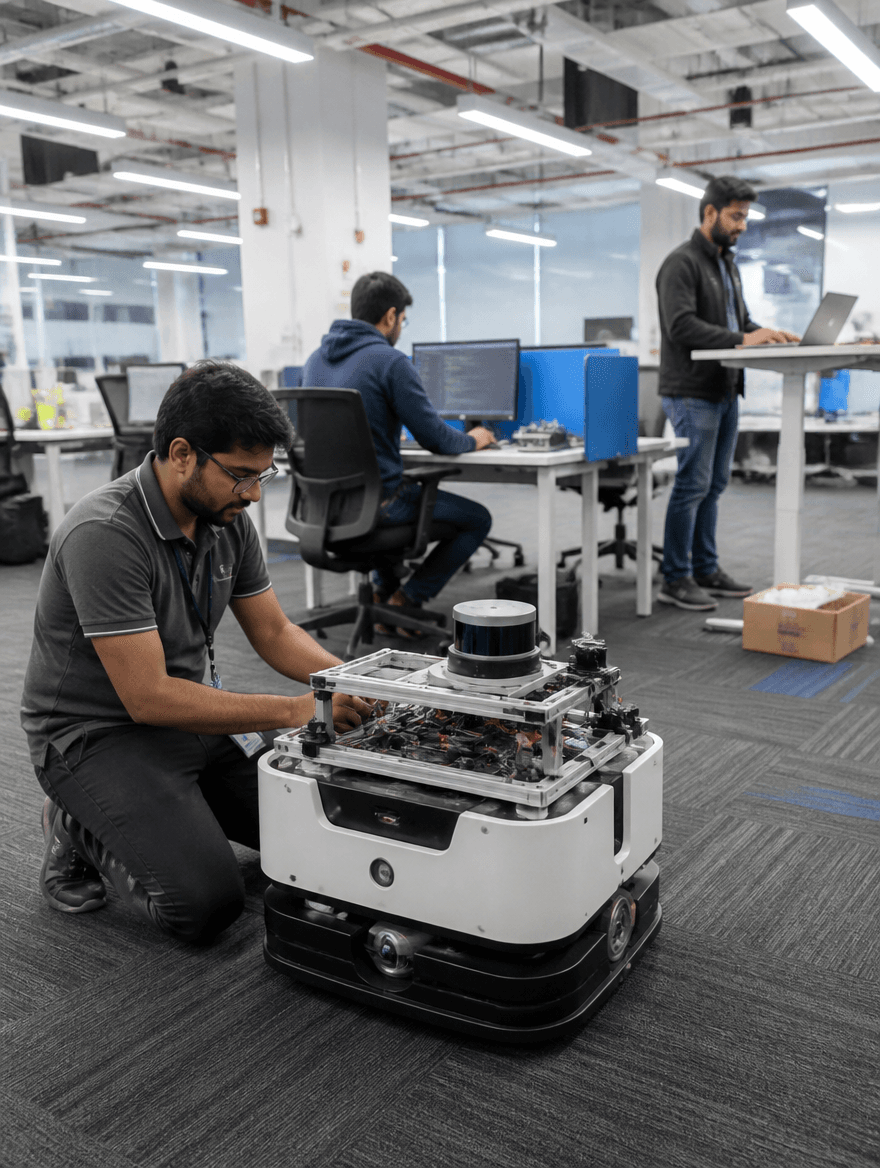
India is a major economy, the world's most populous country, and an established hub for global IT outsourcing. Given those inputs, one might expect the country to actively compete in the humanoid robot race alongside China, the US, and Korea. In practice, things look different: India's robotics market is growing fast, but exclusively in traditional niches, and there is no first-tier humanoid company in the country at all yet.
Scale and growth rate
India's robotics market reached $2.14 billion in 2026, growing 17% year over year. For context, this is sustained double-digit growth for several years running — the market isn't just bouncing off a low base, it's steadily expanding. A telling detail: a record 4,945 industrial robots were installed back in 2023, and the automotive industry accounts for 36% of all demand — more than a third of the entire national robotics market sits in a single sector.
That concentration in auto is logical: India is one of the world's largest car markets and a growing export-manufacturing hub, where international and local automakers invest in modernizing assembly lines, and automating welding, painting, and precision assembly is a classic, decades-proven application for industrial robotic arms.
Why there's no first-tier humanoid
Despite the market's growth, India has no humanoid robotics company comparable in scale and ambition to China's Unitree or Fourier, America's Boston Dynamics, or Korea's Rainbow Robotics. The reasons are complex, but a few key factors stand out.
First, developing a humanoid robot requires simultaneous expertise in mechanics, actuators, AI, and systems integration — plus significant capital over a long horizon with no guaranteed payback. India's venture ecosystem has traditionally been stronger in software and services than in capital-intensive deep-tech hardware.
Second, China holds a massive advantage in the form of a dense local component supply chain — gearboxes, actuators, sensors manufactured literally in the next town over. India would have to build that chain practically from scratch, which requires not just capital but time.
The role India is finding instead
Rather than competing directly in building finished humanoids, the country is becoming a global back office for teleoperation data collection and model fine-tuning — the part of the value chain where the key resource isn't hardware engineering but scalable, relatively low-cost labor for data labeling, teleoperating manipulator robots to train and refine machine-learning algorithms. That's a direct extension of India's already-established niche in global IT outsourcing, just applied to robotics data instead of software development.
A more traditional segment is developing in parallel too: autonomous mobile robots (AMR) for warehouses. A telling example: ANSCER Robotics, a Bangalore-based company developing AMRs for warehouse logistics, closed a $5.4 million Series A round in May 2026, aiming to expand into North American and European markets. This direction matters: the Indian company is moving outward, directly competing in the same markets where more established American and Chinese AMR makers already operate, rather than settling for the domestic market alone.
What this means for assessing India's industry
The Indian case is a good reminder that "lagging in humanoids" doesn't mean lagging in the robotics industry as a whole. The country shows steady organic growth in traditional niches (industrial manipulators for auto, warehouse AMRs) driven by real, growing domestic demand rather than venture hype around the humanoid form factor. Meanwhile, India is embedding itself into the global humanoid development chain not as a maker of finished robots but as a supplier of data and teleoperation services — a less visible niche, but potentially durable given the industry-wide demand for VLA model training data.
The longer-term trajectory
The medium-term question isn't whether India will eventually get a first-tier humanoid company of its own, but at what point its accumulated experience in data, teleoperation, and AMR development converts into something bigger. India's software sector, too, once started with outsourced simple tasks for Western clients and ended up producing global technology giants. Whether that path repeats in robotics is a decade-scale question, not a two-year one, but the structural preconditions — engineering talent, English proficiency, growing domestic demand from the auto industry — are certainly in place.
If you're looking for warehouse automation partners in Asia, Aura Robotics' catalog can help you find vetted AMR suppliers and other solutions.