
медицина · гуманоиды · UBTech · DroidUp
A robot with a 32-36°C body temperature: humanoids move into hospitals and eldercare homes
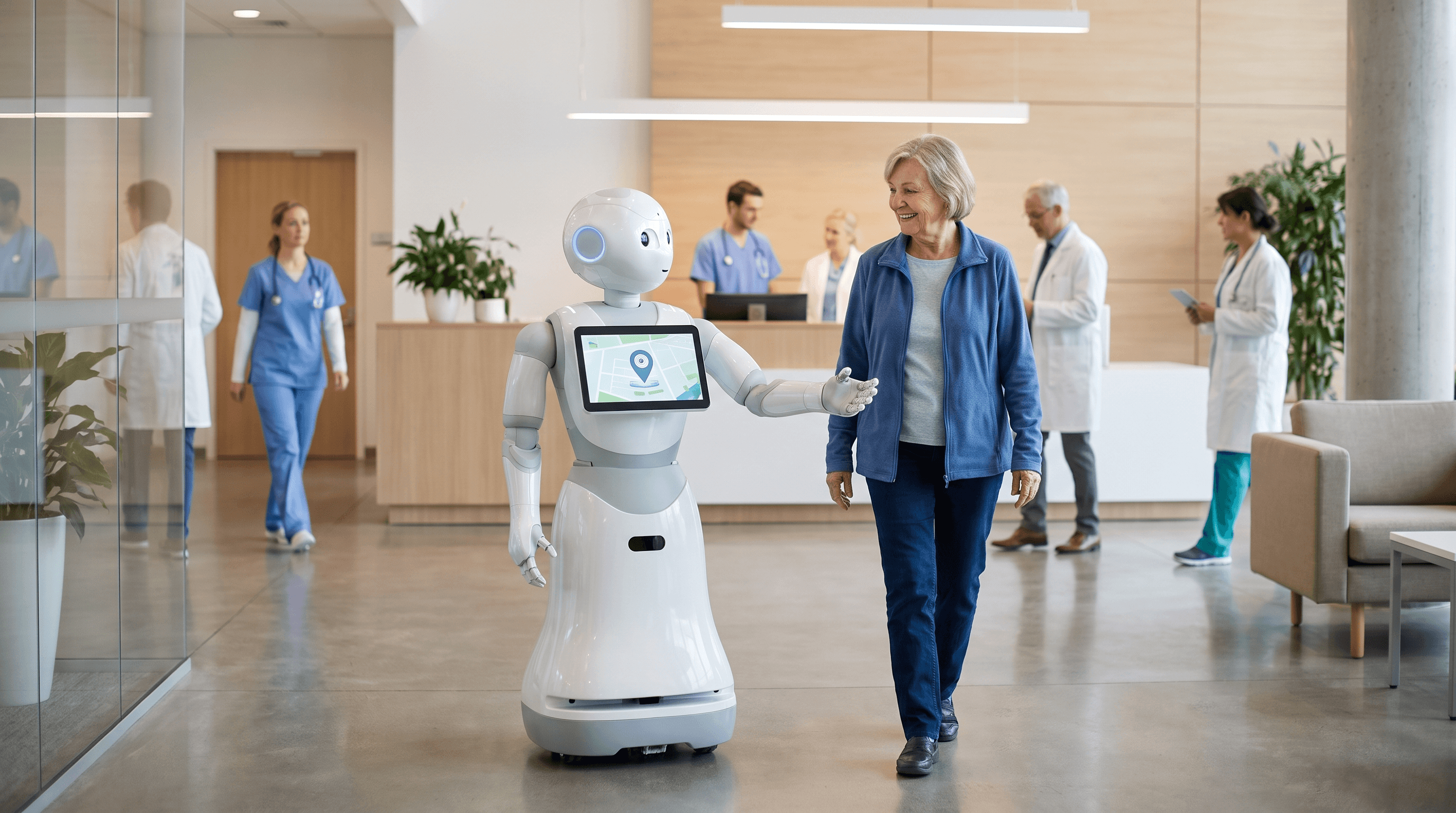
While industrial humanoids conquer assembly lines, a separate and far more delicate niche is forming in healthcare. UBTech / 优必选 — whose company card is in the Aura Robotics catalog — has deployed a navigation-and-consultation solution built on its Cruzr service robot: greeting visitors, answering routine questions, guiding people around a building, and offering interactive entertainment — a scenario already in use in schools, hospitals, government buildings, and malls via the company's healthcare cloud platform, which lets operators dispatch robots by building map and control them remotely.
A more ambitious project: a companion robot with "human" skin
Shanghai-based DroidUp — also featured in the Aura Robotics catalog — is preparing a first production batch of roughly 50 units of its Moya robot by late 2026. It's the company's most ambitious biomimetic project to date: silicone skin with active thermal regulation maintaining a 32-36°C body temperature, 25 degrees of freedom in facial expression, and a claimed 92% human-like gait accuracy at speeds up to 0.83 m/s. The robot costs about $173,000, clearly positioning it not for a mass market but for medical and rehabilitation facilities, eldercare homes, museums, and premium hospitality.
Why healthcare needs "humanness," not just function
Unlike industrial use, where the key criterion is precision and speed of operation, healthcare and eldercare place near-equal weight on the psychological effect of presence: warm-to-the-touch skin and lifelike facial expression reduce a patient's sense of interacting with a mere mechanism — a factor that directly affects emotional state in rehabilitation and geriatric settings. That's precisely why DroidUp is investing in biomimetics that would be functionally excessive for simple medication delivery or wayfinding.
Caution alongside the hype
It's worth noting the flip side: independent observers assess that DroidUp has limited remaining funding — under $15 million by recent estimates — making production scaling as important a question as the technology itself. For buyers, the practical lesson is that choosing a specialized medical robot supplier means looking not just at impressive specs but at the financial stability of a company that needs to support the equipment after the sale.
An overview of medical and care robots is available in the Aura Robotics catalog.