
вьетнам · foxconn · гуманоиды · электроника · автоматизация
Foxconn in Vietnam: humanoids enter the production portfolio for the first time
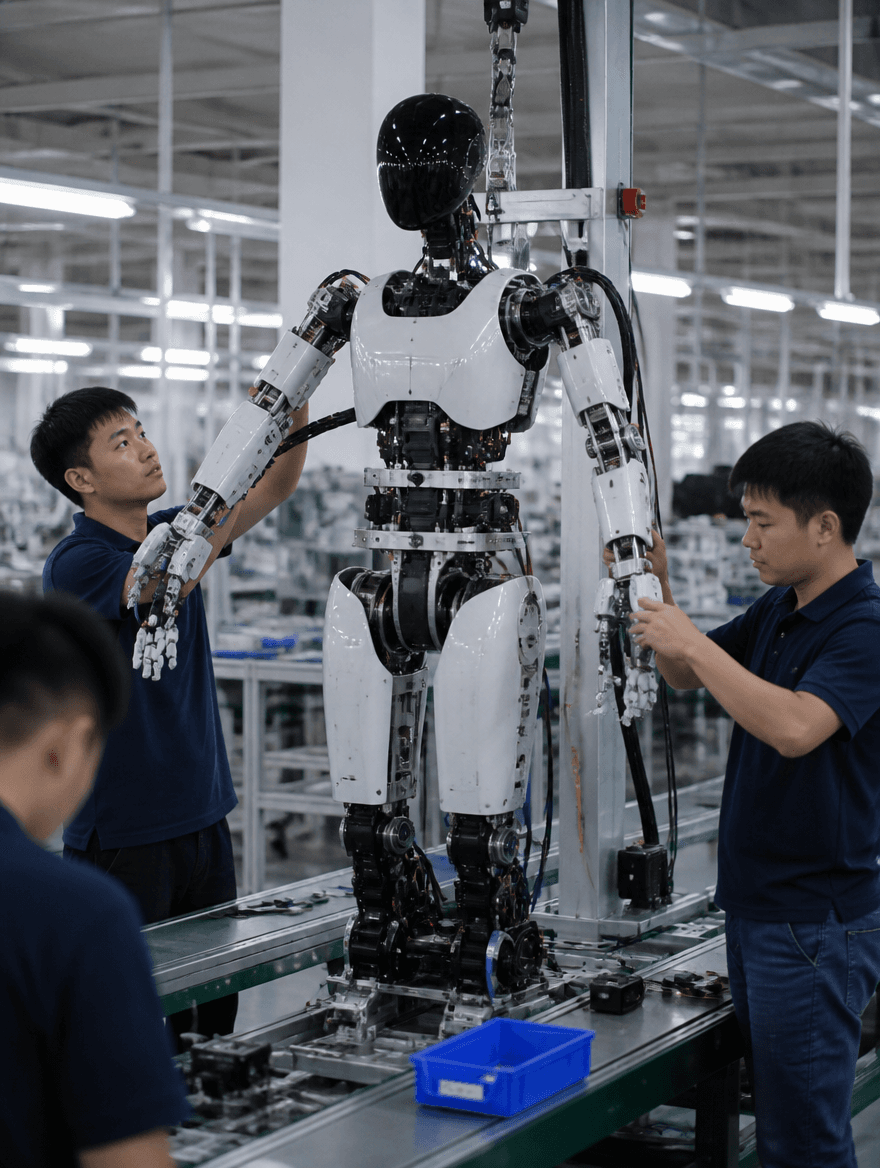
Foxconn 鴻海精密工業 / Hon Hai Precision Industry (Foxconn) — the world's largest contract electronics manufacturer, best known for assembling iPhones for Apple — has spent years building a manufacturing strategy around geographic diversification, gradually shifting capacity from China to Vietnam, India, and other countries. The latest step in that strategy: including industrial humanoids in a Vietnamese plant's production mix for the first time in the company's history there.
What's actually happening
Foxconn raised its investment in Vietnamese unit Fushan Technology to $226 million and is preparing to include industrial humanoids in the production process at its plant in Bac Ninh province for the first time — one of northern Vietnam's major electronics industrial clusters, also home to Samsung and other major tech-manufacturer facilities.
The word "first" matters here. Foxconn is a company with vast automation experience — it has used traditional industrial manipulators and specialized robotic lines at its Chinese plants for years. But the humanoid robot form factor is only now appearing in its Vietnamese portfolio, meaning the decision was deliberately held off until the technology matured enough to justify investment in this specific format.
Why now, and why a humanoid instead of a standard manipulator
Electronics assembly is an industry where tasks change often: a new smartphone or device model requires a new assembly line configuration, new operations, new component layouts. A traditional industrial manipulator is rigidly programmed for a specific task, and retooling it for a new product model takes time and engineering resources. A humanoid platform, in theory, promises greater flexibility: retraining for a new task rather than physically retooling the equipment.
For a contract manufacturer like Foxconn, whose business model relies on rapidly adapting to shifting orders from different clients (one smartphone today, a different device tomorrow), that flexibility is especially valuable — assuming humanoid platforms can actually deliver it in practice, not just in theory.
The Vietnamese market context
Foxconn's decision should be viewed against the backdrop of Vietnam's overall industrial robotics market, which remains fairly modest — about $112 million in 2025, forecast to grow to $231.7 million by 2031. Even $226 million in investment from Foxconn alone into its Vietnamese unit is comparable to the projected size of the entire local robotics market by 2031 — underscoring that large foreign players like Foxconn shape the market far more than local demand does.
An important caveat concerns technology origin: precision gearboxes, servo motors, and controllers for Vietnamese plants are almost entirely sourced from China, Japan, and Germany, while Vietnam's R&D spending sits around 0.4% of GDP. Foxconn will therefore most likely deploy ready-made humanoid platforms developed outside the country in Vietnam rather than local development — meaning the country currently serves as a deployment site for the technology rather than a creation site.
What it means for the industry
The country is forecast to need 1.2 million automation specialists by 2030, and the arrival of a player as large as Foxconn with humanoid robots in its production portfolio is an important maturity signal for local support-service providers: integrators, maintenance specialists, local parts distributors. Even if the robots themselves and their "brains" come from abroad, a local service and support ecosystem will inevitably grow around their operation in Vietnam.
Why Foxconn's decision matters right now
Foxconn rarely acts as a pioneer in technology experiments — the company typically waits until a new technology's risks become predictable and its economics well understood, and only then scales the solution across dozens of plants at once. That's precisely why adding humanoids to its production portfolio now, rather than two or three years ago, should be read as a signal: from the perspective of one of the world's most conservative and experienced industrial operators, the technology has crossed the threshold where investing in it is a justified move rather than a risky bet on the future.
For companies considering Vietnam as a manufacturing base with growing robotics infrastructure, Aura Robotics' catalog collects vetted automation suppliers from the region.