
медицинские роботы · Fourier · BrainCo · экзоскелеты · протезы
Exoskeletons and bionic prosthetics: Fourier and BrainCo, spec by spec
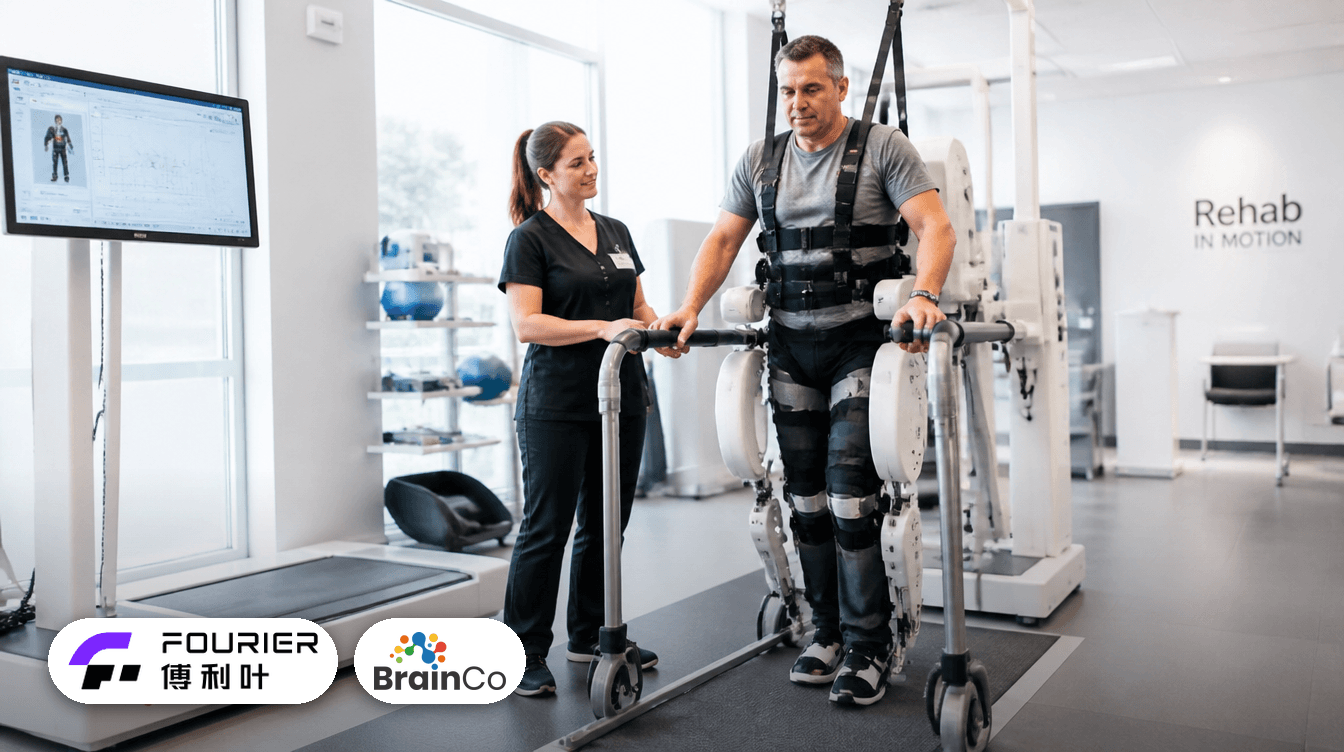
The medical segment in our catalog is the smallest by model count and the most demanding on paperwork — what matters here isn't production-speed percentages, it's certification and clinical data. Two factories: Fourier (Shanghai, exoskeletons and humanoids) and BrainCo (Hangzhou, neural interfaces).
BrainCo: the hand that made Time's list
BrainRobotics is a bionic hand controlled by a combination of neural signals and electromyography (reading electrical activity from the residual limb's muscles). In 2019 it made Time magazine's list of best inventions, received FDA clearance, and is now in serial production — a path from prototype to an approved medical device that's rare for neural-interface hardware.
The same neural-interface platform underlies a line of upper-limb prosthetics for different amputation levels — not one model for everyone, but a lineup matched to specific clinical cases.
BrainCo also makes wearables for other purposes: rehabilitation devices for recovering motor function after injury or stroke, and cognitive-training devices based on reading EEG signals (the brain's electrical activity) — so it's not just prosthetics, it's non-invasive rehab too.
Fourier: humanoids and a rehab exoskeleton
Fourier makes two humanoids — the GR-1 (165 cm, 55 kg, 40 degrees of freedom, walking speed up to 5 km/h) and the GR-2 (175 cm, 63 kg, 53 degrees of freedom, joint torque up to 380 N·m, 12-DoF hands, a swappable 2-hour battery). The jump between generations isn't just height and weight — it's a leap in joint torque and a swappable battery that removes charging downtime.
ExoMotus is a lower-limb exoskeleton built for a different job entirely — not industrial load-carrying, but rehabilitation for spinal-injury patients relearning how to walk. That's a fundamentally different buyer than a warehouse or factory: clinics and rehab centers.
What this means in practice
Medical devices on this list can't just be "bought and switched on" like a warehouse robot — they need certification for the jurisdiction where they'll be used, and often ongoing clinical support. We help sort out those requirements at the consulting stage, before ordering, not after the equipment is already in transit.
The BrainCo and Fourier factories are part of the Aura Robotics Tour route for delegations focused on medical technology and rehabilitation equipment.
These factories are on the route of our Robotics Expedition — see them in person, not just on video.