
гуманоидные роботы · EngineAI · динамика движений · открытая платформа
EngineAI: humanoids that walk faster than a person
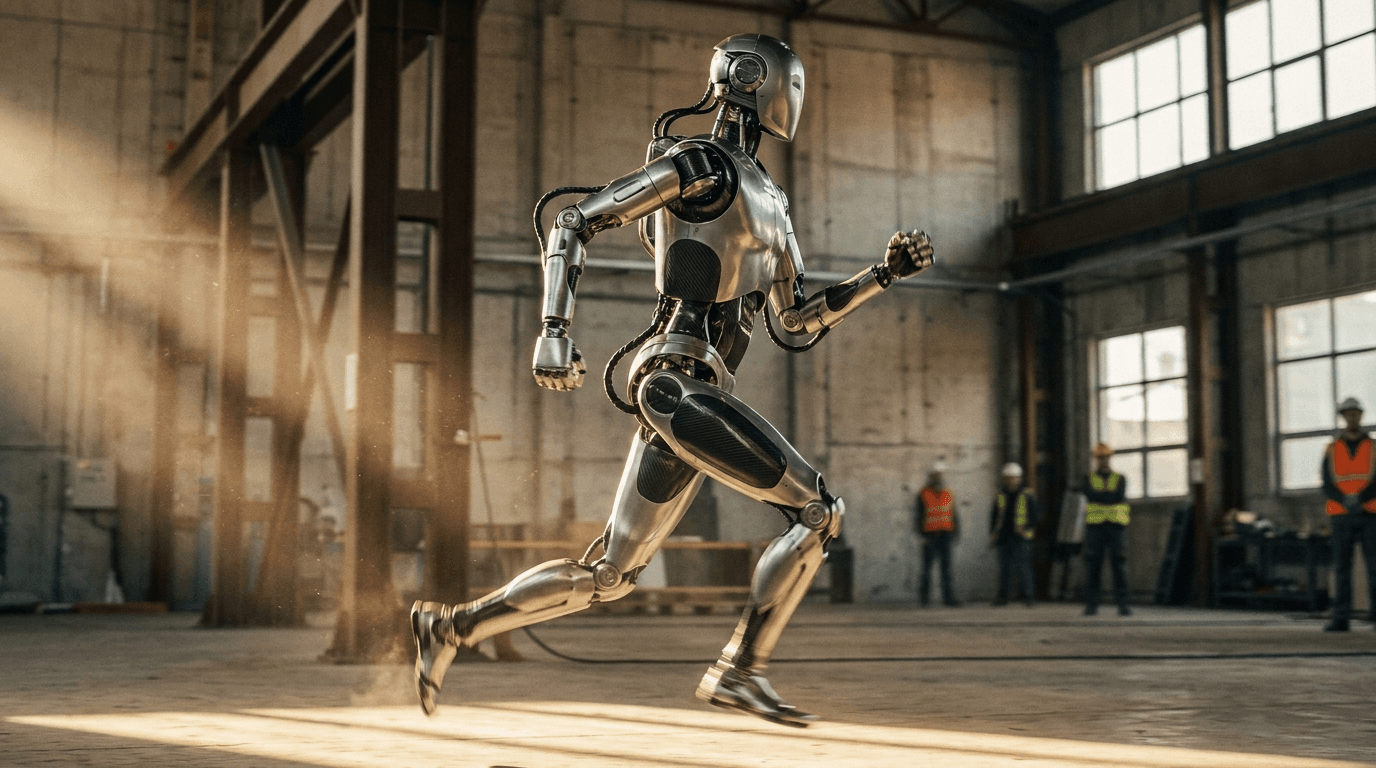
Most humanoids in promotional videos walk carefully — a measured pace, so as not to lose balance on camera. EngineAI / 众擎机器人 took the opposite approach: the company became known specifically for the high dynamics of its movement, not for a careful but slow gait.
A young player betting on speed and openness
EngineAI is a comparatively young company from Shenzhen built around two principles from day one: an affordable entry price and an open platform for developers. The second point matters as much as the first: a closed architecture means a purchased robot does exactly what the manufacturer built into it, while an open one lets the customer's own programmers add behaviors without waiting for a factory update.
PM01: an open platform for going deeper
PM01 is an open-source modular platform with a touchscreen and end-to-end neural-network locomotion control. "End-to-end" here means a single model turns sensor data directly into actuator commands, without a chain of dozens of separately tuned modules — which simplifies and speeds up customizing behavior for a non-standard task.
SE01: 32 degrees of freedom for a natural gait
SE01 is a full-size humanoid with a natural, human-like gait on the same end-to-end architecture: 32 degrees of freedom give the robot enough joints to move smoothly rather than the jerky motion typical of simpler designs.
T800: a flagship whose numbers speak for themselves
The line's flagship, T800, stands 173 cm tall and weighs 75 kg — close to an average adult's proportions. The body carries 29 degrees of freedom, plus 7 more per hand — giving it flexibility approaching a human arm down to the fingers. Actuator torque reaches up to 450 N·m — this figure determines how confidently the robot holds balance and carries load through sudden movements, not just steady walking. And the headline number is a walking speed of up to 7 m/s: that's faster than an average person's jogging pace (a comfortable jog is around 2.5–3 m/s), and several times faster than most humanoids demonstrated today, which rarely exceed 1.5–2 m/s. Power comes from a solid-state battery good for roughly 3 hours of operation: solid-state cell chemistry delivers more stable power output under heavy load than conventional lithium-ion cells.
Where this kind of dynamics actually matters
High speed and stability over rough surfaces aren't an end in themselves — they answer specific scenario requirements. The company is targeting security applications (the robot needs to react and move faster than an intruder or a rule-breaker), museum tour-guide duty (constant movement through a hall without lagging behind visitor flow), and stage shows, where synchronized, fast motion is itself part of the performance. The PM01, SE01 and T800 line is featured in the EngineAI catalog card.
What to weigh when choosing
For a stationary assembly-line role, high walking speed isn't critical, and it's smarter to look at models built for arm payload instead. But for tasks where the robot has to cover a large area in limited time — patrolling, escorting a group of visitors, stage routines — movement dynamics, not grip strength, becomes the deciding parameter. It's worth paying attention to how the company balances speed with safety: the faster a robot moves, the more its emergency-stop and collision-avoidance systems matter, because the cost of an error in fast motion grows non-linearly with speed. PM01's open architecture works, in this sense, as a tool for third-party developers to fine-tune exactly the safety algorithms for a specific operating environment — a museum with a dense visitor flow and a guarded facility perimeter impose very different requirements on reaction distance and permissible speed around people. This is a case where platform openness isn't just a marketing line about "developer accessibility" — it's a practical mechanism for tailoring robot behavior to a customer's specific safety regulations, something a factory can rarely anticipate in advance. One last thing worth clarifying at the selection stage: actual battery runtime in the specific target scenario, not just the spec-sheet figure — dynamic motion drains energy noticeably faster than calm walking, so the stated hours of runtime are almost always calculated for an average, not a peak, operating regime.