
китай · образование · embodied intelligence · кадры · вузы
Embodied intelligence as a major: Chinese universities train a new kind of engineer
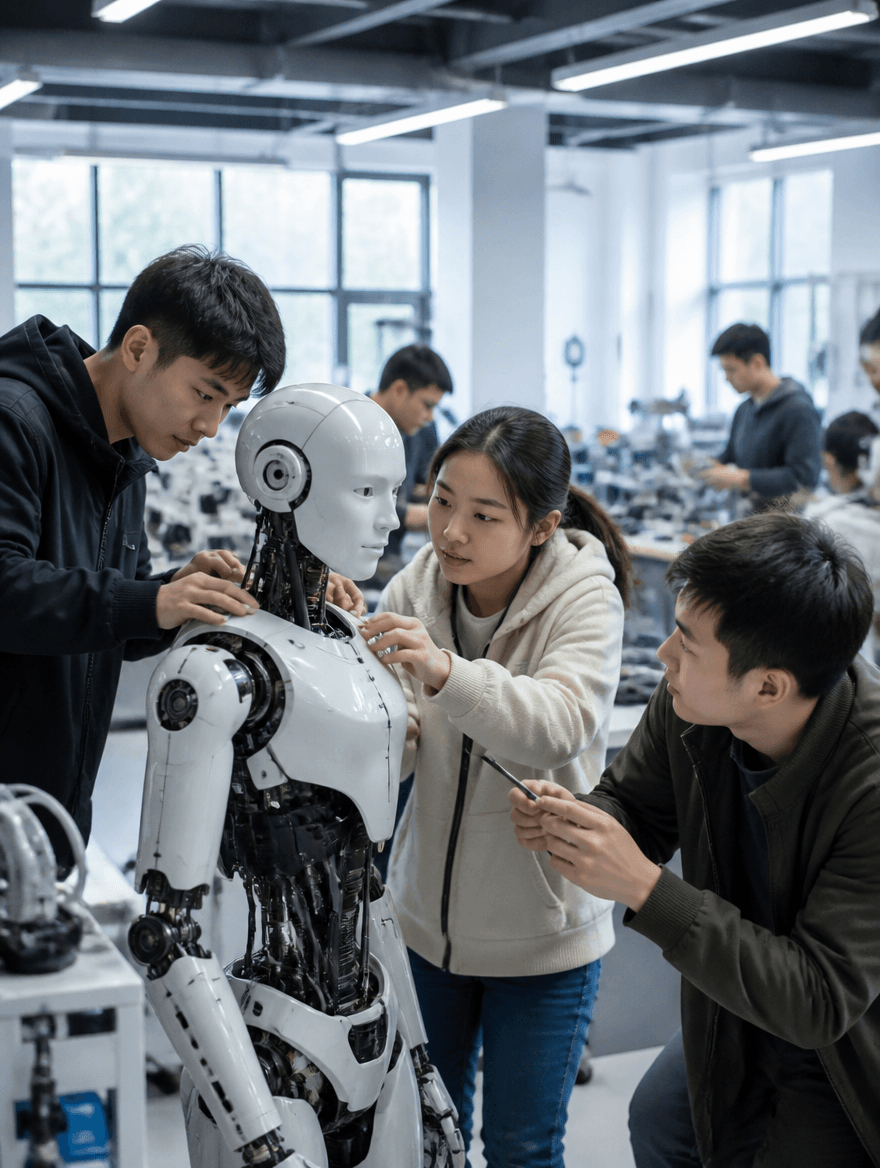
In 2026, China's Ministry of Education added "embodied intelligence" — a major sitting at the intersection of robotics, machine learning, and mechanical engineering — to the official national catalog of higher education majors, alongside 37 other new fields introduced at the same time. For an education system as large as China's, official inclusion in the catalog carries far more weight than opening a single department at one university: it signals to every regional university in the country that the state considers the field strategic and expects mass student enrollment for years to come.
Which universities are the pioneers
The ministry explicitly named nine pioneer universities, including Harbin Institute of Technology (one of the country's oldest and most respected engineering schools, known for its work in aerospace and precision machinery) and Beihang University (Beijing University of Aeronautics and Astronautics). The choice of these particular schools isn't accidental — both have decades of expertise in mechanics and precision engineering, and embodied intelligence as a curriculum requires exactly that combination of classical mechanical engineering with modern machine learning, not either field in isolation.
Tsinghua's institute as a sign of serious intent
Alongside the ministry's decision, Tsinghua University — informally regarded as the country's leading technical school — created a dedicated Institute for Embodied Intelligence and Robotics, bringing automation, mechanical engineering, electronics, and computer science under one roof. This kind of organizational structure, folding previously separate departments into a single institute, signals that Tsinghua treats embodied intelligence not as a passing educational trend but as a permanent field requiring its own administrative and research infrastructure.
Where the talent gap actually originates
The shortage of specialists at the intersection of mechanics, electronics, and machine learning that this university reform aims to close doesn't start at university — it starts years earlier, with whether a future student ever assembled a physical device at all, rather than just swiping through apps as a kid. This is backed up by data on the educational robotics boom: Chinese company WhalesBot, for instance, has sold more than a million kits for teaching children robotics and ran a tournament with a million participants — not an isolated marketing project, but part of a broader talent pipeline working both "top-down" (new university majors) and "bottom-up" (children's educational robotics) at once.
The scale of the workforce need
According to the World Economic Forum, by 2030, 39% of workers worldwide will see a significant share of their core skills change, with AI and technical literacy among the fastest-growing labor-market competencies. Applied to China, that means achieving stated goals for large-scale humanoid deployment — including a target of roughly 100,000 deployed units by 2027 cited in state programs — will require a base of integration engineers that simply doesn't exist in sufficient numbers today, and it's precisely that gap the first graduates of the new major are meant to fill in five to ten years.
What it means for the rest of the world
China's push to institutionalize embodied intelligence as a standalone university major is a rare case of an education system trying to keep pace with an industry rather than lagging a decade behind, as is often the case with emerging technology fields. Other countries hoping to compete in humanoid manufacturing will have to solve the same question — where to find engineers who understand mechanics, electronics, and machine learning at once — and China's simultaneous top-down/bottom-up talent model may or may not be replicable elsewhere: a lot here depends on a scale of state funding that other countries don't always have at their disposal.
More on the companies hiring exactly this kind of specialist can be found in our robotics manufacturers catalog.