
промышленные роботы · Efort · сварочные ячейки · окрасочные роботы
Efort: an automotive-born public company selling turnkey cells, not just robots
Buying a robotic arm and getting a fully working section of a shop floor are two different products, even when both get called "an industrial robot." Efort / 埃夫特智能装备, a publicly listed company from Wuhu that grew out of the automotive industry, specializes in exactly the second option — not a standalone arm, but a complete technology cell.
Automotive roots and a European engineering culture
Efort grew out of the automotive industry — a segment that from the outset demands strict reliability and cycle-time stability from robots: the line can't stop. A distinctive feature of the company is its ownership of European integrator assets — divisions that have historically designed and assembled production lines in Europe. That shows in the engineering culture: where purely Chinese manufacturers more often offer a standalone manipulator, Efort by default thinks in terms of a "turnkey section" — complete with fixturing, a positioner, and a power source.
The ER series: payload matched to the task
The base manipulator line, the ER series, spans from 20 kg at a 1.7 m reach to 35 kg at a 1.8 m reach. The gap between models isn't just spec-sheet numbers: the greater the reach and payload, the larger the workpiece or part the robot can handle without losing accuracy at the far end of its work envelope. Applications include welding, machine tending, dispensing (for example, applying glue or sealant in precise doses) and assembly.
Painting robots: uniformity as the headline metric
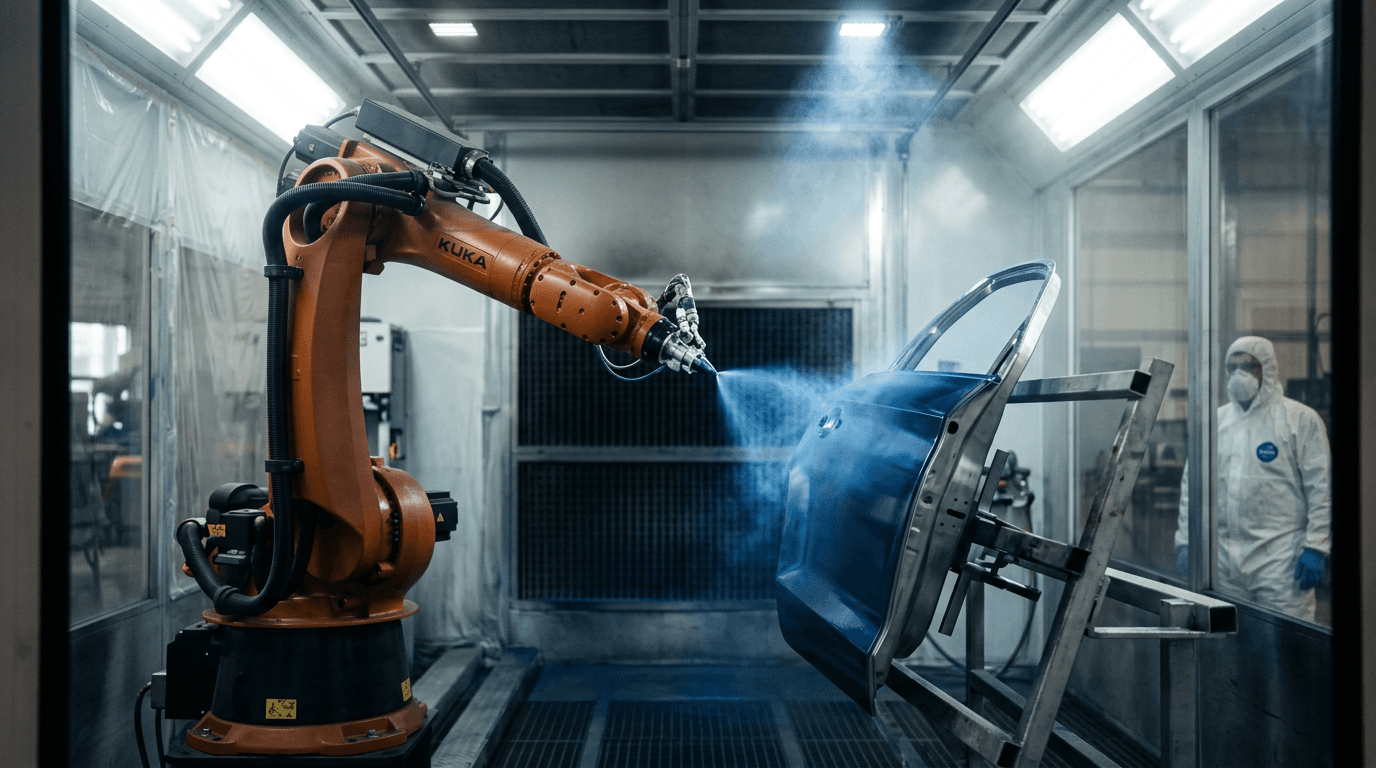
A separate product line covers robots for automated coating application. The key metric here isn't payload but material-application uniformity: an uneven coat of paint means either wasted expensive material or visible finish defects that require rework. Robotic application removes the human factor from that equation — the robot's arm repeats the same trajectory and speed on every part.
Welding cells: a complete solution, not a parts kit
An Efort welding cell is built around a manipulator with a 10–12 kg wrist payload, paired with a welding power source and a positioner — a device that rotates and tilts the workpiece so the seam always sits in a position convenient for the robot. It's exactly this completeness — the power source and positioner already matched and configured to the manipulator — that spares the customer the separate job of integrating components from different vendors.
What this means in practice
The ER line, along with Efort's painting and welding cells, is featured in the catalog. For a shop owner choosing between a standalone manipulator and a turnkey cell, the difference ultimately comes down to time-to-launch: a complete cell requires less on-site integration work, though it also comes more narrowly specialized to one operation compared to a general-purpose manipulator. Efort's European integrator heritage also shows in how a project gets documented: a turnkey cell typically ships with a full technical documentation package — setup sheets, positioner motion cycle charts, power-source maintenance schedules — which noticeably speeds up internal acceptance at plants with the kind of formalized quality-control procedures typical of automotive and adjacent industries. For a plant deploying a robot into a specific process step for the first time, that removes a meaningful chunk of risk: instead of writing operating procedures from scratch, the engineering team gets an already field-tested procedure set tailored to that specific cell configuration, rather than a generic manipulator user manual detached from the actual task. One more point worth raising in advance: how well a turnkey cell fits the equipment already installed on-site — the paint booth's ventilation system, the welding station's power supply, the shop's existing control system. A turnkey solution saves time on integrating its own components with each other, but it doesn't remove the need to check it against a specific plant's infrastructure at the design stage, rather than after the equipment arrives on-site.