
робособаки · DeepRobotics · сварочные роботы · EVS · промышленная автоматизация
Inspection quadrupeds and EVS welding robots: a guide to the industrial lineup
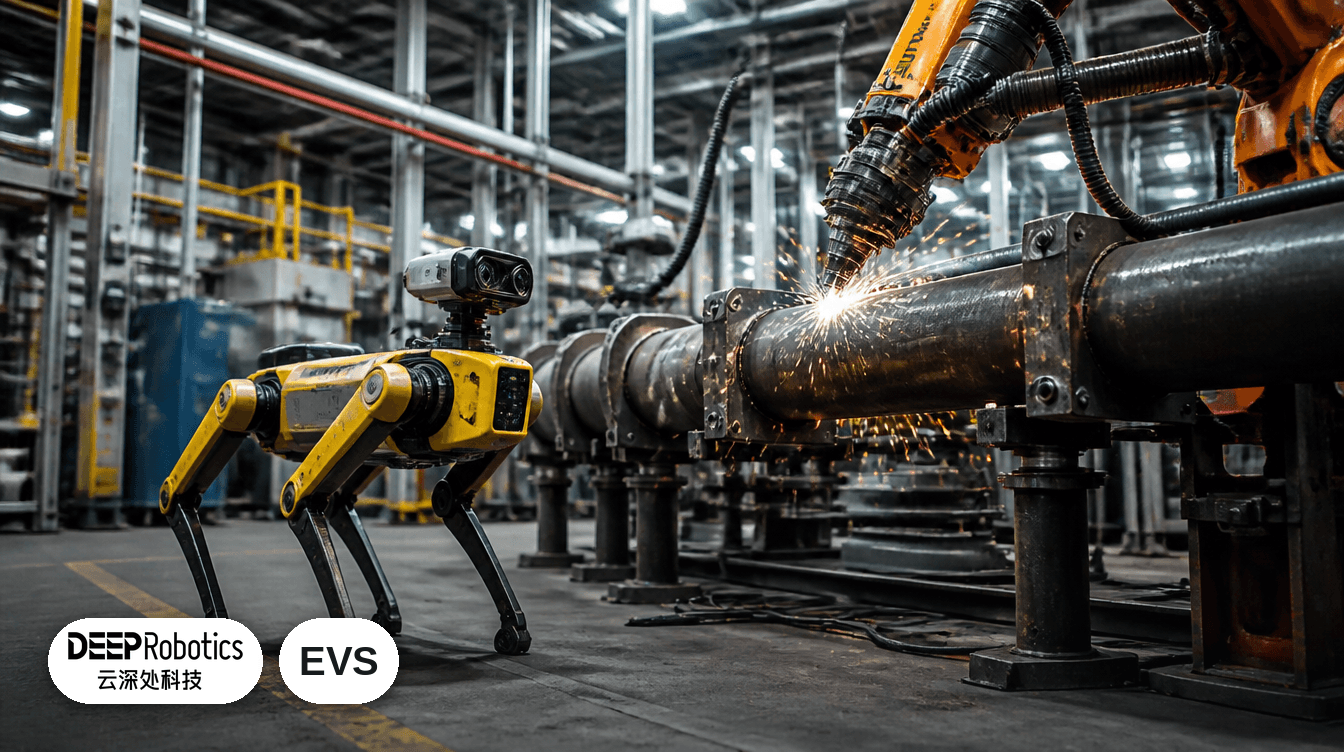
Humanoids grab the headlines, but an industrial buyer's first real purchase is usually an inspection quadruped or a welding robot. Both categories in our catalog break down into clear, measurable numbers. Here they are.
DeepRobotics quadrupeds: X20, X30, Lite3
X20 is the workhorse: IP66-rated, runs from -20°C to +55°C, climbs ledges from 20 cm and slopes up to 45°. Enough for regular rounds at substations, pipelines, warehouses.
X30 is built for longer routes: IP67 (brief water immersion), 2.5-4 hours of runtime versus less on the X20, denser sensors. Chosen for long patrols without recharging — quarries, long pipeline runs.
Lite3 is the light entry point: 12-13.5 kg, 2.5-4.5 kg payload, 1.5-2 hours of runtime. Good for a pilot or simple indoor inspection without extreme conditions.
There's also Jueying Lite — a base predecessor to Lite3, more suited to R&D than industrial deployment.
EVS welding robots: how the stations differ
EVS CS14V10 is a tracked welder, 36.5 kVA station power. It drives itself along the seam when the part can't be moved — large steel structures.
The gantry station moves along an overhead frame — a wider work zone, no tracks needed.
The nine-axis cantilever station adds a rotary table and linear travel to the robot's six axes — the part gets welded from every side without re-fixturing. That saves cycle time immediately and removes the positioning error that almost always creeps in during manual re-fixturing.
The seven-axis rail station runs on a linear rail and services several stations in sequence — one robot instead of a separate install at every position.
Beyond welding, EVS also makes Zhi-series delta robots (Hua — base model for light items, Kong — with machine vision for sorting, Sheng — for heavier parts), SCARA arms for assembly and screwdriving, guard-free collaborative robots, standard 4- and 6-axis arms, and palletizers.
How to choose
Inspection: short, predictable route — go with Lite3, it's cheaper. Large site or harsh conditions (mud, water, temperature swings) — X20 or X30, depending on how much autonomy you need.
Welding: part fixtures at one point — a standard 6-axis robot is enough. Large, linear parts (pipes, beams, hulls) — the tracked CS14V10 or a gantry station. Need to weld from multiple sides without re-fixturing — the nine-axis cantilever station, which usually pays for itself on complex geometry through shorter cycle times.
We take clients to DeepRobotics' factory in Hangzhou and EVS production sites as part of the Aura Robotics Tour — you can see the welding cycle or patrol route in person before signing anything.
These factories are on the route of our Robotics Expedition — see them in person, not just on video.