
чипы · полупроводники · Huawei Ascend · гуманоиды
A humanoid's brain still isn't made in China: chips remain the weak link in localization
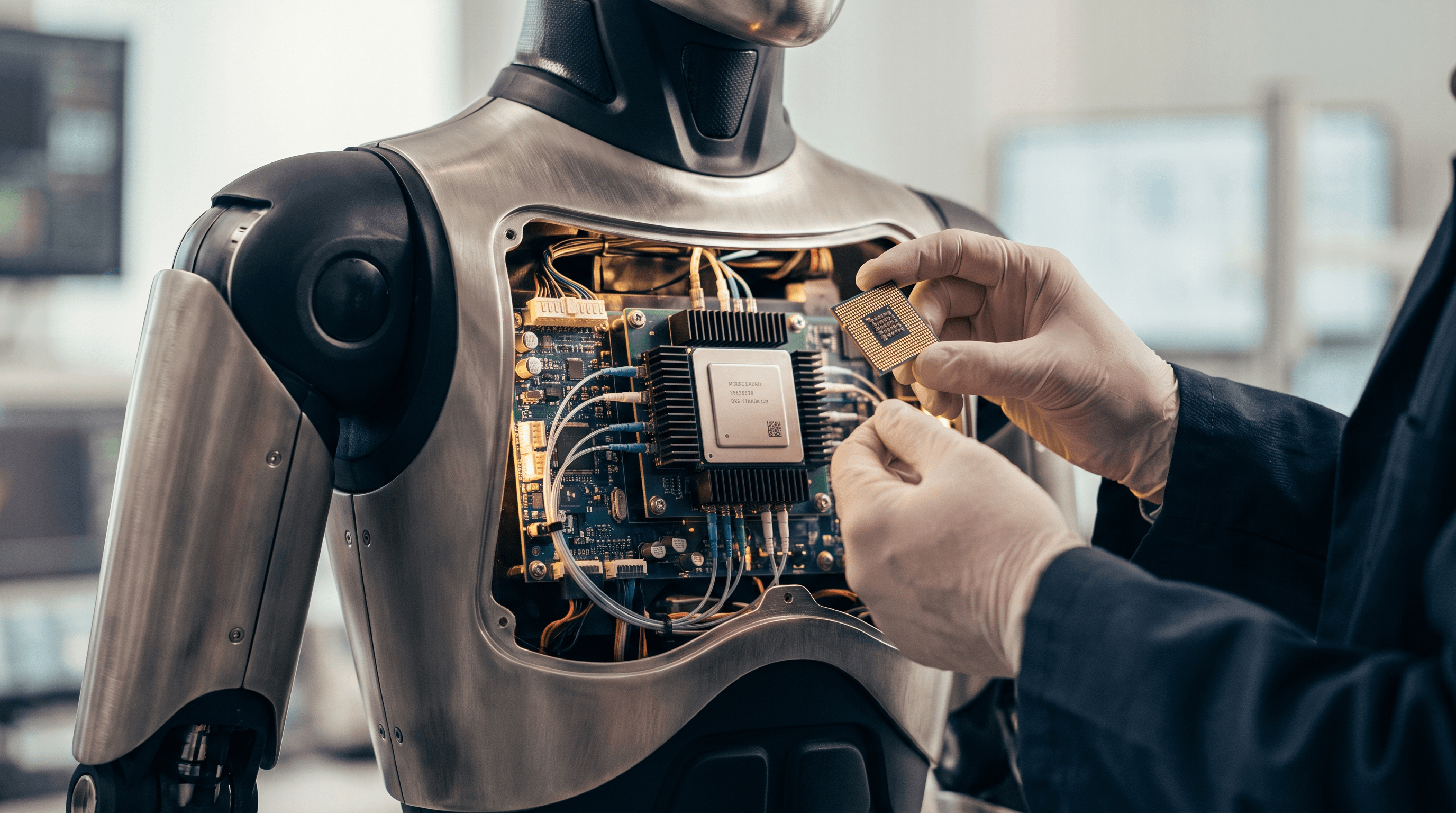
Localization of Chinese robotics components — servo motors, harmonic reducers, sensors — has come a long way in recent years, pushing domestic suppliers' share in these categories to a controlling stake. But in one component, the picture remains fundamentally different: the AI inference chips that handle environmental perception, decision-making, and motion planning in nearly every operating humanoid platform are still mostly manufactured at Taiwan's TSMC, and Nvidia Jetson modules power a significant share of Chinese humanoids.
Why this component is so hard to replace
A servo motor or reducer is precision mechanics, where core competencies are built over decades of engineering experience and capital-intensive machine tool investment. An AI inference chip is an entirely different class of complexity: manufacturing modern semiconductors at leading-edge process nodes requires lithography equipment concentrated among a limited number of global suppliers, and exporting such equipment to China is subject to separate restrictions. That's precisely why mechanical localization has run years ahead of semiconductor localization.
What Huawei is doing
Industry reviews assess that domestic AI accelerators, including the Huawei Ascend line, will increasingly replace Nvidia Jetson modules in Chinese humanoids as the performance gap narrows and supply becomes more predictable. This isn't full displacement yet — it's a gradual expansion of usage share in new models, with robot manufacturers building in compatibility with multiple computing platforms to avoid dependence on a single supplier.
What it means for a robot buyer
For an end buyer of a Chinese robot, chip provenance rarely matters on its own — actual recognition performance and system reaction speed matter far more. But for the industry as a whole, dependence on a foreign semiconductor link remains a systemic risk: this exact component became the subject of US export restrictions in July 2026, aimed at finished robots — and it's reasonable to expect the next round of regulatory attention to target the component base rather than just finished products.
A catalog of Chinese robot manufacturers is available on the Aura Robotics site.