
китай · catl · гуманоиды · батареи · производство
CATL and the 'Xiaomo' robot: a humanoid assembling batteries for its own maker
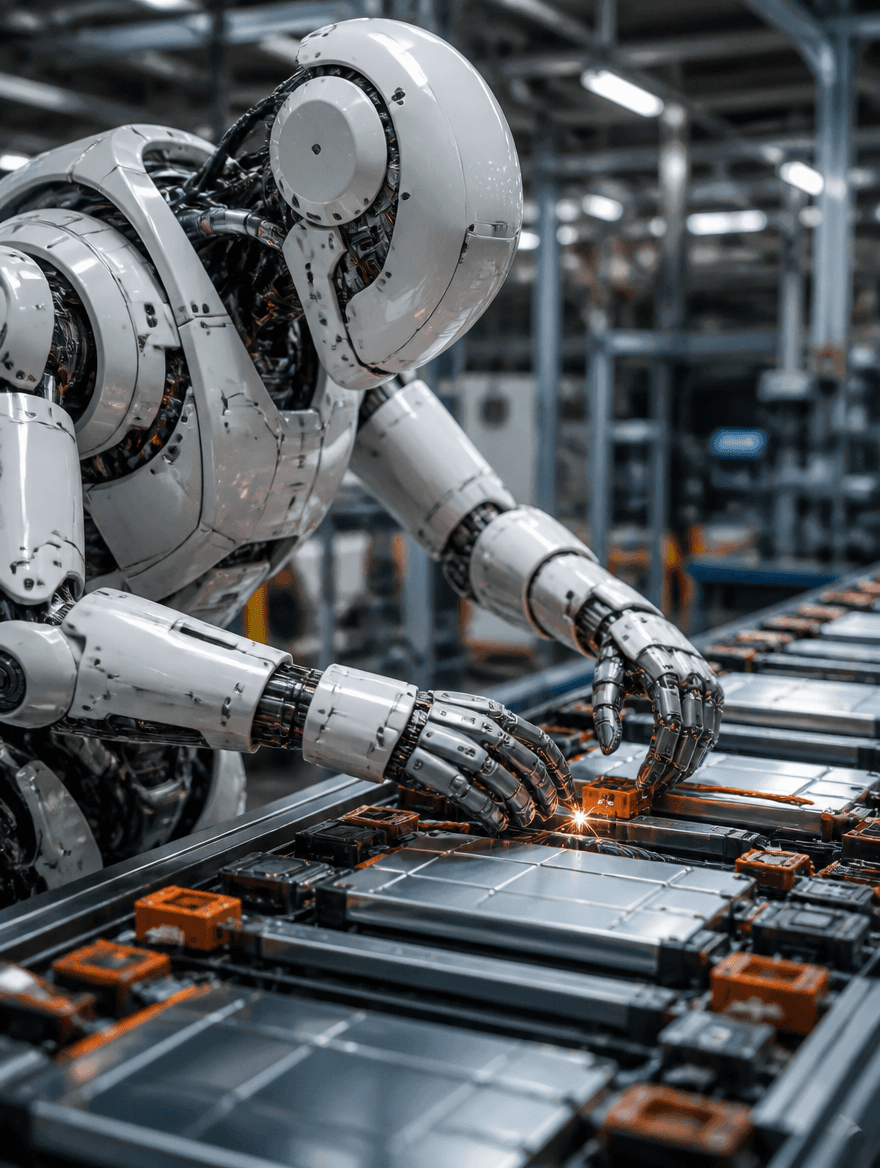
Technology history rarely produces a feedback loop this literal: the world's largest battery manufacturer uses a humanoid robot that runs on its own batteries to assemble those very batteries. That's the deployment of the 'Xiaomo' robot at the CATL 宁德时代 / Contemporary Amperex Technology Co., Limited (CATL) plant in Luoyang, China.
What Xiaomo does on the line
In December 2025, CATL — the world's largest lithium-ion battery manufacturer, supplying cells for a significant share of the global auto industry — deployed a humanoid named Xiaomo at its Luoyang plant, developed by Chinese startup Spirit AI. The robot's task is both narrowly specific and physically demanding: connecting high-voltage connectors on a battery module assembly line.
That operation sounds simple, but actually requires jeweler-grade precision: high-voltage connectors carry voltage that makes any connection error potentially dangerous, both to the module itself and to surrounding equipment. The stated accuracy for the operation is above 99%, at three times the average daily output of a human operator on the same task.
Why CATL specifically needs this
CATL's logic is transparent: the company manufactures battery cells at industrial scale, measured in hundreds of gigawatt-hours annually, and any bottleneck on the module assembly line directly translates into lost output. Manual assembly involving high-voltage connector attachment is exactly that kind of bottleneck — a monotonous operation requiring sustained attention throughout a shift and physically tiring due to precise, repetitive hand movements.
Automating this particular step with a humanoid robot rather than a specialized industrial manipulator gives CATL added flexibility: unlike a rigidly programmed arm built for one specific connector model, a humanoid running a vision-language-action model can retrain for a new battery module configuration much faster — important for CATL, whose battery product line updates regularly to meet new automaker requirements.
The technology inside
The robot runs on a vision-language-action (VLA) model — an AI architecture that unifies visual perception, natural-language instruction understanding, and generation of physical actions into a single loop. This fundamentally sets it apart from previous-generation robots that operated on rigidly fixed motion trajectories: a VLA model lets the robot adapt its precise grasping and connection trajectory in real time, reacting to small deviations in part positioning.
Another telling detail: between primary operations, the robot autonomously switches into line-inspection mode — performing a secondary quality-control function without an additional operator command. It's an example of how a humanoid platform's inherent versatility can cover several tasks at one workstation instead of sitting idle between primary operation cycles.
The symbolism of the moment
One detail deserves particular attention: the robot runs on CATL's own batteries. Formally, that's just a logical choice of power supplier at its own plant — CATL is hardly going to buy someone else's batteries for internal use. But symbolically, it illustrates a broader trend: Chinese companies from adjacent but distinct industries (batteries, robotics, AI) are beginning to form closed technology loops, where one company's product becomes another's infrastructure, and both benefit from scaling together.
For startup Spirit AI, the CATL partnership isn't just a robot supply contract — it's a chance to refine its VLA model on a real, extremely precision-demanding industrial process, which can subsequently be replicated across other heavy-industry segments.
What this means for the battery industry at large
The CATL case is also interesting because it shows that humanoid robotics doesn't necessarily arrive in an industry from outside, as a finished off-the-shelf solution. Large industrial companies with stable cash flow and a well-defined, repeatable production operation are increasingly acting not just as customers but as co-investors and testing grounds for tuning specific VLA models to a specific process. For other battery makers — not just in China, but in Korea, Japan, and the US — CATL's successful experience becomes a benchmark: if the industry's largest player could automate high-voltage connector assembly with a humanoid at over 99% accuracy, the question for competitors is no longer whether to try, but how fast they can catch up.
If your company is interested in similar solutions for precision manufacturing assembly, Aura Robotics' catalog can help you find vetted suppliers of humanoid and specialized industrial robotics.