
строительная робототехника · Bright Dream Robotics · Fangshi Robotics · автоматизация стройки · каталог
Robots vs. Wet Concrete: Two Approaches to Construction-Site Automation in Aura's Catalog
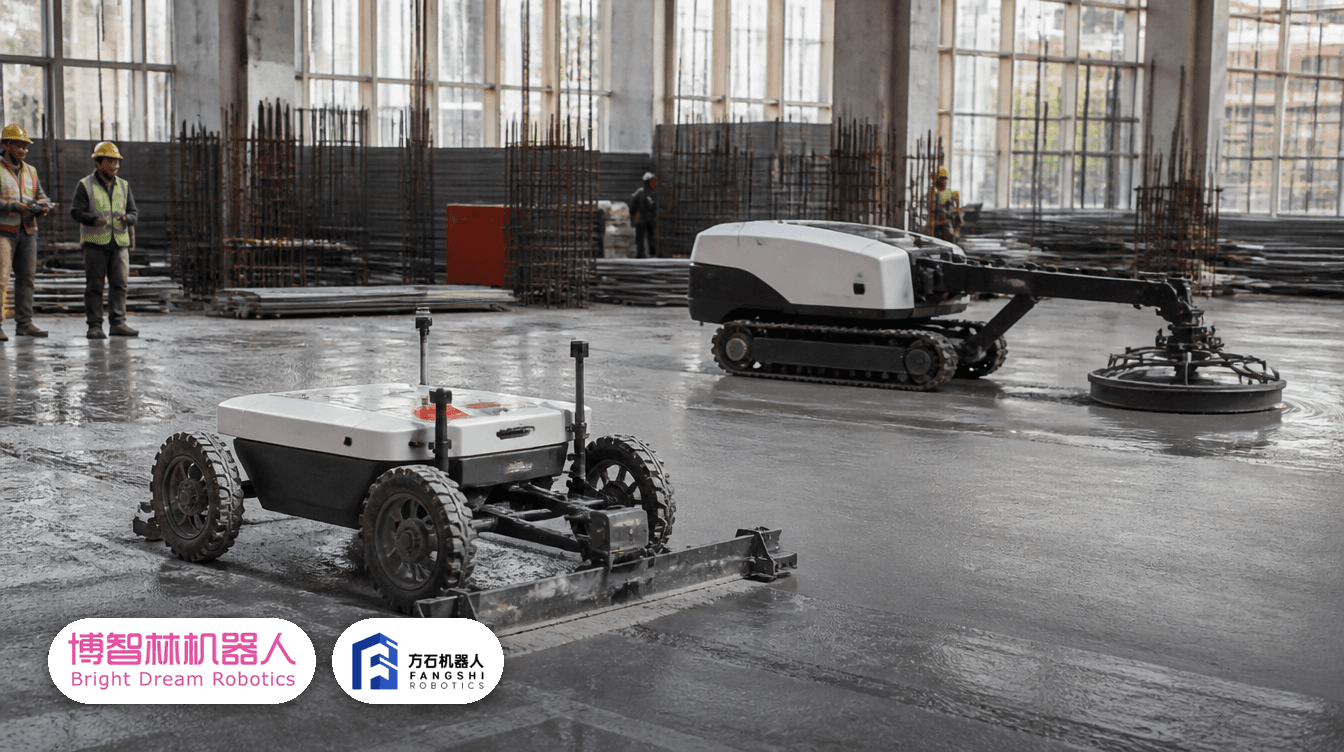
The construction site is one of the few environments where robots are still nearly absent, even though the work there is some of the hardest and most injury-prone: pouring concrete, troweling floors, laying tile. Two manufacturers in Aura's catalog approached automating this environment from opposite ends — and both have already moved well past the pilot stage.
Bright Dream Robotics: a platform, not just a lineup of robots
博智林 / Bright Dream Robotics is a subsidiary of developer Country Garden, founded in 2018 in Foshan. By the company's own count, about 50 construction-robot models are in development, more than 30 have been field-tested on real sites, and 18 are already in commercial use. By October 2021, the company had filed 3,281 patent applications and been granted 1,431 patents — an engineering scale that looks less like a startup and more like an industrial R&D center.
But the real story isn't the number of models — it's how they work together. In December 2021, Bright Dream Robotics deployed its BIM+FMS+WMS system, which automatically distributes tasks among multiple robots on site based on a digital BIM model of the building. That's a fundamentally different kind of problem than "a robot performs one operation": the system has to know which section is ready for the next phase of work and route the right robot there without a human dispatcher.
Fangshi Robotics: three flagship operations perfected into a product line
方石科技 / Fangshi Robotics took the opposite path — instead of a broad lineup, it took a narrow set of operations and pushed them to serial production and commercial scale. Its flagship trio: a laser floor-leveling robot on four wheels (a real-time system checks screed flatness), a tracked trowel robot, and a four-disc trowel robot for large areas. Beyond those, the company also makes robots for concrete-floor work, building surveys, and interior finishing.
The deployment numbers speak for themselves: a presence in over 80 cities, more than 100 construction-company clients including China State Construction, China Railway Construction, and Shanghai Construction Group, and over 500 completed projects — among them Guangzhou Baiyun Airport. The company's robots have also worked on an infrastructure project in Singapore — a rare case of an actual overseas contract for a Chinese construction-robot maker, not just a trade-show demo.
Renting instead of buying is part of the model too
Worth noting separately: Fangshi doesn't just sell robots — it offers them bundled with a labor service. A client can effectively rent a robot along with an operator and a finished result, rather than buy equipment as a capital expense. For a general contractor, that removes the questions of staff training and equipment maintenance — you pay for completed work volume, not for owning a robot.
Two different answers to one investment question
Bright Dream Robotics is betting on the platform approach: the more robots working in sync under one control system, the higher the return on investing in the orchestration system itself rather than in any single machine. Fangshi Robotics, by contrast, shows that for specific, frequently repeated operations (troweling, leveling), a specialized robot with clear rental unit economics scales faster than a general-purpose platform.
For anyone evaluating construction-site robotics, the question isn't "which robot is better" — it's a question of task scale: for dozens of sites run by a single developer with standardized processes, Bright Dream Robotics' approach is compelling. For a specific, repeated operation across sites belonging to different clients, Fangshi's rental-plus-service model removes more risk at the start.
Full spec sheets for the Bright Dream Robotics factory and the Fangshi Robotics factory are in Aura's catalog, with the complete model lineup.
Why this became possible only now
For decades, construction sites were considered too unpredictable an environment for robots: uneven surfaces, dust, a project's geometry changing at every stage. Both manufacturers solved that not by giving the robot general-purpose intelligence, but by narrowly specializing its sensing for one specific task — laser flatness control at Fangshi, or a BIM model as the single source of truth about site conditions at Bright Dream Robotics. In both cases, the robot isn't trying to "understand" the construction site as a whole — it works from a precise digital description of one specific parameter. That's exactly what makes the automation work outside a lab, not just on a trade-show floor.
Requires confirmation
Lead times and exact rental/purchase pricing for both companies' robots aren't given here — they get confirmed individually based on the site and volume of work.
🔗 https://www.aura-robotics.ru/ — choose a robot for your task
These factories are on the route of our Robotics Expedition — see them in person, not just on video.