
промышленные роботы · Borunte · литьё под давлением · штамповка
Borunte: a publicly traded robot maker that pulls parts straight out of the molding machine
Most industrial-robot makers in China are private companies whose financial statements are invisible to a buyer. Borunte Robot / 伯朗特 is an exception: the company was founded in 2008 in Dongguan, Guangdong province, and has been listed on the New Third Board — China's over-the-counter market for mid-size companies — since January 2014. Its registered capital is 225 million yuan, and its subsidiary Shenzhen Huacheng Industrial Control was separately admitted to trading in December 2020.
Why a buyer should care about public-listing status
Public disclosure isn't an abstract detail for investors — it's a practical signal for an equipment buyer: a company obligated to regularly disclose financials is less likely to vanish from the market without warning, and it typically maintains a more stable service network, since its reputation is on the line with regulators and shareholders, not just with customers.
A full line — from general-purpose to highly specialized
Borunte's lineup is unusually broad for a single manufacturer: general-purpose six-axis robots with 1 to 500 kg payload and 500 to 3,500 mm reach, four-axis palletizers, SCARA robots for fast small-part assembly, collaborative robots for working alongside people without a safety cage, and parallel (delta) robots from 3 kg for high-speed picking and packing with a machine-vision system.
Stamping and injection molding — a specialization rarely offered separately
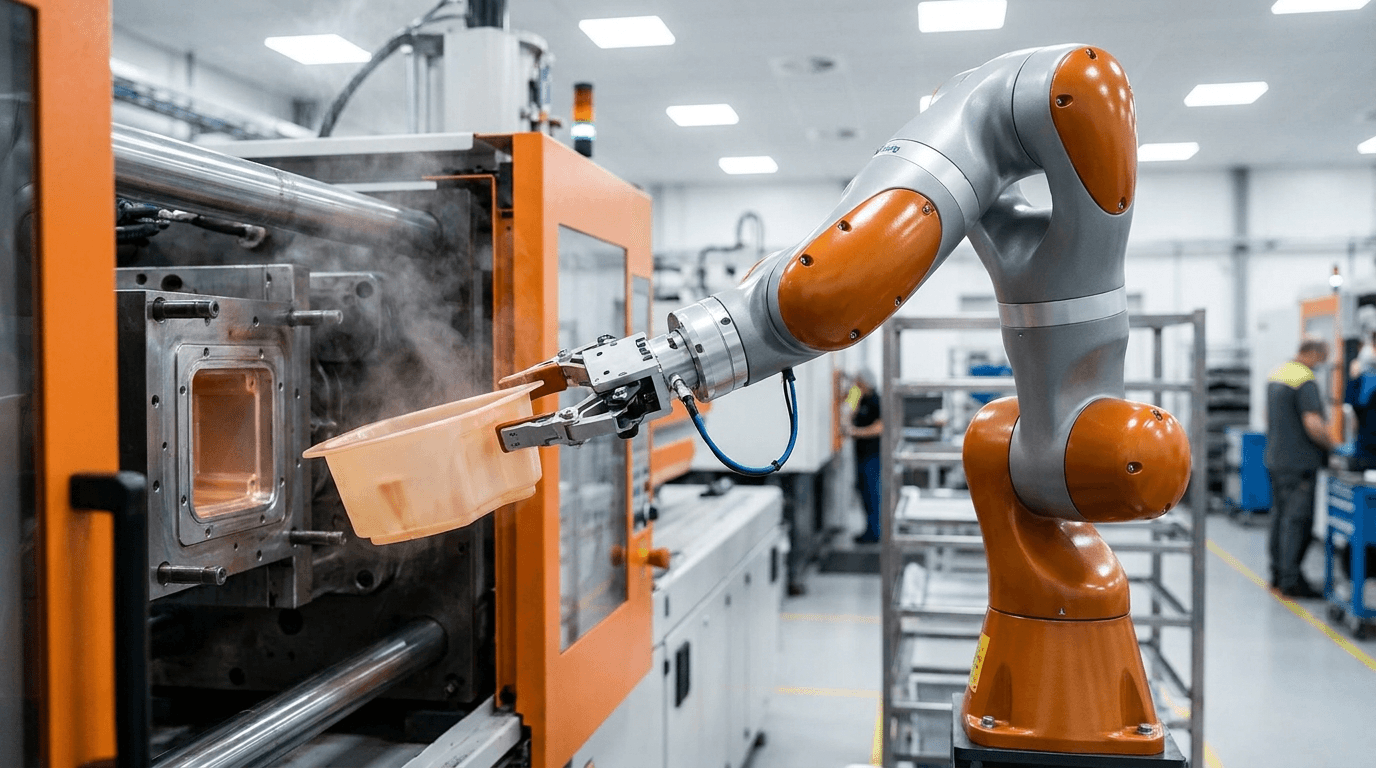
Two narrow lines deserve particular attention: stamping robots for tending presses (loading and unloading blanks in sync with the press cycle, where timing is measured in fractions of a second) and injection-molding robots, which extract the finished part from the mold right after injection molding, while the plastic is still hot and the tool hasn't cooled for the next cycle. That second job is one of the most common tasks in plastic-parts manufacturing, and automating it directly removes the risk of burns and injuries to an operator working next to hot tooling.
Broad coverage of a single shop's operations
Borunte's applications span almost every operation in a typical shop: packaging, injection molding, machine loading and unloading, assembly, metalworking, electronics, material handling, stamping, grinding, welding, palletizing, painting and bending. That breadth is typical of large Chinese manufacturers: they cover the full automation cycle of a single shop rather than a single operation, which simplifies vendor selection for a plant that needs to solve several different tasks at once. Borunte's full line — from six-axis robots to injection-molding robots — is featured in the factory's catalog card.
What to look for
If a shop works with plastic molding, a specialized injection-molding robot immediately closes a known bottleneck — the mold-unloading point that used to require an operator. For more general assembly and handling tasks, the general-purpose six-axis line, spanning 1 to 500 kg payload, lets you match one model to different stations across the same plant without switching between manufacturers. A practical nuance for a plant running both an injection-molding station and a stamping station in parallel: robots from the same line can service both processes, and therefore be supported by a single technical team. Borunte's specialized injection-molding and stamping robots run on the same control platform as the company's general-purpose six-axis models, so operator and programmer training doesn't have to be duplicated for each separate equipment type — the programming interface and setup logic stay recognizable regardless of the specific job at hand. The line's wide payload range, from 1 to 500 kg, also means a plant can start with one or two models for a specific task and then expand its equipment fleet to new stations without switching suppliers or risking incompatibility between different manufacturers' equipment on the same production floor. Finally, for a plant running several types of molding machines of different ages, it's worth asking the supplier about the compatibility range of injection-molding robots with the already-installed equipment fleet — the interface between a robot and a press can differ between molding-machine manufacturers, and confirming compatibility upfront saves far more time at commissioning than sorting it out after the fact.