
гуманоиды · AgiBot · Robotera · каталог
Humanoids Already at Work: AgiBot Yuanzheng A2 vs Robotera L7
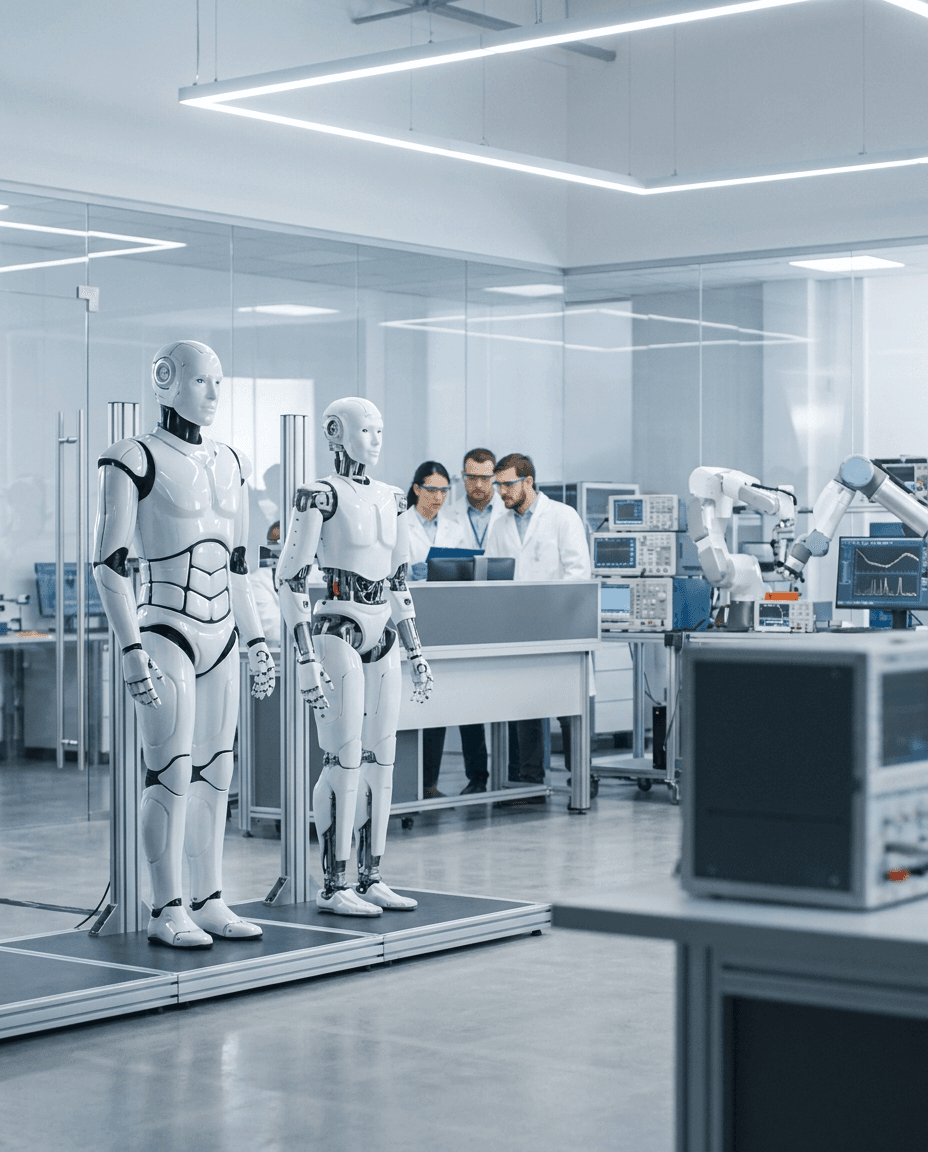
Talk about humanoid robots and it's easy to slide into futurology — but the Aura Robotics catalog holds machines that are already working, not just posing at trade shows. Two standout examples, AgiBot's Yuanzheng A2 and Robotera's L7, show two different paths to getting humanoids onto a real factory floor.
AgiBot Yuanzheng A2: not a prototype, a fleet
智元机器人 / AgiBot has something most competitors still lack — deployment numbers. The 1.69 m tall Yuanzheng A2, with 49 degrees of freedom, up to 7 km/h top speed and up to 80 kg payload, is already running in a fleet of 960+ units on real production lines. That's not a pilot batch for an investor deck — it's a working population handling component transport and line-support tasks.
The practical takeaway for a buyer: an 80 kg payload puts the robot in the range where it can move subassemblies and semi-finished parts between assembly stations, not just carry light items. AgiBot was also among the first Chinese humanoid makers to move from one-off prototypes to serial production — so the question "can I actually buy more than one" is already settled by track record, not a promise.
Robotera L7: university engineering at production speed
星动纪元 / Robotera is a rare case where a humanoid maker's backer isn't a venture fund but a university: the company grew out of Tsinghua University's Institute for Interdisciplinary Information Sciences, and it's the only humanoid maker in which Tsinghua itself holds an equity stake. The flagship L7 stands 171 cm tall, packs 55 degrees of freedom and hits 4 m/s — noticeably faster than the catalog average — with 12-DoF hands lifting up to 20 kg.
L7 runs on Robotera's own ERA-42 model, which combines vision, proprioception (the sense of the body's position in space) and language in a single loop. In practice that means the robot can take a voice instruction and adjust its body motion for the task on the fly, rather than executing a hard-coded sequence — a difference that matters most where the work environment changes from shift to shift.
Which one fits your task
If the job is conveyor-line logistics with a predictable cycle and you need reliability already proven at scale, AgiBot and its 960+ deployed units remove the risk of "will this actually work outside a demo booth." If the priority is response speed and adapting to a changing environment — where the vision-plus-language-plus-motion loop matters — Robotera and its ERA-42 model is the closer fit.
Market context worth knowing
While the catalog's deployment numbers keep growing, the whole humanoid segment is being rapidly repriced by investors: on August 6, 2026, one of China's largest humanoid developers went public on Shanghai's STAR Market at a valuation of roughly $9 billion, with first-half revenue growth of 35.6% to 45.4% year over year. That's not about a specific model in our catalog, but it's a solid signal that demand for humanoids on the factory floor is no longer a hypothesis — it's a measurable trend that serious money is now backing.
Bottom line
AgiBot's Yuanzheng A2 and Robotera's L7 aren't a technology showcase — they're two working platforms with different strengths: deployment scale versus speed and adaptability. Both are available to order through the Aura Robotics catalog; the standard lead time for humanoid-category items is 4-7 weeks.
These factories are on the route of our Robotics Expedition — see them in person, not just on video.