
гуманоидные роботы · AgiBot · UBTech · DeepRobotics · промышленная автоматизация
Humanoids on the assembly line: what AgiBot's 960 deployed robots actually mean
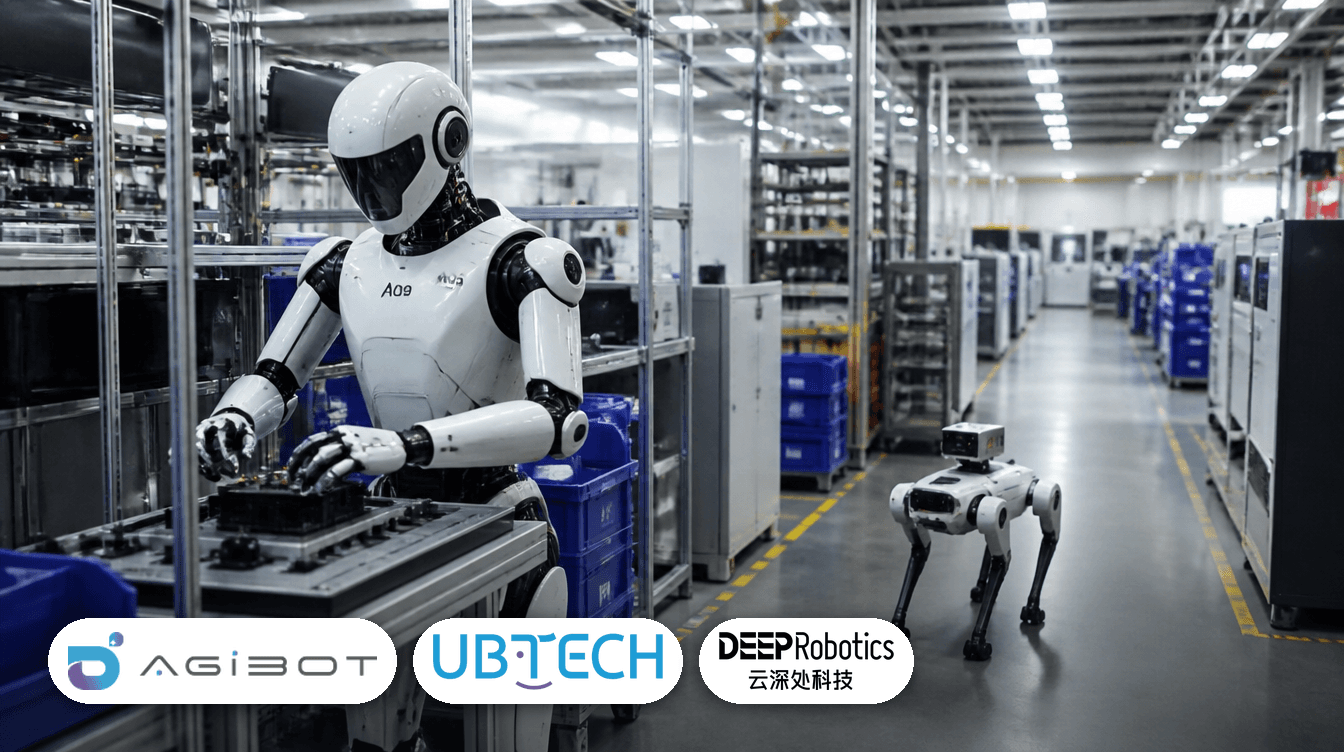
Humanoids on car-plant floors today aren't prototypes anymore — they're production units, and the first question worth asking about any of them isn't "can it walk," but "how many are already deployed." Three years ago that question would have sounded odd — humanoids on a factory floor were more of a trade-show demo than a working unit. Today, three Chinese manufacturers with three different engineering approaches give three concrete answers to what task a robot should actually be picked for.
AgiBot: from prototype to series ahead of the field
AgiBot is one of China's fastest-growing embodied-AI developers, and its flagship Yuanzheng A2 is well past demo stage: 1.69 m tall, up to 49 degrees of freedom, up to 7 km/h, up to 80 kg payload. The number that matters is 960+ units already deployed on factory floors — not showroom pieces, but working units on the line: moving components, servicing equipment, handling tasks that need human-like versatility rather than a lab manipulator's precision.
UBTech's Walker S: an inspector, not a laborer
UBTech takes a different angle: Walker S is deployed on automotive factories specifically for quality control and sorting — tasks where what matters isn't payload but repeatable, stable motion and the ability to spot defects visually. UBTech is a publicly listed company and one of the oldest players in humanoid robotics, and alongside its industrial line it also runs Cruzr, a service robot for retail floors and business lobbies. The same manufacturer, in other words, builds both a "working hand" for the shop floor and a "face" for the front desk.
What if the job isn't hands — it's eyes?
Not every factory task calls for a humanoid form. DeepRobotics builds industrial inspection quadrupeds — the X20, for instance: IP66-rated, operating at -20…+55 °C, clearing 20 cm+ steps and 45° slopes. It isn't a humanoid competitor, it's a different tool for a different job: where the task is walking a hazardous site — a substation, a tunnel, a pipeline — rather than manipulating objects, a sealed four-legged platform beats an upright robot with arms.
Why this matters when you're choosing
Three factories, three different answers to the same question: what robot form actually fits your task. The most common mistake at first contact with this market is choosing by appearance — "the humanoid looks more impressive" — instead of by task. Yuanzheng A2's 80 kg payload is irrelevant if what you need is visual inspection; X20's IP66 rating is useless on an electronics assembly line. And the gap between 960 deployed units and a handful of pilots isn't abstract either — it means the factory has already worked out maintenance, repair, and staff-training scenarios, not just the underlying technology.
These aren't isolated examples — the humanoid category alone in our catalog currently holds 44 models from 17 different factories, each with its own engineering school and its own answer to "what is this actually built for." AgiBot, UBTech, and DeepRobotics are three of them, picked here because they make the difference between form and purpose easiest to see.
We take clients to all three factories as part of the Aura Robotics Tour — to see exactly how each of the three models works on a real line, not in a demo reel.
These factories are on the route of our Robotics Expedition — see them in person, not just on video.